
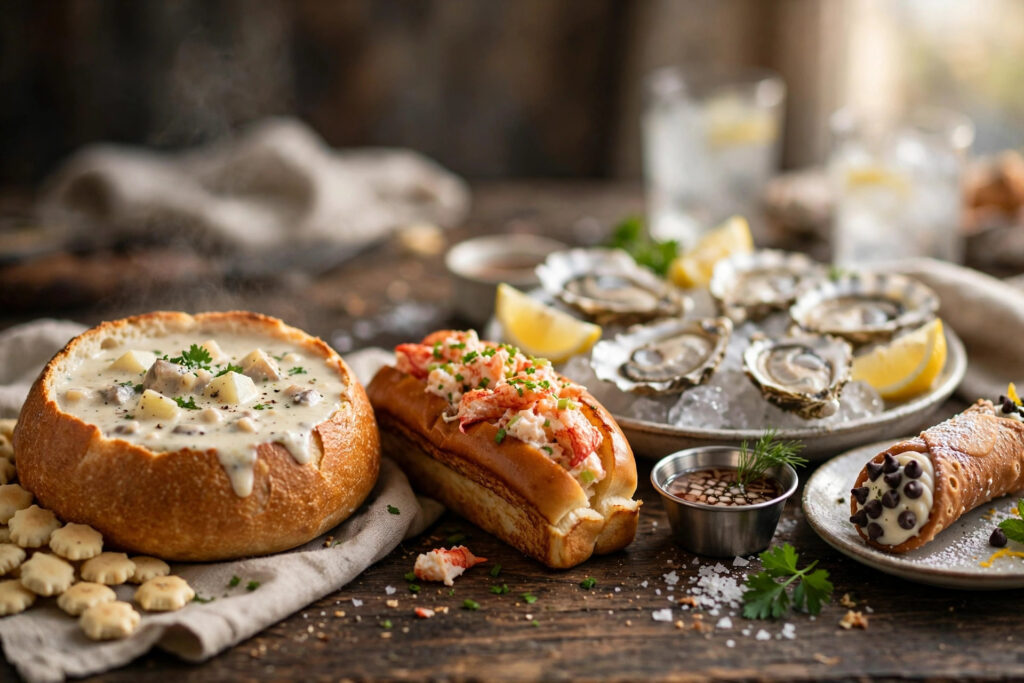
Boston is one of those cities where eating well feels effortless. It’s old enough to have a real food culture — we’re talking a restaurant that has been serving chowder since 1826 — yet young enough in spirit to keep reinventing itself with ramen counters, modern izakayas, and some of the most exciting Middle Eastern food on the East Coast. Whether you land here for a weekend of history walks or a full food-focused trip, the question always comes up fast: where to eat in Boston when there are so many good options and only so many meals in a day? This guide sorts that out for you — the famous dishes, the neighborhoods that matter, the restaurants worth your time, and the prices you should expect.
Quick answer: Eat clam chowder and a lobster roll at James Hook or Neptune Oyster, grab cannoli in the North End from Mike’s Pastry or Modern Pastry, try Union Oyster House for history, and explore Seaport seafood, Back Bay fine dining, South End bistros, Chinatown dim sum, and East Boston’s Latin restaurants for the city’s full range.
What is Boston known for food?
Boston’s food identity starts in the water. The cold Atlantic off New England produces some of the best seafood in America, and the city has built centuries of tradition around it. New England clam chowder — thick, creamy, loaded with clams and potatoes — is the dish Boston is famous for, and locals take strong opinions about whose is best. Then there’s the lobster roll: sweet chunks of lobster meat piled into a buttered, toasted split-top bun, either dressed with mayo or served warm with drawn butter. Both styles are worth trying, and yes, the “which is better” debate never ends.
Beyond seafood, Boston has its own quirky classics. Boston baked beans go back to the colonial era (the city’s old nickname, “Beantown,” comes from them — sailors and traders cooked beans in molasses on Saturday nights). The North End, the city’s Italian quarter, is synonymous with cannoli, and the eternal Mike’s Pastry versus Modern Pastry rivalry gives visitors a delicious reason to try both. There’s also the Boston cream pie — actually a cake — invented at the Parker House in 1856, plus oyster bars that feel like institutions, cozy chowder houses, and old-school pizzerias serving cracker-thin bar pizza.
Modern Boston adds layers to all that history. The Seaport District transformed from parking lots into the city’s flashiest dining neighborhood in the last decade. The South End brims with chef-driven bistros and some of the best brunch in New England. And waves of immigration have given Boston a genuinely great Vietnamese scene in Dorchester, Salvadoran and Colombian food in East Boston, and destination-worthy Japanese and Middle Eastern restaurants that draw diners from all over the country. For more city eating guides like this one, browse our Food Guides hub.
Which neighborhoods are best for food lovers?
Boston is a walking city, and each neighborhood eats a little differently. Here’s how to plan your meals by area:
| Neighborhood | Known for | Price level |
|---|---|---|
| North End | Italian restaurants, cannoli, espresso bars | $$ |
| Seaport | Modern seafood, oyster bars, rooftop dining | $$$ |
| Back Bay | Fine dining, French bistros, Newbury Street cafés | $$$ |
| South End | Trendy bistros, brunch, diverse small plates | $$–$$$ |
| Chinatown | Dim sum, noodles, late-night budget eats | $ |
| Fenway / Kenmore | Casual game-day bars, pizza, breweries | $–$$ |
| East Boston | Salvadoran, Colombian, Mexican, waterfront views | $–$$ |
| Cambridge / Harvard Square | Eclectic cafés, bookstores with coffee, global eats | $–$$ |
| Allston | Student-friendly: Korean, ramen, tacos, dive bars | $ |
| Dorchester | Vietnamese pho and banh mi, Caribbean bakeries | $ |
If you’re short on time, prioritize three: the North End for an evening stroll-and-eat, the Seaport for one great seafood dinner with harbor views, and Chinatown for a cheap, satisfying lunch. They’re all easy to reach on the T, and each one shows you a completely different side of the city.
Where can I get the best lobster roll in Boston?
This is the question every visitor asks, and the honest answer is that the “best” depends on what style you like. The two camps are Maine-style (cold lobster meat tossed with a little mayo, sometimes celery, in a chilled bun) and Connecticut-style (warm lobster meat drenched in melted butter). Try one of each before you pick a side.
For a classic, no-fuss experience, James Hook & Co. on the waterfront has been selling lobster since 1925, and their rolls are generous and straightforward — expect to pay around $30–$35 depending on the market. Neptune Oyster in the North End serves one of the most celebrated rolls in the city, hot with butter, though the line can stretch down the block at lunch. Row 34 in the Seaport does a refined version in a beautiful raw-bar setting, and Legal Sea Foods — the local chain Bostonians actually defend — is a reliable bet at multiple locations, including right in the airport if you’re short on time.
Here’s a quick showdown of the heavy hitters:
| Spot | Style | Approx. price |
|---|---|---|
| Neptune Oyster (North End) | Hot with butter | $33–$36 |
| James Hook & Co. (Waterfront) | Cold with mayo | $30–$35 |
| Row 34 (Seaport) | Hot with butter | $32–$38 |
| Legal Sea Foods (multiple) | Both styles | $28–$34 |
| Island Creek Oyster Bar (Kenmore) | Hot with butter | $30–$36 |
| The Daily Catch (North End) | Cold with mayo | $28–$33 |
Prices shift with the lobster market, so treat these as ballparks. One tip: order your lobster roll at lunch rather than dinner — portions are the same and the wait is usually shorter.
What are Boston’s best restaurants for fine dining?
Boston’s fine dining scene doesn’t chase trends as hard as New York or LA, which is part of its charm. The top rooms here are confident, precise, and deeply rooted in New England ingredients.
O Ya in the Leather District is the city’s most famous splurge: a tiny, candlelit omakase counter where the tasting menu runs well over $200 per person and every bite is engineered to surprise. Book weeks ahead. Menton, Barbara Lynch’s flagship in the Seaport, pairs French-Italian technique with New England seafood in one of the most elegant dining rooms in the city — the tasting menu is the move for anniversaries. No. 9 Park, perched above Boston Common, has been a special-occasion staple for decades, known for its prune-stuffed gnocchi (trust us) and a wine list that rewards lingering.
For something slightly less formal but still exceptional, Oleana in the Cambridge serves Ana Sortun’s celebrated Turkish-Middle Eastern cooking — the baked Alaska with olive oil and the Sultan’s delight are dishes people cross the country for. Sarma, her sister restaurant in Somerville, does playful small plates in a lively, book-ahead setting. And Myers + Chang in the South End remains the city’s favorite “fun fancy” dinner: Taiwanese-inspired small plates, dan dan noodles, and a room that buzzes every single night.
What are the best restaurants in Boston overall?
Fine dining aside, these are the spots that define eating in Boston — the names locals give when friends visit and ask where to eat in Boston:
- Union Oyster House — Open since 1826, it’s the oldest continuously operating restaurant in the United States. The raw bar and chowder live up to the history, and the warren of wood-paneled rooms feels like eating inside a museum. A must for first-timers.
- Neptune Oyster — The North End’s tiny, always-packed raw bar. Beyond the lobster roll, the hot lobster sandwich and the oyster selection (often 10+ varieties) are outstanding. Go at off-hours to beat the line.
- Santarpio’s Pizza — East Boston institution since 1903, famous for blistered, smoky pies and a wonderfully gruff dining room. The sausage and garlic pizza is the order. Cash-only traditions have eased, but the old-school vibe hasn’t.
- Regina Pizzeria — The North End original (since 1926) serves brick-oven pizzas with a charred, chewy crust that has a cult following. It’s touristy and proud of it — and the pizza genuinely delivers.
- The Daily Catch — A North End sicilian seafood spot so small the tables nearly touch. The calamari fra diavolo and the lobster fra diavolo (served over pasta in the pan) are legendary. There’s a second, roomier location in the Seaport.
- Mike’s Pastry vs. Modern Pastry — You can’t write about Boston without the cannoli wars. Mike’s (Hanover Street, the one with the box everyone carries) versus Modern (a block away, locals’ favorite). Honest advice: buy one from each and decide for yourself.
- Toro — Ken Oringer’s South End tapas bar that helped put Boston on the national food map. The corn with aioli and the short-rib bocadillo are classics; it stays loud, fun, and packed.
- James Hook & Co. — Part lobster market, part casual seafood counter on the Northern Avenue waterfront. Grab a roll or fried clams and eat outside watching the harbor. As Boston as it gets.
- Row 34 — The Seaport’s temple of raw bars: island creek oysters, a deep beer list, and one of the city’s best lobster rolls. Great for a long, lazy seafood lunch.
- Tatte Bakery — Boston’s beloved bakery-café (now with locations everywhere, but it started here). The shakshuka, the nut boxes, and just about any pastry in the case are excellent. Expect a line at weekend brunch.
- Flour Bakery — Joanne Chang’s bakery-cafés are a Boston institution. The sticky buns are famous for a reason, and the sandwiches make an ideal picnic before a walk along the Charles.
- Quincy Market / Faneuil Hall — Yes, it’s touristy. Yes, you should still go once. The food hall inside Quincy Market is the fastest way to sample chowder, lobster rolls, and Boston cream pie in a single stop — then walk it off on the Freedom Trail.
If you love planning food trips around live music and Southern cooking too, check out our guide on where to eat in Nashville — hot chicken, meat-and-threes, and all.
Where do locals eat cheap in Boston?
Boston has a reputation for being pricey, and downtown dining can be — but locals know the pockets where a great meal costs under $15. Chinatown is the undisputed champion: hand-pulled noodles, dumpling houses, roast duck over rice, and bakeries selling pork buns for a couple of dollars. It’s also one of the few neighborhoods where kitchens stay open late.
Dorchester is where Boston eats pho. The Vietnamese restaurants along Dorchester Avenue serve huge, fragrant bowls for around $12–$15, plus banh mi that put most sandwich shops to shame. In Allston, the student population keeps prices honest: Korean BBQ, ramen, tacos, and late-night slices within a few blocks of each other. East Boston delivers some of the city’s best-value meals — pupusas, bandeja paisa, and tacos from family-run spots, often with waterfront views thrown in for free.
Budget tactics that actually work: eat your biggest meal at lunch (many Back Bay and Seaport spots offer lunch menus at half the dinner price), hit bakery happy hours (Tatte and Flour discount remaining pastries near closing), and remember that oyster happy hours — $1.50–$2 oysters at places like Row 34, Island Creek, and B&G Oysters — are a Boston tradition, usually weekday afternoons. For another American food city that rewards budget explorers, see our guide on where to eat in New Orleans.
What’s the best time to visit Boston for food?
Honestly? September and October. The weather is perfect for walking between meals, the summer crowds have thinned, and it’s peak season for the region’s produce — you’ll see local corn, tomatoes, and apples all over menus, and many restaurants run fall specials. May and June are nearly as good, with patio season in full swing and the first of the soft-shell crabs and local strawberries.
Summer brings the biggest crowds and the highest prices, but also the best raw-bar weather — there’s nothing like oysters and a cold beer on a Seaport patio in July. Winter is the insider’s season: restaurant weeks (Greater Boston’s Dine Out Boston runs twice a year, in winter and summer) offer prix-fixe deals at top restaurants, hotel rates drop, and a bowl of chowder tastes twice as good when it’s snowing outside. Just pack a real coat — the wind off the harbor is no joke.
Event-wise, the Boston Seafood Festival (August, on the Fish Pier) and the North End feasts (summer weekends, with street food and processions) are worth timing a trip around if you’re a serious eater.
How much should I budget for food in Boston per day?
Boston sits in the upper-middle range for US food cities — cheaper than New York or San Francisco, pricier than most of the South and Midwest. Here’s a realistic daily food budget per person:
| Travel style | Daily food budget | What it looks like |
|---|---|---|
| Budget | $40–$60 | Bakery breakfast, Chinatown or food-hall lunch, casual dinner (pizza, tacos, pho), no alcohol |
| Mid-range | $90–$140 | Café breakfast, nice lunch out, one proper restaurant dinner with a drink or two |
| Splurge | $200–$350+ | Brunch at a hotspot, raw-bar lunch, tasting-menu dinner with wine pairing |
A few pricing realities: expect $16–$20 for a cocktail, $7–$9 for a beer at a bar, $18–$28 for a main at a casual restaurant, and $35–$55 for a main at an upscale spot. Tipping 18–20% is standard. And that lobster roll? Budget $30+ — it’s a splurge item even for locals, priced by the volatile wholesale lobster market.
What tourist mistakes should I avoid when eating in Boston?
A few easy traps to sidestep. Don’t eat only in the tourist core. Faneuil Hall and the Freedom Trail are fun, but the restaurants within a two-block radius of them are the most overpriced in the city — walk ten minutes in any direction and quality jumps while prices drop. Don’t skip the North End at night. Many visitors do the cannoli run by day and leave; the neighborhood’s red-sauce restaurants and espresso bars are at their best after dark.
Don’t assume you can walk into Neptune Oyster or O Ya on a Saturday. Boston’s most popular small restaurants book out or line up fast — make reservations the moment your dates are firm, and have a backup plan. Don’t order chowder only once. Every spot does it differently — Legal’s is the benchmark creamy version, Union Oyster House leans traditional, and some modern kitchens do lighter, broth-forward takes. Trying three is research, not gluttony.
Don’t sleep on breakfast. Boston does mornings well — from Flour’s sticky buns to South End brunch lines — and breakfast is the cheapest meal to eat out. Finally, don’t tip like you’re at home abroad — if you’re visiting from outside the US, remember that 18–20% on the pre-tax total is the norm, since servers’ wages depend on it.
Frequently Asked Questions About Eating in Boston
What food is Boston most famous for?
New England clam chowder and the lobster roll top the list, followed by Boston baked beans, cannoli from the North End’s Italian bakeries, Boston cream pie (invented at the Parker House in 1856), and fresh oysters from the city’s many raw bars. If you only try three things, make it chowder, a lobster roll, and a cannoli.
Is Boston expensive for food?
It can be, but it doesn’t have to be. A mid-range traveler should budget $90–$140 per day for food. Chinatown, Dorchester, Allston, and East Boston all offer excellent meals under $15, while fine dining tasting menus run $150–$250+ per person. Lunch is consistently the best value — many upscale restaurants offer cheaper midday menus.
Do I need reservations at Boston restaurants?
For popular spots, yes — especially on weekends. Neptune Oyster, O Ya, Menton, Oleana, Sarma, and Myers + Chang all book up days or weeks ahead (Neptune doesn’t take reservations, so go early or at off-hours). For casual neighborhood spots, walk-ins are usually fine on weeknights.
What is the North End known for?
The North End is Boston’s historic Italian neighborhood, famous for its red-sauce restaurants, espresso bars, and the great cannoli rivalry between Mike’s Pastry and Modern Pastry. It’s the city’s most atmospheric dining neighborhood — narrow streets, old churches, and the smell of garlic in the air. Go in the evening for the full effect.
Where can I find late-night food in Boston?
Boston is not a late-night city — most kitchens close by 10–11 PM, and the T stops running around 12:30 AM. Your best bets after midnight are Chinatown (several spots serve until 2–4 AM), a handful of Allston and Fenway bars with late kitchens, and 24-hour diners like the South Street Diner near the Theater District.
Is Legal Sea Foods actually good, or just a tourist trap?
It’s genuinely good — locals defend it. Legal Sea Foods built its reputation on strict freshness standards (their “if it isn’t fresh, it isn’t Legal” slogan is backed by real quality control), and the chowder is a legitimate benchmark. It’s a chain, so it lacks the charm of a one-off oyster bar, but for a reliable seafood meal — including at the airport — you can order with confidence.
Boston rewards eaters who wander a little and ask questions — the best meal of your trip might be a $12 bowl of pho in Dorchester or a butter-drenched lobster roll eaten on a harbor bench. For more city-by-city eating guides, from Southern comfort food to Creole classics, keep exploring our Food Guides and start planning your next food trip.

I’m Lila Spoonbelle, your host on this flavorful ride through food, fun, and fearless puns. Let’s turn every bite into a burst of laughter!