
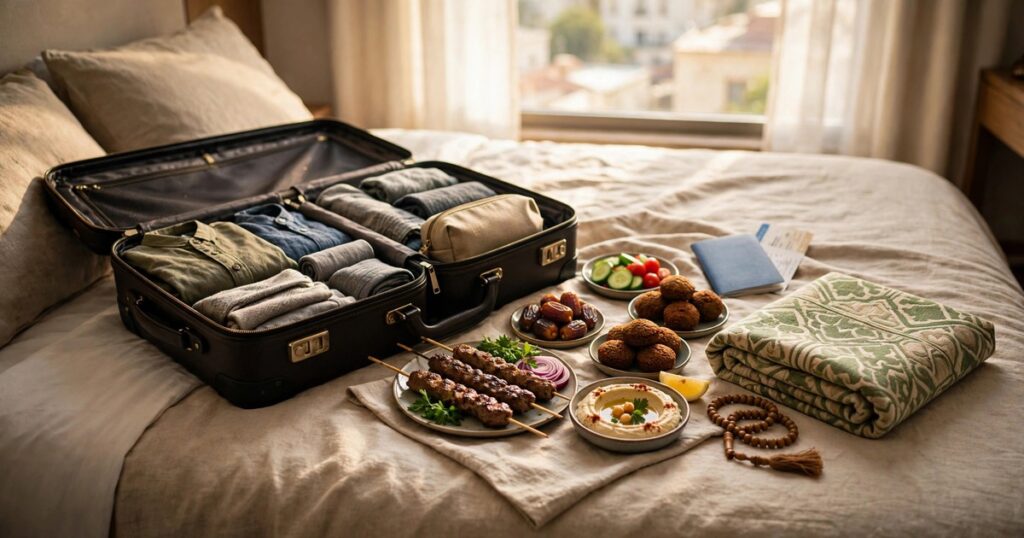
Traveling the world as a Muslim used to mean one long exercise in planning: Where will I eat? Where will I pray? Will the hotel room face the Qibla? In 2026, halal travel has grown into a well-mapped, well-served way of seeing the world. From halal-certified resorts in Türkiye to prayer rooms in Tokyo’s airports, the infrastructure Muslim travelers need is bigger — and easier to find — than ever before. This guide walks you through the whole journey: planning, booking, eating, praying, packing, and budgeting, wherever your wanderlust takes you.
What Does Halal Travel Actually Mean in 2026?
At its simplest, halal travel means traveling in a way that respects Islamic principles: eating halal food, being able to pray five times a day, and avoiding alcohol and haram activities. But the term has grown into something bigger. Today it covers an entire travel ecosystem — hotels, restaurants, airlines, tour operators, and even cruise lines — that cater specifically to Muslim travelers.
A few basics worth knowing before you plan anything:
- Halal-certified means a product, kitchen, or hotel has been audited and certified by a recognized halal authority. Not every “Muslim-friendly” place is certified, and that’s okay — certification matters most in non-Muslim countries where you can’t assume the supply chain.
- Halal-friendly hotels typically offer halal food options, alcohol-free rooms (no minibar surprises), prayer mats on request, and Qibla direction markers in rooms. Some go further with gender-segregated pools or family-only beach hours.
- Muslim-friendly vs. halal-certified: In Muslim-majority countries like Malaysia or the UAE, halal is the default — you rarely need to ask. In places like Japan or Italy, look for certified or Muslim-owned restaurants instead, since halal is the exception, not the rule.
- Qibla direction — the direction of the Kaaba in Makkah that Muslims face during prayer — changes with every destination. Your phone’s compass app (or a dedicated Qibla finder) solves this in seconds.
The halal travel market is booming, which is genuinely good news for you: more options, better standards, and honest reviews from a community of millions of Muslim travelers sharing tips online every day.
How Do I Plan a Halal Trip Before I Book Anything?
Good halal travel starts at home, not at the airport. A couple of hours of research saves you days of stress. Here’s the order of operations that works best:
- Pick your destination tier. Some places make halal travel effortless; others take real effort. Knowing which tier your destination falls into shapes everything else (see the tiers below).
- Research halal food availability. Search “[city] halal restaurants” and check apps like Zabihah or HalalTrip before you commit. A city with 200 halal restaurants gives you freedom; a city with 3 gives you a schedule.
- Map the prayer situation. Are there mosques? Does the airport have a prayer room? Muslim Pro and Halal Navi both show prayer spaces on a map.
- Check the calendar. Traveling during Ramadan changes the equation entirely (more on that below) — mostly for the better in Muslim countries, and mostly trickier elsewhere.
- Book halal-aware accommodation first, then build your itinerary around it. A good hotel base with halal breakfast solves half your daily planning.
What Are the Three Tiers of Muslim-Friendly Destinations?
Not all destinations are equal for Muslim travelers. Thinking in three tiers keeps expectations honest:
- Tier 1 — Muslim-majority countries (Malaysia, Türkiye, UAE, Indonesia, Saudi Arabia, Morocco, Qatar). Halal food is the default, mosques are everywhere, and nobody looks twice at a hijab. Travel is essentially frictionless.
- Tier 2 — Halal-aware cities (London, Paris, Singapore, Sydney, Toronto, New York). Large Muslim populations mean thriving halal restaurant scenes and visible mosques. You’ll plan a little, but you’ll eat very well. London alone has thousands of halal restaurants.
- Tier 3 — Difficult destinations (much of rural East Asia, parts of Eastern Europe, remote South America). Halal food is scarce, mosques are few, and you’ll rely on self-catering, seafood/vegetarian dishes, and careful planning. Still very doable — just plan harder.
Here’s a quick region-by-region comparison to help you choose:
| Region | Ease of Halal Food | Prayer Facilities | Notes |
|---|---|---|---|
| Southeast Asia (Malaysia, Indonesia) | ⭐⭐⭐⭐⭐ Effortless | Everywhere | The gold standard for halal travel; incredible street food |
| Middle East & Gulf (UAE, Türkiye, Morocco) | ⭐⭐⭐⭐⭐ Effortless | Everywhere | Luxury halal resorts common; great for families |
| UK & Western Europe (London, Paris, Berlin) | ⭐⭐⭐⭐ Easy in cities | Common in cities | Huge halal scenes; rural areas need planning |
| North America (US, Canada) | ⭐⭐⭐⭐ Easy in cities | Common in cities | Zabihah app is essential; small towns are thin |
| East Asia (Japan, South Korea, Hong Kong) | ⭐⭐⭐ Growing | Airports + major mosques | Improving fast; see our complete halal food guide to Japan and our guide to halal food in Hong Kong |
| Australia & New Zealand | ⭐⭐⭐⭐ Easy in cities | Common in cities | Strong halal certification bodies; great meat quality |
| South Asia (India, Pakistan, Bangladesh) | ⭐⭐⭐⭐⭐ Effortless | Everywhere | Watch for regional meat-sourcing differences in India |
How Do I Book a Halal-Friendly Hotel?
Your hotel is your base camp, and the right one removes half the friction of halal travel. Here’s what to look for and what to ask before you book:
What Should I Look for in a Halal-Friendly Hotel?
- Halal food on site — a halal-certified restaurant or at least a halal breakfast option. This alone is worth paying extra for.
- Alcohol-free rooms — no minibar stocked with alcohol, or the option to have it emptied before arrival.
- Prayer amenities — prayer mats available on request and a Qibla marker or sticker in the room.
- Family-friendly facilities — some halal resorts offer women-only pool hours or private family beaches.
- Location near a mosque — in Tier 2 and 3 destinations, this matters more than the hotel’s own amenities.
What Questions Should I Ask the Hotel Before Booking?
Don’t be shy — hotels hear these questions all the time now. Ask directly:
- Is your restaurant halal-certified, or do you serve halal options? (There’s a difference — “halal options” can mean just a couple of dishes.)
- Can the minibar alcohol be removed from my room before check-in?
- Do you provide prayer mats and Qibla direction in rooms?
- Is the nearest mosque within walking distance?
- For resorts: are there women-only or family-only swimming hours?
Platforms like HalalBooking.com filter specifically for these features, which beats scrolling through generic hotel reviews hoping someone mentioned halal food in passing. For inspiration and destination ideas, browse the Travel Guides section here on GiggleGrubs.
How Do I Find Halal Food While Traveling?
Food is the part of halal travel most people stress about — and honestly, it’s the part with the best tools available. Between apps, local Muslim communities, and a few smart strategies, you’ll rarely go hungry.
Which Apps Help Me Find Halal Restaurants Abroad?
- Zabihah — the veteran halal restaurant finder, strongest in North America and the UK, with community reviews.
- HalalTrip — global coverage with restaurant listings, attraction guides, and trip-planning tools built for Muslim travelers.
- Halal Navi — excellent for Japan and increasingly useful across Asia; shows halal restaurants, mosques, and prayer spaces on one map.
- Muslim Pro — primarily a prayer-time and Qibla app, but its halal restaurant listings are handy in a pinch.
- Google Maps — don’t underestimate it. Searching “halal restaurant near me” works surprisingly well in Tier 2 cities, and reviews often confirm halal status.
A practical tip: cross-check. An app listing from 2021 might be a closed restaurant in 2026. Check the restaurant’s Instagram or give them a quick call — it takes two minutes and has saved many a dinner plan.
What Are “Naturally Halal” Dishes I Can Eat Anywhere?
In Tier 3 destinations where certified halal is nowhere to be found, fall back on dishes that are halal by nature:
- Seafood — grilled fish, sushi, shrimp pasta. Seafood is halal across all madhhabs, making coastal cities easy.
- Vegetarian and vegan dishes — lentil curries, vegetable stir-fries, falafel, bean dishes. Just confirm no wine or lard in the cooking.
- Egg-based breakfasts — omelets, shakshuka (ask about the meat), plain breads and cheeses.
- Fresh fruit and street snacks — fruit is always safe; roasted corn, nuts, and fresh juices are reliable fillers.
The two questions that matter at any restaurant: “Is there pork or lard in this?” and “Is the meat halal?” If the meat isn’t halal, order the fish or vegetarian option and move on with your day.
How Do Supermarkets Fit Into Halal Travel?
Underrated strategy, especially for Tier 3 destinations: the supermarket run. Most cities have at least one international or Middle Eastern grocery store with halal-certified meat, and regular supermarkets stock plenty of vegetarian staples, canned fish, bread, cheese, and fruit. If your accommodation has a kitchenette, you can self-cater breakfast and even dinner — cheaper, fully halal, and zero stress. Look for halal certification logos on packaging (they vary by country, so learn your destination’s main ones before you go).
If East Asia is on your radar, two of our most-read guides go deep on exactly this: our complete halal food guide to Japan covers Tokyo, Osaka, and Kyoto restaurant by restaurant, and halal food in Hong Kong maps out where to eat from Chungking Mansions to Causeway Bay.
How Do I Find Prayer Spaces While Traveling?
Missing prayers because you couldn’t find a quiet corner is one of the most avoidable travel frustrations. The fix is mostly about knowing where to look:
- Mosque-finder apps — Muslim Pro, Halal Navi, and even Google Maps (“mosque near me”) will surface the nearest masjid with directions.
- Airport prayer rooms — most major international airports now have multi-faith prayer rooms; many in Muslim-majority countries have full mosques inside the terminal. Check your layover airports in advance.
- Shopping malls — in the Gulf, Southeast Asia, and increasingly in Western cities with large Muslim populations, big malls have dedicated prayer rooms (often marked on mall directories).
- Your hotel room — the fallback that always works. A travel prayer mat and a Qibla app mean you can pray anywhere clean and quiet.
- Ask locals — Muslim shopkeepers and restaurant staff almost always know the nearest prayer spot. People are generally happy to help.
For wudu on the go, carry a small water bottle and packable wudu-friendly items (more in the packing list below). Many travelers also keep a lightweight travel prayer mat that folds to pocket size — it weighs almost nothing and removes the “where do I pray?” question entirely.
What About Halal Travel Agencies and Insurance?
Are There Tour Operators Just for Muslim Travelers?
Yes — and they’re one of the best developments in halal travel. If you’d rather have someone else handle the halal logistics:
- CrescentRating — the best-known authority in the space; they rate destinations, hotels, and airlines on Muslim-friendliness (their ratings are a great research shortcut even if you book independently).
- HalalBooking.com — halal-filtered hotel and resort booking with verified amenities.
- Halal-friendly tour operators — companies like Islamic Travel, Riwaq Travel, and regional specialists run group tours with halal meals, prayer stops, and Muslim guides built into the itinerary.
- Umrah/Hajj operators — if your trip includes pilgrimage, book only with licensed, well-reviewed operators; this is one area where cutting corners is never worth it.
Do I Need Special Travel Insurance as a Muslim Traveler?
Standard travel insurance works fine for most Muslim travelers — there’s no separate “halal insurance” requirement. That said, two things are worth checking: first, some Gulf-based insurers offer takaful (Islamic insurance) if you prefer a Sharia-compliant policy; second, if you’re traveling for Umrah or Hajj, make sure your policy explicitly covers pilgrimage travel and any pre-existing conditions, since Saudi visa rules can be strict. Read the fine print on adventure activities too — the policy doesn’t care about halal, but it does care whether you were scuba diving.
How Do I Travel During Ramadan?
Ramadan travel is a special case — and it can be genuinely magical if you plan for it. Here’s how the experience splits:
- In Muslim-majority countries, Ramadan is the best time to visit. Nights come alive with iftar markets, taraweeh prayers in beautiful mosques, and a festive atmosphere you won’t find any other month. Restaurants may close during the day, so plan lunches at your hotel or with packed food.
- In non-Muslim countries, Ramadan is logistically trickier — fewer communal iftars, shorter restaurant hours aren’t a thing (everything’s normal), and you’ll be fasting while everyone else eats lunch around you. On the upside, nothing closes, and many cities have Muslim community iftars worth seeking out.
- Fasting while flying or road-tripping — Islamic rulings allow travelers to skip fasts and make them up later. Many scholars consider long-haul travel a valid reason. Decide based on your own practice and consult someone you trust — there’s no single right answer.
- Suhoor and iftar planning — stock your hotel room with dates, water, and suhoor-friendly food (oats, bread, fruit). Know the local Maghrib time via Muslim Pro so iftar never catches you off guard.
- Book iftar experiences — hotel iftar buffets in the Gulf and Southeast Asia are legendary and open to everyone. In 2026, many are bookable online in advance.
What Should I Pack as a Halal Traveler?
Beyond the usual travel gear, a few small items make halal travel dramatically smoother. None of them take up real space:
- Travel prayer mat — lightweight, pocket-folding. The single most useful halal travel item.
- Qibla compass — a dedicated app works, but a tiny physical compass never runs out of battery.
- Wudu-friendly kit — a small squeezable water bottle, quick-dry towel, and mist spray bottle for wudu in airports and public restrooms.
- Modest swimwear — a burkini or swim hijab if you plan on beaches or pools; check the hotel’s policy first.
- Snacks for transit days — protein bars, nuts, and dried fruit with halal certification for long travel days when food options are uncertain.
- A scarf or shawl — useful for mosque visits (covering requirements vary) and doubles as a layer on cold flights.
- Reusable cutlery and a food container — for supermarket meals and street food on the go.
- Printed emergency contacts and your hotel address in the local language — old school, but invaluable if your phone dies in a Tier 3 destination.
What Does a 7-Day Halal Trip Planning Timeline Look Like?
Here’s a realistic countdown for planning a halal-friendly trip, starting a week out:
- Day 7 — Choose and tier your destination. Decide Tier 1/2/3 and set expectations accordingly.
- Day 6 — Research food. Map halal restaurants with Zabihah/HalalTrip; save 2–3 options per day of your trip.
- Day 5 — Book halal-friendly accommodation. Use HalalBooking or direct hotel questions (see above).
- Day 4 — Map prayer logistics. Note mosques near your hotel, airport prayer rooms for layovers, and download offline maps.
- Day 3 — Sort flights, insurance, and documents. Confirm takaful/insurance choice; check visa rules.
- Day 2 — Pack the halal kit. Prayer mat, Qibla compass, wudu kit, snacks, modest swimwear.
- Day 1 — Download everything offline. Prayer times, Qibla finder, offline maps, restaurant lists, hotel confirmations. Charge every device.
- Day 0 — Travel day. Pray before departure if timing works, keep snacks accessible, and enjoy the trip.
How Can I Save Money on Halal Travel?
Halal travel doesn’t have to mean luxury resorts — though those exist if you want them. A few budget realities:
- Tier 1 destinations are often the cheapest. Malaysia, Indonesia, and Morocco deliver incredible value: street food for a few dollars, affordable hotels, and zero halal surcharges because halal is the default.
- Self-catering beats restaurant-hunting in Tier 3. A kitchenette plus a supermarket run is cheaper than eating out — and it’s automatically halal.
- Travel off-season. Halal-friendly hotspots like Türkiye and the Gulf spike in summer and during Eid holidays. Shoulder seasons cut hotel prices dramatically.
- Group tours split costs. Halal group tours bundle halal meals, transport, and guides — often cheaper per day than DIY in expensive destinations like Japan or Scandinavia.
- Watch the currency, not just the price tag. A $30 meal is cheap in Zurich and expensive in Kuala Lumpur. Budget in local terms using Numbeo or recent traveler reports.
- Eat where locals eat. In Muslim-majority countries, the best food is the cheapest food — night markets and local warungs beat hotel restaurants every time.
Frequently Asked Questions
Is halal travel only for Muslim-majority countries?
Not at all. While Muslim-majority countries are the easiest, halal travel works anywhere with planning. Cities like London, Paris, Toronto, and Sydney have enormous halal food scenes, and even challenging destinations like Japan are improving every year — certified restaurants, Muslim-friendly hotels, and prayer spaces are growing fast.
How do I know if a restaurant is really halal?
Look for halal certification from a recognized body, check whether the restaurant is Muslim-owned, and read recent reviews from Muslim diners on apps like Zabihah or HalalTrip. When in doubt, ask the staff directly: “Is your meat halal-certified?” A trustworthy place answers clearly; a vague answer is your cue to order the fish.
Can I travel halal on a tight budget?
Absolutely — some of the best halal travel destinations are also the cheapest. Southeast Asia (Malaysia, Indonesia) and Morocco offer amazing food and accommodation at backpacker prices, with halal as the default. Self-catering, street food, and off-season travel keep costs low anywhere.
What if I can’t find a mosque or prayer room?
Your hotel room always works — a travel prayer mat and a Qibla app are all you need. Many travelers also pray in quiet corners of airports, parks, or rest stops. The requirement is a clean, quiet space, not a formal building.
Is it safe to travel as a visibly Muslim traveler?
Millions of hijabi women and bearded men travel the world every year without incident. That said, conditions vary: research local attitudes, dress with cultural awareness, and in unfamiliar areas, keep a low profile and stay in well-reviewed accommodation. Trust your instincts the way any traveler should.
Do I need to book through a halal-specific travel agency?
No — independent planning with the apps and strategies in this guide works perfectly well, and many experienced Muslim travelers prefer it. Halal-specific agencies and platforms like HalalBooking are worth it if you want the logistics handled for you, especially for family trips, honeymoons, or first-time visits to Tier 3 destinations.
How far in advance should I plan a halal trip?
A week of focused planning is enough for most trips (see the 7-day timeline above). For Ramadan travel, Hajj/Umrah, or peak-season trips to popular halal destinations, book accommodation 2–3 months ahead — the best halal-friendly hotels fill up fast.
Restaurant brand? Get featured — Work With Us.

I’m Lila Spoonbelle, your host on this flavorful ride through food, fun, and fearless puns. Let’s turn every bite into a burst of laughter!