
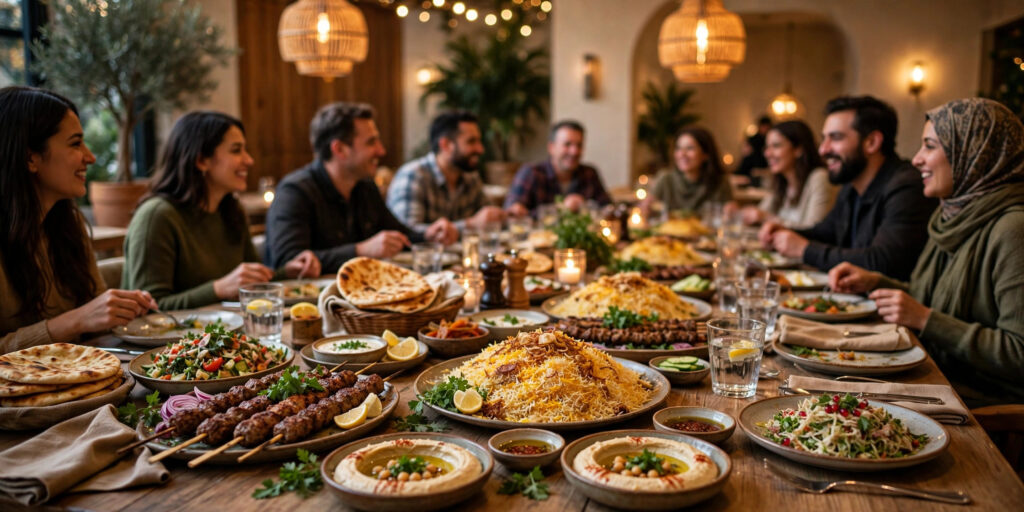
Booking a restaurant for four people is easy. Booking one for forty is a different job entirely — and when every guest needs halal food, the job gets harder still. The restaurant needs a dining room big enough to hold your whole party at one table, or at least in one room. It needs a kitchen that can serve forty plates of hot food at roughly the same time, instead of in a slow trickle that leaves half the table eating while the other half waits. It needs a set menu that keeps the bill predictable, a deposit policy that does not punish you for two guests cancelling, and — most importantly — a halal status you can actually trust, not just a sign in the window.
Most restaurant lists do not help with any of this. They rank restaurants by how good the food is for two people on a Friday night, which tells you nothing about whether the same place can handle your mother’s sixtieth birthday, your cousin’s walima, a company iftar, or a graduation dinner for thirty cousins who all arrived at once. A restaurant can serve a wonderful biryani for two and still be a terrible choice for a large group, because its dining room seats twenty-four, it has no private room, and its kitchen falls apart when twelve orders land at the same time.
This guide is built the other way around. It starts with how to choose a halal restaurant for a large group — capacity, seating layouts, private rooms, set menus, minimum spends, deposits, and how far ahead you actually need to book — then it lists ten real halal restaurants across the United States and Canada that genuinely seat large parties, with an honest halal-status label on every single one. It covers what a group dinner costs per person, how to handle mixed halal and non-halal guests without making anyone uncomfortable, what to do about kids and dietary restrictions, and a booking checklist you can use for any restaurant, anywhere. Prices and capacities change, and halal certification can change too, so every listing ends with the same advice: check before you go.
If you are planning a big halal meal and want more ideas in the same spirit, our Food Guides hub has halal restaurant guides from cities across the United States, and our halal catering guide covers the alternative — bringing the food to your own venue — for parties too big for any restaurant dining room.
Quick answer: The best halal restaurants for large groups are big dining rooms and banquet halls with private rooms, set menus, and a halal status — places like Aga’s in Houston, Al-Ameer in Dearborn, and Rumi’s Kitchen in Atlanta. Book 4 to 8 weeks ahead, expect $20 to $45 per person, and confirm the halal certification before you pay a deposit.
What Makes a Halal Restaurant Good for a Large Group?
A good large-group restaurant is not just a good restaurant with more chairs. The things that matter at a table for two — a clever menu, a romantic corner, a chef with a signature dish — matter far less when you are feeding forty people who all need to eat at the same time. What matters instead is space, systems, and certainty, and the restaurants that are good at large groups are good at them for specific, checkable reasons.
The first is capacity, and it means more than the number on the fire certificate. A restaurant that seats eighty people across twenty small tables is not a large-group restaurant — it is a small restaurant that happens to be busy. What you need is a dining room that can hold your party together: one long table, or two or three tables pushed together in the same room, with enough space between tables for people to get up, for servers to move, and for a wheelchair or a stroller to pass. Ask the restaurant how many people it can seat at a single table, not just how many chairs it owns. A place that can do a single table of twenty, or a private room for forty, is a genuinely different proposition from a place that can only do four tables of eight in different corners of the room.
The second is a kitchen that can handle volume. A restaurant kitchen works on tickets, and when forty tickets arrive at once, a kitchen without a system serves the first ten tables and leaves the rest waiting. The restaurants that handle groups well usually do it one of two ways: a set menu, where everyone eats the same three or four courses and the kitchen cooks in bulk, or a limited group menu, where the party chooses from five or six dishes instead of the full menu of forty. Both are signs of a kitchen that has thought about groups. A restaurant that insists your party of forty can order anything off the full menu, with no warning about timing, is either very good or has never actually done it — and you should find out which one before the night.
The third is a private room, or at least a semi-private space. For a wedding dinner, a walima, an iftar party, or a family gathering where people will give speeches, say prayers, or let children run around, a private room changes everything. It gives you your own space, your own noise level, and usually your own server. It also gives the restaurant a reason to take your booking seriously: a private room is a commitment on both sides. Not every large-group meal needs one — a graduation dinner for twelve does not — but for twenty or more, a private room is usually the difference between a dinner and an event. Expect the restaurant to ask for a minimum spend or a room fee for it, which is normal and fair, and ask what that minimum includes before you agree.
The fourth, and the one that matters most for this guide, is halal certainty. A restaurant that serves halal food to a table of two can be checked by one person reading a menu and asking a question. A restaurant that serves halal food to a table of forty needs the same certainty, multiplied by forty guests who are all trusting your judgement. The halal status of a restaurant is not a vibe. It is a fact about where the meat comes from, who certified it, and whether the kitchen keeps halal and non-halal food separate. The listings later in this guide give each restaurant an honest label — fully halal, halal meat, halal options, or unverified — and tell you what that label means, because a restaurant that serves halal chicken but cooks it in the same kitchen as pork is a different choice from a restaurant where everything on the menu is halal.
Finally, there is the human part: a restaurant that is good at large groups has a person you can talk to. Not a host who takes a reservation, but an events manager, a banquet coordinator, or an owner who will answer the phone, walk the room with you, talk through the menu, and put the details in writing. If you cannot get a named person and a written confirmation, the restaurant is telling you something about how your event will be handled — believe it.
How Do You Choose a Halal Restaurant for a Large Group?
Choosing well means checking seven things before you fall in love with the food. The food matters, of course — nobody wants a memorable venue with forgettable biryani — but the food is the last thing to check, not the first. A restaurant with wonderful food and a dining room that seats eighteen is useless for a party of thirty, and a restaurant with a beautiful private room and no halal certification is useless for a halal party of any size.
Start with capacity and layout. Ask how many people the restaurant can seat at one table, how many it can seat in a private room, and whether your party would be split across rooms. Ask to see the room, in person if you can, or in photographs if you cannot. Look at the tables, not the decor: are they round tables of eight or ten, which are best for conversation, or long banquet tables, which are best for speeches? Is there space for a buffet, a dessert table, or a small stage? Is there a separate entrance for a large party, or will forty people have to queue at the front door? And ask the question nobody asks until it is too late: where do people park, and is there enough of it?
Next, check the halal status properly. Ask three questions: is all the meat halal, or only some dishes? Who certified it — which organisation, and is the certificate current? And does the kitchen handle any non-halal meat or alcohol, and if so, how is it kept separate? A fully halal restaurant, where everything on the menu is halal and no pork or alcohol is served at all, is the simplest choice for a large group, because there is nothing to get wrong. A restaurant that serves halal meat alongside non-halal dishes can still work, but it needs a clear answer on separation, and you should be comfortable repeating that answer to your guests. If the restaurant cannot answer these questions, or answers vaguely, that is your answer: pick somewhere else. For a party of two, a vague answer is a risk you can take yourself. For a party of forty, it is a risk you are taking for forty people.
Then look at the menu and the format. For a large group, a set menu is almost always better than a la carte, for three reasons: the kitchen can cook it on time, the bill is predictable, and nobody spends twenty minutes choosing. Ask whether the restaurant offers a set menu for groups, what it includes, and whether it can be adjusted for vegetarians, vegans, and children. Ask about the per-person price, what it includes — does it cover drinks, dessert, tax, and service, or are those extra? — and whether there is a minimum number of guests for the set menu. Some restaurants require a minimum of fifteen or twenty for a set menu; some will do it for ten. Ask, too, whether the restaurant can do a buffet or family-style service, where big platters go in the middle of the table and everyone shares. Family-style works beautifully for Middle Eastern, South Asian, and Persian food, it is usually cheaper per person than plated courses, and it turns dinner into a shared event rather than forty separate meals.
Then the money questions: deposit, minimum spend, and cancellation. Most restaurants that take large-group bookings ask for a deposit, usually a credit card hold or a percentage of the estimated bill, and most have a cancellation policy — a deadline after which the deposit is kept. Both are normal. What you need to know is the number and the deadline: how much is the deposit, when is it due, is it refundable, and by when can you change the guest count without penalty? Ask whether the final headcount is due a week before, three days before, or on the day, and what happens if five guests cancel at the last minute. A restaurant that lets you confirm the final number 48 hours ahead is far more forgiving than one that locks it a week out, and for a family event where guests are famously unreliable, that flexibility is worth real money.
Finally, check the practical details that ruin evenings: is there a time limit on the table, and what happens if your party runs long? Is there a cake-cutting fee if you bring your own cake? Can you bring your own decorations, and is there a charge for setting them up? Is there a sound system or a microphone for speeches, and does the restaurant charge for it? Is there a prayer space, or a quiet room, for guests who need one — a question that matters a great deal at an iftar or a wedding, and that most restaurant guides never think to ask. And is the restaurant accessible: step-free entry, an accessible restroom, space for a wheelchair at the table? None of these are deal-breakers on their own, but together they decide whether the evening feels easy or feels like a fight.
| What to check | Why it matters for a large group | What a good answer sounds like |
|---|---|---|
| Single-table capacity | Keeps your party together instead of split across the room | “We can seat 24 at one long table, or 40 in the private room.” |
| Private or semi-private room | Your own space, noise level, and server for speeches and prayers | “The private room seats 50, with a minimum spend of $1,500 on weekends.” |
| Halal certification | Forty guests are trusting your judgement on this | “All our meat is halal, certified by [organisation], certificate on the wall.” |
| Set menu for groups | Kitchen can serve everyone on time; bill is predictable | “A three-course set menu at $32 per person, vegetarian option included.” |
| Deposit and cancellation | Protects you if guests cancel; protects the restaurant if you do | “$300 deposit, refundable until 7 days before, final count 48 hours ahead.” |
| Time limit on the table | A two-hour limit can cut a wedding dinner short | “The room is yours for four hours; extra time is $100 per hour.” |
| Prayer space and accessibility | Essential at iftars and weddings; basic courtesy everywhere else | “There is a quiet room upstairs, and step-free entry at the back.” |
How Far Ahead Should You Book a Halal Restaurant for a Large Group?
The honest answer is: further ahead than you think, and the further ahead, the better the room you get. A table for eight can be booked the day before. A private room for forty on a Saturday in December cannot. The restaurants that are good at large groups are good at them because they are popular, and popular restaurants fill their private rooms first — which means the best rooms go to the people who book earliest, not the people who ask nicest.
For a party of ten to fifteen on a weekday, two to three weeks is usually enough, and some restaurants will take it with a few days’ notice. For a party of twenty to thirty on a weekend, four to six weeks is the safe range. For a private room, a party of forty or more, or any event on a Friday or Saturday evening, six to eight weeks is realistic, and for a wedding or a walima, two to three months is not excessive — especially if the date is anywhere near Ramadan, Eid, or the December holiday season, when every halal restaurant with a private room is booked solid.
Ramadan deserves a warning of its own. Iftar bookings at popular halal restaurants fill up weeks in advance, and the best rooms — the ones with space for a large family iftar, a community iftar, or a corporate iftar — are often booked before Ramadan even begins. If you are planning an iftar party for a large group, start calling in the month before Ramadan, ask about the iftar set menu and the iftar timing, and be ready to pay a deposit on the spot, because the restaurant will have five other people asking for the same night. The same applies to the nights around Eid, to graduation weekends in May and June, and to wedding season, which in most American cities runs from late spring through early autumn.
There is also a smarter way to think about timing: book the room before you send the invitations. It feels backwards — surely you should know how many people are coming before you book a room for them — but in practice, the room is the constraint, not the guest list. A restaurant that can hold forty will hold thirty happily, and a restaurant that can hold twenty-five will not hold thirty no matter how nicely you ask. Book a room slightly bigger than you need, with a final headcount deadline that lets you adjust, and then invite with confidence. The alternative — inviting forty people and then discovering that no restaurant in your city can seat them together on your date — is a much worse problem.
One more timing tip: visit the restaurant before you book, if you can. Photographs lie, or at least they flatter, and a room that looks grand online can feel cramped in person, while a plain-looking dining room can turn out to have exactly the long tables and the quiet corner you need. A visit also tells you things no website will: how loud the room is when it is full, how the staff treat a walk-in, whether the halal certificate is actually displayed, and whether the owner is the kind of person who will answer the phone on the night. If you cannot visit, ask for a video walkthrough, or at least recent photographs of the room set for a large party — not the empty room, the room with tables set and chairs out.
| Party size and occasion | How far ahead to book | Notes |
|---|---|---|
| 10–15 people, weekday dinner | 2–3 weeks | Often possible with a few days’ notice; ask about a set menu |
| 15–25 people, weekend dinner | 4–6 weeks | Book the room before sending invitations |
| 25–50 people, private room | 6–8 weeks | Best rooms go first; expect a deposit and a minimum spend |
| 50+ people, wedding or walima | 2–3 months | Consider a banquet hall or a catered venue instead — see our halal catering guide |
| Iftar party during Ramadan | 4–6 weeks before Ramadan | Popular rooms book out before Ramadan begins |
| Eid, graduation, December holidays | 6–8 weeks | Peak demand; be ready to pay a deposit immediately |
How Much Does a Halal Group Dinner Cost Per Person?
Group dinners are usually cheaper per person than the same meal ordered a la carte, because the restaurant is cooking in bulk and knows exactly how many people are coming. But the range is wide, and it depends on the city, the cuisine, and the format. A family-style dinner at a casual halal restaurant in Houston or Dearborn can run $20 to $30 per person, while a three-course plated dinner at a smart Persian restaurant in Atlanta or a Lebanese restaurant in Chicago can run $40 to $60. A banquet hall with a full set menu, a private room, and a minimum spend can work out to $50 or more per person once drinks, dessert, tax, and service are added — and a wedding dinner in a banquet hall can run far higher, which is why the catering route is often cheaper for very large parties.
The number that matters is not the per-person menu price. It is the all-in per-person cost: menu price, plus drinks, plus dessert, plus tax, plus service charge or tip, plus any room fee or minimum spend divided across your guests. A $30 set menu becomes $45 per person once you add a $5 drink, a $6 dessert, 8% tax, and a 20% service charge. A restaurant that quotes $35 per person “all-in” may be cheaper than a restaurant that quotes $28 per person before extras. Always ask for the all-in number, in writing, before you compare two restaurants.
There are four ways to keep the cost down without making the dinner feel cheap. The first is family-style or buffet service, which is almost always cheaper per person than plated courses, because the kitchen cooks big trays instead of forty individual plates. The second is a lunch booking instead of a dinner booking: the same restaurant, the same room, often the same food, at a lower price, and with more availability. The third is a weekday instead of a weekend, when minimum spends are lower and some restaurants will waive the room fee entirely. And the fourth is to ask about the set menu tiers: most group restaurants offer two or three set menus at different prices, and the middle one is usually the best value — the cheapest can feel thin, and the most expensive is often the same food with one luxury dish added.
Children change the maths, and you should ask about it directly. Some restaurants charge half price for children under ten, some offer a smaller children’s set menu, and some will simply let you order a few extra dishes for the kids’ table. Ask before the night, not on it. And ask about drinks: a restaurant that charges $4 for a soft drink and $6 for a mint tea can add $10 per person to the bill before anyone has eaten, while a restaurant that includes soft drinks and tea in the set menu is giving you a real saving. Alcohol is a non-issue at fully halal restaurants, which do not serve it, but at restaurants with halal options it is worth asking whether alcohol is served in the same room, and whether your party can be seated away from the bar.
Finally, deposits and minimum spends are not the enemy. A $300 deposit on a $1,500 dinner is the restaurant’s insurance that you will turn up, and a minimum spend is its way of making the private room worth opening. The question is not whether these exist — they almost always do for large groups — but whether the numbers are fair and whether they are in writing. Get the quote in writing, with the per-person price, the inclusions, the deposit, the minimum spend, the cancellation deadline, and the final headcount deadline, and keep it. A restaurant that will not put it in writing is a restaurant you should not book.
Which Halal Restaurants Are Best for Large Groups?
The ten restaurants below were chosen for one thing above all: they can actually seat a large party, in one room, with food that is halal and a kitchen that has done this before. They cover Pakistani, Indian, Middle Eastern, Lebanese, Yemeni, Persian, and Mediterranean food, across Houston, Dearborn, Atlanta, Chicago, the San Francisco Bay Area, Toronto, and Montreal. Every listing gives you the city, the kind of space, the rough capacity, the cuisine, and an honest halal-status label. Capacities and prices are planning figures, not promises — restaurants renovate, menus change, and halal certification can change hands, so confirm the details and the halal status with the restaurant before you pay a deposit. Check before you go.
1. Aga’s Restaurant & Catering — Houston, Texas
Halal status: Fully halal. Capacity: roughly 200 in the dining room, with a banquet hall for larger events. Cuisine: Pakistani and North Indian.
Aga’s is the large-group halal restaurant that other large-group halal restaurants are measured against. It is a big, well-established Pakistani and Indian restaurant in Houston with a dining room built for crowds, a separate banquet hall, and a catering operation that handles weddings and walimas as a matter of routine. The menu is the classic North Indian and Pakistani spread — biryani, karahi, kebabs, naan, curries — served family-style or as a buffet, which is exactly the format that works for forty people who need to eat at the same time.
For a large group, the banquet hall is the draw: it is a proper event space, not a corner of the dining room, with room for speeches, a stage, and a dessert table, and the restaurant’s catering team is used to handling the logistics of a wedding dinner — the timing, the courses, the headcount changes. The restaurant is fully halal, which removes the halal question entirely, and the per-person cost for a group set menu or buffet is generally in the $20 to $35 range, though you should confirm the current price and the minimum spend for the banquet hall before you book. If your party is in Houston and it is large, start here.
2. Aladdin Mediterranean Cuisine — Houston, Texas
Halal status: Fully halal. Capacity: roughly 150 to 200, with private rooms for smaller parties. Cuisine: Mediterranean and Middle Eastern.
Aladdin is one of Houston’s best-known Mediterranean restaurants, and it is built for groups: a large dining room, private rooms that can be booked for family gatherings and corporate dinners, and a menu of shawarma, kebabs, hummus, and grilled meats that works beautifully served family-style in the middle of a long table. The restaurant is fully halal, and it has been serving Houston’s Muslim community for years, which means the staff are used to the questions large-group organisers ask — about prayer space, about set menus, about bringing a cake — and they have answers ready.
The private rooms are the practical advantage for a party of twenty to forty: your own space, your own server, and a set menu that keeps the evening moving. Aladdin is also a good choice for a mixed group, because the Mediterranean menu — grilled chicken, fish, salads, rice, mezze — suits guests who are not used to spicy food, and there are plenty of vegetarian options. Expect a group dinner to run roughly $25 to $40 per person for a set menu, before drinks and service — check before you go, and ask about the private room minimum spend, which varies by day and time.
3. Al-Ameer Restaurant — Dearborn, Michigan
Halal status: Fully halal. Capacity: roughly 150 to 200 in the main dining room. Cuisine: Lebanese and Middle Eastern.
Dearborn is the city in America where halal restaurants are not a niche but the norm, and Al-Ameer is one of its anchors: a large, long-running Lebanese restaurant with a dining room that can hold a big family gathering without breaking a sweat. The menu is classic Lebanese — shawarma, kafta, mixed grills, hummus, tabbouleh, fattoush — and it is served in the generous, shareable style that suits a large table, with big platters in the middle and everyone helping themselves.
For a large group, the appeal is the combination of space, price, and certainty. The restaurant is fully halal, the dining room is big enough for a party of thirty or forty at pushed-together tables, and the food is the kind that pleases a wide range of guests, from grandparents to children. Group dinners here are generally at the affordable end of the range, roughly $20 to $30 per person for a shared meal, though you should confirm the current menu and any group minimum. If your party is in the Detroit area, Dearborn is the city to look in, and Al-Ameer is a strong place to start.
4. Sheeba Restaurant — Dearborn, Michigan
Halal status: Fully halal. Capacity: roughly 100 to 150. Cuisine: Yemeni.
Sheeba is Dearborn’s best-known Yemeni restaurant, and it is a different kind of large-group choice: not a banquet hall, but a big, bustling dining room built around the Yemeni tradition of sharing — mandi and haneeth served on huge platters of fragrant rice, with whole lamb or chicken, and everyone eating from the same tray. It is a format that turns a large dinner into an event, and it is one of the reasons Yemeni restaurants are so popular for family gatherings.
The dining room seats well over a hundred, and a party of twenty or thirty fits comfortably at a set of large tables. The restaurant is fully halal, and the food is generous, flavourful, and affordable — a shared platter dinner generally works out to roughly $20 to $30 per person, though prices should be confirmed before you book. Two things to know before you go: the sharing format means the meal is communal by design, which is wonderful for a family but less suited to a formal corporate dinner; and the restaurant is popular, especially on weekends, so a large party should book well ahead. Ask about a set menu for your group size, and about seating — the traditional floor seating in some Yemeni restaurants is not for everyone, so confirm what the dining room offers.
5. Rumi’s Kitchen — Atlanta, Georgia
Halal status: Fully halal. Capacity: roughly 150 to 200, with private dining options. Cuisine: Persian.
Rumi’s Kitchen is one of the best-known Persian restaurants in the United States, and it is a genuinely good large-group venue: a large, elegant dining room, private dining options for smaller parties, and a kitchen that is used to serving big tables of kebabs, rice, and stews. The menu is Persian — koobideh and chicken kebabs, ghormeh sabzi, zereshk polo, saffron rice — and it is served in a style that works well for groups, with rice and kebabs shared across the table.
For a large group, Rumi’s is the smarter, more polished choice: the room is beautiful enough for a wedding dinner or a graduation celebration, the service is professional, and the food suits guests who want something a little special without anything too spicy or unfamiliar. It is also fully halal, which removes the halal question entirely. Expect a group dinner here to run roughly $35 to $50 per person for a set menu, at the higher end of this list — check before you go, and ask about the private dining minimum and the set menu options, which are the right format for a party of twenty or more.
6. Maydoon — Chicago, Illinois
Halal status: Fully halal. Capacity: roughly 150 to 200, with a private events space. Cuisine: Mediterranean and Middle Eastern.
Maydoon is a large, modern Mediterranean restaurant in Chicago, and it is one of the city’s most reliable choices for a big halal party: a spacious dining room, a private events space that can be booked for gatherings, and a menu built around sharing — mezze platters, grilled meats, shawarma, and flatbreads that arrive in the middle of the table and get passed around. It is the kind of restaurant where a party of thirty feels like a party, not a problem.
The restaurant is fully halal, which matters in Chicago, where many Mediterranean restaurants serve halal meat alongside other options and the certification question needs asking every time. Maydoon’s private events space is the practical draw for a large group, and the restaurant’s events team is used to handling family gatherings, corporate dinners, and community iftars. Expect a group dinner to run roughly $30 to $45 per person for a set menu — confirm the current pricing and the private events minimum before you book. If your party is in Chicago and you want more ideas for the city, our halal food in Chicago guide covers the restaurants and neighbourhoods worth knowing.
7. Zareen’s — Palo Alto, California
Halal status: Fully halal. Capacity: roughly 100 to 150, with space for large tables. Cuisine: Pakistani and Indian.
Zareen’s is a well-loved Pakistani restaurant in Palo Alto, in the heart of Silicon Valley, and it is a good example of a restaurant that is not a banquet hall but still handles large groups well: a large dining room, long tables that can be pushed together, and a menu of curries, biryani, kebabs, and naan that is made for sharing. It is fully halal, and it is popular with Muslim families across the Bay Area, which means the staff understand large family parties — the children, the grandparents, the guests who arrive late, the headcount that changes on the day.
For a large group, the best approach is a set menu or a family-style order, with the restaurant’s signature dishes — the biryani, the chicken karahi, the kebab platters — shared across the table. Expect a group dinner to run roughly $25 to $40 per person, though Bay Area prices run higher than most American cities, so confirm before you book. Zareen’s also does catering, which is worth knowing if your party outgrows the dining room: the same food, delivered to your own venue, is often the better option for fifty or more. Our halal catering guide explains how that works and what it costs.
8. Paramount Fine Foods — Mississauga and Toronto, Canada
Halal status: Fully halal. Capacity: varies by location, roughly 100 to 200 at the larger restaurants. Cuisine: Middle Eastern and Lebanese.
Paramount Fine Foods is a Canadian chain of Middle Eastern restaurants, and for a large group it has an advantage no single restaurant can match: multiple large locations across Mississauga, Toronto, and beyond, all fully halal, all with big dining rooms, and several with private rooms for events. The menu is Lebanese and Middle Eastern — shawarma, mixed grills, manakeesh, mezze — and the restaurants are designed for families, with long tables, high chairs, and a relaxed atmosphere that suits a party with children.
For a large group, the practical move is to call the location nearest your party and ask about its private room and its group set menu, because the capacity and the room layout vary from one restaurant to another. The larger locations can hold a party of forty or fifty, and the chain’s catering arm can handle events that outgrow the dining room entirely. Expect a group dinner to run roughly CAD $25 to $40 per person for a set menu — confirm the current price at your chosen location, and confirm the halal status as well, even though the chain is fully halal, because a large-group organiser should never take a certification on trust.
9. Damas — Montreal, Canada
Halal status: Halal meat — confirm the current certification before you book. Capacity: roughly 100 to 150. Cuisine: Syrian.
Damas is one of Montreal’s best-known restaurants, a Syrian restaurant with a large dining room, a menu of mezze, grilled meats, and slow-cooked dishes, and a reputation that draws diners from across the city. It is a good large-group choice for a special occasion — a graduation dinner, a family celebration, an anniversary — because the room is beautiful, the food is distinctive, and the sharing style suits a long table of twenty or thirty.
The halal label on this one needs care, and this guide is honest about it. Damas is widely described as serving halal meat, and it is popular with Montreal’s Muslim community, but halal certification and sourcing can change, and a restaurant of this size may not be fully halal in the way a dedicated halal restaurant is. That is why it is labelled “halal meat — confirm before you book” rather than “fully halal”. Call the restaurant, ask which meats are halal and who certifies them, and get the answer in writing before you pay a deposit. If the answer is clear and current, Damas is a wonderful choice for a large group. If it is not, pick somewhere else. Expect a group dinner to run roughly CAD $40 to $60 per person — check before you go.
10. Bawarchi Biryanis — Multiple US Cities
Halal status: Halal meat — verify at your location before you book. Capacity: varies by location, roughly 80 to 150 at the larger restaurants. Cuisine: South Indian and Hyderabadi.
Bawarchi Biryanis is a chain of South Indian restaurants across the United States, known above all for its Hyderabadi biryani, and its larger locations have the big dining rooms and long tables that make a large-group dinner possible. The menu is South Indian — biryanis, curries, dosas, kebabs — and it is the kind of food that works well served family-style, with a biryani in the middle of the table and everyone helping themselves.
The halal label on this one also needs care. Bawarchi restaurants describe their meat as halal, and many locations display halal certification, but because it is a chain, the sourcing and certification can vary from one location to another — which is why this listing says “verify at your location” rather than giving a blanket guarantee. Call the specific restaurant you plan to book, ask about its halal certification, and confirm it before you pay a deposit. Capacity varies by location too, so ask the restaurant how many it can seat at one table. Expect a group dinner to run roughly $20 to $35 per person for a shared meal — check before you go.
One more honest note about this list. The Halal Guys, the famous New York cart-turned-restaurant, does not appear on it, and the reason is instructive: its restaurants are small, fast-casual spaces built for a quick lunch, not for a party of thirty. For a large group, the better move is a group takeout order from a place like The Halal Guys, served at your own venue, than a seated dinner in a room that cannot hold you. The same applies to any small, popular halal restaurant you love: if it cannot seat your party together, love it for a table of four, and book somewhere bigger for a table of forty.
What Questions Should You Ask Before You Book?
The difference between a smooth large-group dinner and a stressful one is usually a phone call. Not a long call — ten minutes, with a list of questions in front of you, and the answers written down. The questions below are the ones experienced organisers ask, and the ones first-time organisers wish they had. Ask them all, and get the answers in writing — an email confirmation, not a verbal promise remembered differently by two people on the night.
Start with the room and the numbers. How many people can you seat at one table? Is there a private room, and what is its capacity and minimum spend? What is the largest party you have hosted recently, and how did it go? These are not rude questions. A restaurant that has hosted a party of fifty before will answer them easily; a restaurant that has not will hesitate, and the hesitation tells you what you need to know.
Then the food and the halal status. Is all the meat halal, or only some dishes? Who certified it, and can I see the certificate? Is any pork or alcohol served in the restaurant, and how is it kept separate from halal food? Can you do a set menu for our group size, and what does it include? Can you cater for vegetarians, vegans, and children, and is there a children’s price? Can you do a buffet or family-style service instead of plated courses? And the question that saves the most arguments on the night: what exactly is included in the per-person price — drinks, dessert, tax, service?
Then the money and the timing. How much is the deposit, when is it due, and is it refundable? By when do you need the final headcount, and what happens if the number changes after that? Is there a time limit on the table or the room, and what does extra time cost? Is there a cake-cutting fee, a decoration fee, or a charge for a microphone and sound system? And what is your cancellation policy, in writing?
Then the practical details. Is there a prayer space or a quiet room? Is the restaurant step-free and accessible? Where do guests park, and is there enough parking for a large party? Can we bring our own cake, our own decorations, or our own flowers? Can we arrive early to set up, and how early? Is there somewhere to store gifts, or a coat check for a winter event? And who is my contact on the night — a named person, with a phone number — if something goes wrong?
Finally, the question that matters most and is asked least: what happens if something goes wrong? What if the kitchen is running late, what if a dish runs out, what if the room is not ready when we arrive? A good restaurant will have an answer — a manager on duty, a backup dish, a plan. A restaurant that has never thought about it will not, and you will find out on the night, when it is too late to fix.
How Do You Handle Mixed Halal and Non-Halal Guests?
Many large halal gatherings include guests who do not eat halal — colleagues, neighbours, in-laws, friends from work — and the question is how to feed everyone well without making the halal guests anxious or the non-halal guests feel like an afterthought. The answer is simpler than it looks, and it starts with the venue: the easiest mixed group is a fully halal restaurant, because there is nothing to separate, nothing to explain, and nothing for anyone to worry about. Every guest eats the same food, the halal guests are completely comfortable, and the non-halal guests usually do not notice the difference — a good kebab is a good kebab, whatever the certification.
If you are booking a restaurant that serves halal meat alongside non-halal dishes, the conversation needs to be more careful. Tell the restaurant in advance that part of your party eats halal and part does not, and ask how the kitchen keeps them separate — separate grills, separate utensils, separate preparation areas. Ask whether the halal dishes are clearly marked on the menu, and whether the servers know which dishes are halal without having to ask the kitchen. For a large group, the cleanest approach is usually a halal set menu for the whole party: everyone eats halal, nobody has to choose, and the kitchen cooks one menu instead of two. Most non-halal guests will not mind in the slightest, and many will not even notice.
There are two things to avoid. The first is a mixed buffet where halal and non-halal dishes sit side by side with no labels, because guests will serve themselves from the wrong tray, and the halal guests will spend the evening wondering rather than eating. If the format has to be a buffet, insist on clear labels and separate serving utensils for every dish, and put the halal dishes on their own table if you can. The second is alcohol: if some of your guests drink and some do not, a fully halal restaurant solves the problem by not serving it, and nobody is put in the position of declining a drink in front of colleagues. At a restaurant that does serve alcohol, ask whether your party can be seated away from the bar, and whether the set menu can be alcohol-free.
One more thing, and it is about manners rather than logistics: do not make the halal food the “special” food. If the menu offers a halal option that is smaller, plainer, or more expensive than the regular menu, that is a restaurant telling your halal guests that they are an inconvenience. A good large-group restaurant offers a halal menu that is as good as the regular menu — the same quality, the same generosity, the same price — because halal guests are not a special dietary request. They are your guests.
What About Kids, Dietary Restrictions, and Seating?
Children are the part of a large-group dinner that organisers forget until the night, and then they are the only thing anyone notices. A party of forty with eight children needs a different plan from a party of forty adults: a kids’ table, or children seated with their parents; a children’s menu, or at least a few plain dishes — rice, chicken, bread — that a picky five-year-old will actually eat; high chairs for the toddlers; and space for a stroller that is not blocking the aisle. Ask the restaurant about all of it in advance, and ask whether children eat free, half price, or full price, because the answer changes the bill by hundreds of dollars on a large party.
Dietary restrictions beyond halal need the same advance notice. Vegetarian and vegan guests are common at large gatherings, and a good halal restaurant will have vegetarian dishes on the menu already — lentils, chickpeas, vegetable curries, salads — but you should confirm that the set menu includes a proper vegetarian main course, not just a side dish promoted to a main. Guests with allergies need a direct conversation with the restaurant: nuts, gluten, dairy, shellfish. Tell the restaurant in advance, in writing, and ask how the kitchen handles allergies — separate preparation, clean utensils, a named dish for the allergic guest. Do not leave it to the night, and do not leave it to a server who may not know.
Seating is the part that feels like a small detail and turns out to be the whole evening. For a party of twenty or more, a seating plan is worth the effort: it stops the awkward standing around, it puts the people who need to talk next to each other, and it stops the loudest table from forming by accident. Round tables of eight or ten are best for conversation, because everyone can see everyone else; long banquet tables are best for speeches, because everyone faces the same way. Put the older guests and anyone with mobility issues near the entrance and the restrooms, put the children at one end or at their own table, and put the people giving speeches where they can stand and be seen. And leave one seat free at the head table for the person who will inevitably arrive late and need somewhere to sit.
How Do You Plan an Iftar or Wedding Dinner at a Halal Restaurant?
Iftar parties and wedding dinners are the two large-group events where the details matter most, because both have a timing that cannot move. An iftar has to be ready at Maghrib, not ten minutes after it. A walima has to be ready when the guests arrive, not when the kitchen catches up. Both need a restaurant that understands the occasion, and both need a plan that is agreed in advance, in writing, with a named person responsible for it.
For an iftar, the first question is timing: what time is Maghrib on your date, and will the food be on the table at that time? Ask the restaurant whether it offers an iftar set menu, what it includes — dates and water to break the fast, a starter, a main, a dessert — and whether the iftar menu is served at a fixed time or as guests arrive. Ask whether there is a prayer space, or a quiet room, because guests will want to pray Maghrib, and a restaurant that has thought about this will have an answer ready. Ask about the deposit and the minimum spend, which are often higher during Ramadan, and book early — the best rooms go weeks before Ramadan begins. And if your iftar is for a community or a company, ask whether the restaurant can do a buffet, which is often the best format for a large iftar, because guests arrive at slightly different times and a buffet lets everyone eat when they are ready.
For a wedding dinner or walima, the first question is the room: is it big enough, is it private, and does it look like a wedding venue or a dining room with a tablecloth on it? Ask about the set menu tiers, and taste the food before you book if you can — a tasting for two is a small cost that prevents a large regret. Ask about the cake: can you bring your own, is there a cutting fee, and where will it be displayed? Ask about decorations: can you bring your own, is there a charge for setting them up, and how early can you arrive? Ask about the sound system and the microphone for speeches, and about the timing — how long is the room yours, and what happens if the evening runs long? And ask about the headcount: weddings are notorious for guests who say yes and do not come, and guests who were not invited and do, so a final headcount deadline 48 hours before, with a little flexibility on the night, is worth more than a discount.
For both occasions, and for any large event, there is one piece of advice that matters more than the rest: have a backup plan for the food. Not a second restaurant, but a simple agreement with the one you booked — that if a dish runs out, there is a replacement; that if the kitchen is late, the starters keep coming; that if the headcount grows by five on the night, there is food for five more. A restaurant that agrees to that, in writing, is a restaurant that has done this before. And if your party is simply too big for any restaurant dining room — fifty, eighty, a hundred guests — the honest answer is not a bigger restaurant, but a caterer at your own venue, and our halal catering guide covers exactly that, with costs, menus, and ten verified halal caterers across the United States.
What Is the Large-Group Booking Checklist?
Use this checklist for any large-group booking, at any restaurant, in any city. Print it, or keep it on your phone, and work through it before you pay a deposit. If you can answer every item, you are ready to book. If you cannot, you have found the questions you still need to ask.
Eight weeks before: choose your date and your rough headcount; shortlist two or three restaurants that can seat your party; visit the restaurant, or ask for a video walkthrough; ask about capacity, private rooms, halal certification, set menus, and the all-in per-person price.
Six weeks before: choose the restaurant; agree the menu, the format, and the price in writing; pay the deposit; confirm the cancellation deadline and the final headcount deadline; send save-the-dates or invitations with the venue, the time, and the dress code.
Two weeks before: confirm the headcount so far; tell the restaurant about vegetarians, vegans, allergies, and children; confirm the prayer space, the accessibility, and the parking; agree the seating plan; confirm the cake, the decorations, and the sound system.
48 hours before: give the restaurant the final headcount; confirm the arrival time, the contact person, and the phone number; confirm the menu, the drinks, and the dessert; check the weather and the traffic, and tell your guests the arrival time, not the dinner time.
On the night: arrive early; check the room, the tables, and the seating; meet your contact person; check the halal certificate is displayed, if that matters to your guests; enjoy the dinner — the planning is done, and the evening is the reward for it.
After the night: check the bill against the written quote before you pay; ask about any charge you do not recognise; leave a review if the restaurant earned one, and tell the restaurant what went well and what did not — a good restaurant wants to know, and a good organiser helps the next party by saying so.
Frequently Asked Questions About Halal Restaurants for Large Groups
How many people count as a large group at a restaurant?
Most restaurants treat a party of ten or more as a large group, and a party of fifteen or more as a group that needs a set menu, a deposit, and advance planning. A party of eight can usually book a table and order off the menu like any other table. A party of twenty needs a conversation with the restaurant. A party of forty needs a private room, a set menu, and a written agreement. The exact threshold varies by restaurant, so ask — but as a rule, if your party needs more than two tables pushed together, it is a large group, and it should be booked as one.
Do halal restaurants charge extra for large groups?
Not usually as a surcharge, but large groups do pay differently: a deposit, a minimum spend for a private room, and a set menu price that may be higher or lower than the a la carte menu. The set menu is often cheaper per person than ordering individually, because the kitchen cooks in bulk, but the all-in cost — drinks, dessert, tax, service, and any room fee — can be higher than the menu price suggests. Always ask for the all-in per-person cost in writing, and compare restaurants on that number, not on the menu price alone.
How do I verify a restaurant is really halal?
Ask three questions: is all the meat halal, or only some dishes? Who certified it, and is the certificate current? And does the kitchen handle any non-halal meat or alcohol, and how is it kept separate? A trustworthy restaurant will answer all three clearly, will show you the certificate, and will name the certifying organisation. A restaurant that answers vaguely, or cannot name its certifier, is a reason to choose somewhere else. For a large group, where forty guests are trusting your judgement, the standard is higher than for a table of two — and if you are still unsure, pick a fully halal restaurant, where everything on the menu is halal and there is nothing to get wrong.
Can I bring my own cake to a halal restaurant?
Usually yes, but ask in advance, because some restaurants charge a cake-cutting fee — typically $1 to $3 per person — and some require the cake to come from a licensed bakery. Make sure the cake itself is halal, too: no alcohol in the filling, no gelatine from a non-halal source in the icing, and no pork-based ingredients. If you are ordering from a bakery, tell them it needs to be halal, and ask what they use for gelatine. Our best halal desserts guide lists ten real halal bakeries and dessert cafes across the United States, which is a good place to start if you need a halal cake for a large party.
What is the best format for a large halal dinner — plated, buffet, or family-style?
Family-style is usually the best format for a large halal dinner, and it suits the food: big platters of biryani, kebabs, rice, and mezze in the middle of the table, everyone sharing. It is cheaper per person than plated courses, it is faster to serve, and it turns dinner into a shared event. A buffet is the best format when guests arrive at different times, as at an iftar, or when the party is very large. Plated courses are the best format for a formal occasion — a wedding dinner, an anniversary — where the pacing and the presentation matter. For a party of twenty or more, ask the restaurant which format it recommends, and why: a restaurant that has hosted large groups before will have a clear opinion.
What if some of my guests do not eat halal?
Book a fully halal restaurant, and the problem disappears: everyone eats the same food, the halal guests are completely comfortable, and the non-halal guests usually do not notice the difference. If you book a restaurant with halal options alongside non-halal dishes, tell the restaurant in advance, ask how the kitchen keeps halal and non-halal food separate, and consider a halal set menu for the whole party so nobody has to choose. Avoid a mixed buffet with no labels, where guests can serve themselves from the wrong tray, and ask whether alcohol is served in the room, and whether your party can be seated away from the bar.
How far ahead should I book a halal restaurant for a wedding or iftar?
For a wedding or walima, two to three months ahead is realistic, and more if the date is in wedding season or near a holiday. For an iftar party during Ramadan, start calling four to six weeks before Ramadan begins, because the best private rooms book out before the month starts. For a regular large-group dinner on a weekend, four to six weeks is the safe range, and for a weekday dinner for fifteen or fewer, two to three weeks is usually enough. The rule is simple: the bigger the party, the better the room, and the busier the season, the earlier you should book — and always book the room before you send the invitations.
Booking a halal restaurant for a large group is not complicated, but it is a job that rewards doing it properly. The restaurants on this list are a starting point, not a final answer: the right restaurant for your party is the one that can seat your guests together, feed them on time, prove its halal status, and put the details in writing — at a price you can afford, on a date you can book. Start with the checklist, call the restaurant, ask the questions, and visit the room if you can. The dinner will take care of itself once the booking is right. And if your party is too big for any dining room, or you would rather bring the food to your own venue, our halal catering guide covers the catering route, and our halal date night guide is there for the evenings when it is just the two of you. If you run a restaurant, a catering kitchen, or a food brand and want to reach the readers of this guide, we would love to hear from you — visit our Work With Us page to start the conversation.

I’m Lila Spoonbelle, your host on this flavorful ride through food, fun, and fearless puns. Let’s turn every bite into a burst of laughter!