
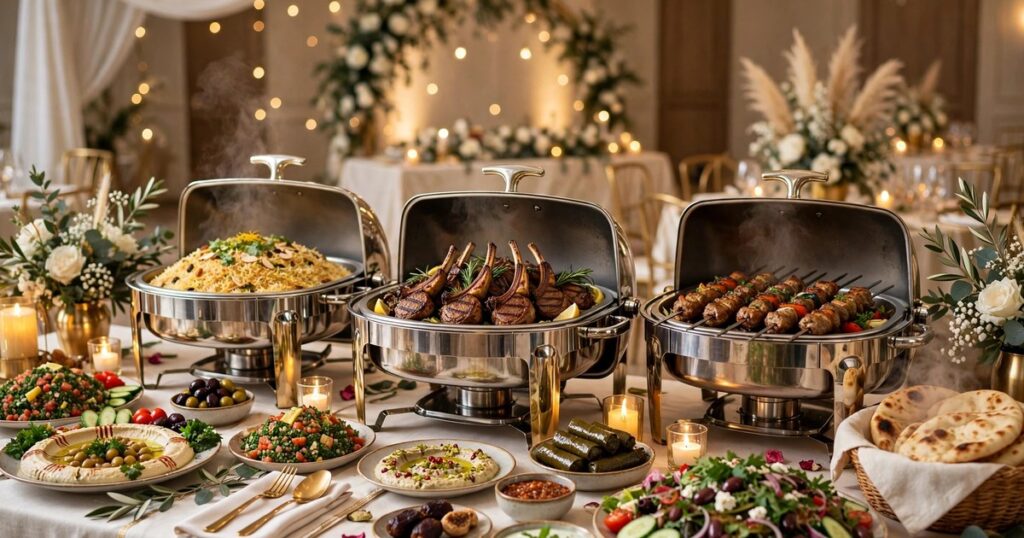
A wedding menu is the one part of the day every single guest remembers. Long after the speeches blur together and the dancing shoes come off, people will still be talking about the biryani, the lamb chops, or the dessert table — and for Muslim families, the food carries one extra question that has to be answered before anything else: is it really halal?
Halal catering is the answer to that question, and it has grown into a proper industry of its own. A decade ago, a halal wedding in America usually meant a family friend cooking trays of food in a home kitchen, or a restaurant that would quietly supply trays for a hall. Today there are dedicated halal caterers in every major city — full-service wedding caterers with tasting menus, live grill stations, mocktail bars, and dessert spreads — who will feed 300 guests without a single compromise on halal standards. The food has caught up with the occasion.
This guide is for anyone planning a halal wedding, walima, or big family event: what halal catering actually means, what it costs, how to vet a caterer before you hand over a deposit, what a good wedding menu looks like, and ten real caterers across the United States whose halal claims were verified in this session from their own websites and listings. Every caterer here was checked by web search in this session. Where a price is given, it comes from a published source and may have changed; where no price is given, the caterer does not publish one that could be verified. Always check before you book.
If you like planning food-first celebrations, our Food Guides hub has more in the same spirit, from halal restaurant guides to city food crawls. A halal wedding is not a smaller version of a normal wedding. It is the same celebration — the same joy, the same full room, the same long table — with the comfort of knowing every guest can eat everything on it.
Quick answer: Halal catering means food prepared to Islamic dietary rules: halal-sourced meat, no pork, and no alcohol in the cooking. For a wedding, expect roughly $40 to $95 per guest for a buffet or full-service menu, and book 4 to 12 months ahead for peak dates. This guide covers costs, menus, vetting questions, and ten verified halal caterers across the US.
What Is Halal Catering?
Halal catering is food prepared for an event according to Islamic dietary law. In practice, that means four things, and a good caterer will be able to explain all four without hesitating. First, all meat and poultry must be halal — slaughtered according to Islamic requirements. Many caterers go further and specify zabiha halal, meaning the animal was slaughtered by hand by a Muslim with the proper blessing, rather than by machine. Second, there is no pork anywhere in the kitchen — not in the main dishes, and not hidden in a sausage, a gelatin, or a stock. Third, no alcohol is used in the cooking: no wine in a sauce, no beer in a batter, no rum in a dessert. Fourth, the halal food is kept separate from any non-halal food during preparation, storage, and service, so there is no cross-contact.
That fourth point is the one couples most often forget to ask about, and it is the one that matters most when a caterer also serves non-halal clients. A caterer can buy halal meat and still fail the test if it is cooked on the same grill as pork, stored in the same fridge as alcohol, or served from the same buffet line as a non-halal dish. The caterers in this guide were chosen because they state their standards clearly — several of them run fully halal kitchens where the question never arises at all.
It is also worth knowing that “halal” is not one single standard, and different families draw the line in different places. Some families are comfortable with any halal-certified meat. Others want zabiha only, hand-slaughtered, and will ask for the supplier’s name. Some families are happy eating halal food at a venue that also serves alcohol at a separate bar; others want a fully dry event with no alcohol on the premises at all. None of these positions is wrong. What matters is knowing where your family stands before you start calling caterers, because it changes which caterers fit and which questions to ask. The vetting section below gives you the exact questions.
Halal catering is not one cuisine, either. The caterers in this guide cook Pakistani, Indian, Yemeni, Afghan, Turkish, Lebanese, Moroccan, and Tex-Mex food — and most of them will build a mixed menu if your families come from different backgrounds. A wedding with a Pakistani family on one side and a Turkish family on the other can have a biryani station and a doner station side by side, and nobody has to compromise. That flexibility is one of the reasons halal catering has grown so fast: it is not a restriction on the menu, it is a standard the menu is built to.
How Much Does Halal Catering Cost?
Catering is usually the single biggest line in a wedding budget, and halal catering is no different. The national picture comes from The Knot’s 2026 Real Weddings Study, which surveyed 10,474 couples married in 2025: couples spent an average of $80 per guest on wedding catering, with regional averages ranging from $62 in the Midwest to $123 in the Mid-Atlantic. For 100 guests, that is about $8,000 for food alone, before the bar, sales tax, and service charges. Zola’s 2026 catering guide gives a similar picture by service style: a buffet runs $40 to $65 per guest, a plated dinner $65 to $85, food stations $45 to $75, and a cocktail reception $35 to $55.
Halal catering sits inside those same ranges rather than above them. Susan’s Weddings in New York, one of the caterers below, says its full-service halal wedding catering starts at $95 per guest, and notes that halal sourcing itself rarely changes the per-guest figure much — the price moves with guest count, service style, menu, and staffing. At the other end of the scale, the drop-off and buffet caterers in this guide publish much lower numbers: Bigi Awasaana in Los Angeles lists packages from $19 to $27 per guest, Karachi Chaat House in Chicago lists $18 to $48 per guest depending on the package, Ottoman Kitchen in Virginia lists buffet packages from $17.99 to $26.99 per guest, and Oasis Food Market in Oakland lists $10 to $16 per head. The gap between those two ends is not a mystery — it is the difference between food dropped off in trays and a full-service wedding with staff, rentals, setup, and service.
What actually moves the price is worth understanding before you compare quotes, because two quotes that look $20 apart per guest may not be quoting the same thing at all. Service style is the biggest lever: a buffet is cheaper than a plated dinner, and a drop-off tray service is cheaper than either. Guest count matters too — most caterers price per person, but many have a minimum spend or a minimum guest count, and the per-person price often falls as the guest count rises. The menu matters: lamb chops and premium cuts cost more than chicken and rice, and live cooking stations cost more than trays. Location matters: the same menu costs more in New York than in Houston. And the fine print matters most of all: service charges of 18% to 22%, sales tax, staffing, rentals, delivery, and cake-cutting fees can add a third or more to the food price. Always ask for an all-in quote, in writing, before you compare two caterers.
One practical habit will save you real money. Get three written quotes for the same menu, the same guest count, and the same service style, and compare the all-in totals — not the headline per-person number. A caterer quoting $55 per guest with staffing, rentals, and tax included can be cheaper than a caterer quoting $45 per guest with all of those added on top. And remember that the cheapest quote is not always the best value: a caterer who underprices a 300-guest wedding is a caterer who may run out of food, and running out of food at a wedding is the one mistake nobody forgets.
| Event type | Typical per-person range | What it usually includes | Notes |
|---|---|---|---|
| Wedding buffet (full service) | $40–$65 | Buffet, staffing, setup | Zola 2026 guide; The Knot average is $80 per guest overall |
| Wedding plated dinner | $65–$85 | Plated courses, table service | Zola 2026 guide; premium menus run higher |
| Food stations / live grill | $45–$75 | Chef-attended stations | Zola 2026 guide |
| Cocktail reception | $35–$55 | Passed bites, small plates | Zola 2026 guide |
| Halal drop-off / tray catering | $10–$48 | Food trays, delivery, no service staff | Published packages from caterers in this guide |
| Walima / nikah dinner | $18–$65 | Buffet or family-style, often smaller guest count | Varies widely by city and menu |
| Corporate lunch / office event | $12–$27 | Boxed lunches or buffet trays | Published packages from caterers in this guide |
| Eid / iftar gathering | $10–$32 | Trays, buffet, community portions | Published packages from caterers in this guide |
Two warnings about prices in this guide. First, every per-person figure above comes from a published source found in this session — The Knot, Zola, or the caterer’s own website — and prices change, so treat them as planning ranges, not quotes. Second, several caterers in this guide do not publish prices at all and quote per event. That is normal for wedding catering, and it is not a red flag on its own. It just means you need to ask for a written quote with your date, your guest count, and your menu, and compare it like for like with the others.
What Questions Should You Ask a Halal Caterer?
The tasting tells you whether the food is good. The questions tell you whether the caterer is trustworthy. Ask these before you pay a deposit, and ask for the answers in writing — in the contract, not just in a phone call. A caterer who is proud of its halal standards will answer every one of these gladly. A caterer who dodges them is telling you something.
Start with the halal questions, in this order. Is all the meat halal, or only some dishes? Is the meat zabiha, hand-slaughtered, and who is the supplier — can they name the certification body? Is any alcohol used in the cooking, including in sauces, marinades, and desserts? Is there pork anywhere in the kitchen, and how is cross-contact prevented? Is the kitchen fully halal, or does it also prepare non-halal food for other clients? And if your event is at a venue with its own kitchen, will the caterer bring its own equipment and keep its food separate? These questions sound strict, and they are meant to be. A wedding is the one event where you cannot afford to find out afterwards.
Then ask the practical questions. What is the minimum guest count, and is there a minimum spend? What exactly is included in the per-person price — food only, or staffing, rentals, setup, and cleanup as well? What are the service charge and tax, and are they included in the quote? How many staff will be on site per 50 guests? What happens if the guest count changes — up or down — in the final week? What is the deposit, when is the balance due, and what is the cancellation policy? Can you do a tasting, what does it cost, and does the tasting fee go toward the booking? These are the questions that separate a professional caterer from a good cook with a van, and they matter just as much as the food.
Ask about the food itself, too. Can the menu be customised for your families — a mix of cuisines, a kids’ menu, vegetarian and vegan options, gluten-free and nut-free dishes? How is the food kept hot and fresh during service — chafing dishes, live stations, or a kitchen on site? What desserts are included, and can you bring your own cake or mithai? What drinks are included — soft drinks, mocktails, chai, water — and what do they cost per guest? And who is your point of contact on the day, and will they be on site from setup to the last plate? The answer to that last question is more important than it sounds: the caterer who sends a manager who stays is a different experience from the caterer who drops off trays and leaves.
Finally, ask for proof you can check. Can they show photos of a recent wedding of a similar size? Can they share two recent references — ideally families who had a wedding, not just a corporate lunch? Do they have a food hygiene or safety certification, and are they licensed and insured? A caterer with a track record will have all of this ready. A caterer who cannot produce any of it is asking you to take a leap of faith with the most important meal of your life, and you should not.
What Does a Halal Wedding Menu Look Like?
A good halal wedding menu does two jobs at once: it honours the families’ food traditions, and it feeds 200 or 300 people — including guests who have never eaten South Asian or Middle Eastern food — without anyone going hungry or feeling lost. The menus that work best follow a simple shape: something to welcome guests, something to graze on, a main spread with real choice, and a dessert that feels like a celebration.
Start with the welcome. Most halal weddings open with drinks and small bites while guests arrive and the families greet each other: mango lassi or rosewater lemonade, chai or mint tea, dates and nuts on the tables, and passed appetisers like samosas, spring rolls, or falafel. This is the part of the menu that sets the tone, and it is worth spending on: guests who are welcomed well forgive a slow main course, and guests who stand around hungry for an hour do not.
The main spread is where the families’ traditions show. A Pakistani or Indian wedding menu usually centres on biryani — chicken or lamb, fragrant and properly spiced — alongside a karahi or qorma, a BBQ selection of seekh kebabs, chicken tikka, and malai boti, and naan and raita to go with it. A Middle Eastern or Turkish menu leans toward mezze and grills: hummus, tabbouleh, fattoush, shawarma carved off the spit, kofta, and rice pilaf. An Afghan menu brings qabuli pulao with sweet carrots and raisins, chapli kebabs, and mantu dumplings. A Yemeni menu brings mandi — slow-cooked lamb or chicken over smoked rice — which is one of the most wedding-worthy dishes in halal catering, because it is cooked in large quantities and served family-style. And a Moroccan menu brings tagines, couscous, and pastilla. Most of the caterers in this guide will mix two traditions on one menu, which is the right call when the two families eat differently.
Two practical rules make the main spread work. First, always include a vegetarian main that is a real dish, not an afterthought: paneer makhani, daal palak, vegetable biryani, or a mezze spread that vegetarians can build a full plate from. At a 300-guest wedding, 30 or 40 guests may be vegetarian, and they should not be eating side dishes for dinner. Second, label everything. A small card next to each dish — the name, whether it is spicy, whether it contains nuts or dairy — lets guests serve themselves with confidence and saves the caterer a hundred questions. This matters even more when the guest list includes non-Muslim friends and colleagues who are eating halal food for the first time: a labelled buffet is welcoming, an unlabelled one is intimidating.
Then comes dessert, and at a halal wedding dessert is not an afterthought — it is a course of its own. The classic spread is mithai and Middle Eastern sweets: gulab jamun, kheer, zarda, jalebi, baklava, knafeh, and kulfi, often alongside a wedding cake. A live dessert station — jalebi fried to order, kulfi scooped from a cart, or a kunafa station with the cheese pulled hot — turns dessert into entertainment, and it is one of the most photographed parts of the evening. Our best halal desserts guide lists ten real bakeries and dessert cafes across the United States if you want to source the sweets separately from the main caterer, or pair a bakery order with your caterer’s savoury menu.
Drinks deserve the same thought as food. A halal wedding has no alcohol, which means the drinks list has to work harder — and the good news is that it can be better than a bar. Rosewater lemonade, mango lassi, mint tea poured from a height, cardamom sparkling drinks, and zero-proof mocktails made with the same care as cocktails: these are the drinks guests remember and photograph. Several caterers in this guide run mocktail programs, and if yours does not, a separate mocktail or chai station is worth the extra cost. A wedding where the drinks are an afterthought — warm soft drinks in cans — feels like one, however good the food is.
What Kinds of Events Can a Halal Caterer Handle?
Weddings get the most attention, but a halal caterer is useful for far more than the big day — and most of the caterers in this guide built their businesses on the smaller events first. Knowing what each event type needs helps you brief the caterer properly, because a walima and a corporate lunch are not the same job.
The wedding itself — the baraat or the main reception — is the biggest and most formal event: 200 to 500 guests, a full buffet or plated dinner, staffing, rentals, and a timeline that has to survive speeches, prayers, and photography running late. This is the event where full-service catering earns its price, and where you should book the caterer who has done weddings of your size before, not the caterer who is cheapest.
The walima, the reception hosted by the groom’s family, is usually slightly smaller and slightly more relaxed than the baraat, but the food expectations are just as high. Many families use the walima to serve a different menu from the baraat — if the baraat was Pakistani, the walima might be Middle Eastern or mixed — which is a good reason to ask your caterer about a second menu rather than repeating the same food two nights running.
The nikah is often the most intimate event: 50 to 150 guests, at home or in a mosque hall, with a simpler menu — biryani, karahi, naan, and dessert, served buffet-style. This is where drop-off and tray catering shines: the food arrives hot in trays, the family serves it, and the cost per guest is a fraction of a full-service wedding. Several caterers in this guide, including Karachi Chaat House and Oasis Food Market, are built exactly for this scale.
Corporate events and office lunches are a different job again: boxed lunches or buffet trays, delivered on time, labelled clearly, with vegetarian and vegan options counted in advance. Ottoman Kitchen in Virginia and Lone Star Halal Catering in Houston both list corporate catering as a core service, and it is worth knowing that a caterer who handles offices well is usually a caterer who is reliable on timing — which is exactly what you want at a wedding.
Eid and iftar gatherings, graduation parties, aqeeqahs, and engagement dinners fill out the rest of the calendar. These are usually 30 to 150 guests, often at home or in a community hall, and the best caterers for them are the ones with low minimums and flexible packages — Oasis Food Market, for example, has no minimum headcount at all, and Bigi Awasaana in Los Angeles caters from 15 guests upward. If you are planning a smaller event, ask about minimums first: a caterer with a 100-guest minimum is the wrong caterer for a 40-person aqeeqah, however good the food is.
How Far in Advance Should You Book a Halal Caterer?
The short answer is: earlier than you think, especially for a wedding. The long answer depends on the season, the city, and the caterer — and the sources in this session give a useful range. For summer and fall weddings, Olive & Shae, a wedding caterer listed on Zola, recommends booking at least 12 months in advance. Catered by Chef Bri in Washington, DC recommends at least 10 months for summer and fall weddings. For the halal caterers in this guide, the lead times are shorter but still real: Karachi Chaat House in Chicago recommends booking at least 2 weeks ahead for smaller events and 4 to 6 weeks for weddings and large gatherings; Bigi Awasaana in Los Angeles recommends at least 2 weeks for smaller events and 4 or more weeks for weddings; Laree Adda in New Jersey advises at least one month ahead for large groups and weddings; Oasis Food Market in Oakland asks for 48 hours’ notice for tray catering.
The pattern is clear. A small tray order can be booked in days. A wedding cannot. For a wedding, the practical timeline is: start shortlisting caterers 9 to 12 months before the date, do tastings 6 to 9 months out, and book 6 months out at the latest for a peak-season Saturday. Peak season for halal weddings in the US runs from late spring through early fall, and again around the winter holidays — and the best caterers in a city like Dearborn, Chicago, or Houston will be booked for those Saturdays a year ahead. If your date is a Friday or a Sunday, or an off-peak month, you will have more choice and more room to negotiate.
There is also a timeline inside the booking. Once you have chosen a caterer, expect to pay a deposit to hold the date — Laree Adda, for example, asks for a 50% deposit in advance to guarantee a reservation — and to confirm the final guest count about a week before the event. The menu is usually finalised a month out, the tasting happens before that, and the final headcount, seating plan, and service timeline are locked in the last week. Build in a buffer: guest counts at South Asian weddings almost always grow in the final week, and a caterer who has planned for 300 will cope with 320 far better than a caterer who planned for exactly 300 and ran out.
One more timing note, and it is specific to halal weddings. If your wedding falls during Ramadan, or in the weeks just after Eid, caterers in Muslim-majority neighbourhoods will be at their busiest — iftar catering, Eid gatherings, and community events all compete for the same kitchens. Book even earlier for those dates, and confirm the delivery and setup times in writing, because a caterer juggling three Eid events on your weekend is a caterer who needs a clear schedule from you.
What About Alcohol, Pork, and Mixed Menus?
This is the section most guides skip, and it is the one that causes the most awkward conversations — so here it is, plainly. A halal event has no alcohol and no pork. That is the rule, and every caterer in this guide states it on their own website. But there are three situations where families get caught out, and all three are worth planning for.
The first is the venue. Some wedding venues have their own bar, or a house caterer who serves alcohol at other events. If your venue serves alcohol at the bar, ask whether the bar can be closed or moved for your event, and whether the venue’s kitchen can be kept halal for your date — separate equipment, separate storage, no pork cooked that day. Put the answer in writing. A venue that says “we’ll work around it” without a written plan is a venue that has not thought about it.
The second is the mixed guest list. At many halal weddings, a large share of the guests are non-Muslim friends, colleagues, and neighbours. They do not need alcohol to enjoy the evening — a good mocktail list and a proper chai station will do more for the atmosphere than a bar ever would — but they do need to know what they are eating. Label the food, explain the menu, and do not apologise for it. A halal wedding is not a wedding with something missing. It is a wedding with a full table that everyone can eat from, and that is a better experience for every guest, not a lesser one.
The third is the caterer who is halal-friendly rather than fully halal. Some caterers — usually large general wedding caterers — will offer halal meals for individual guests, or a halal menu cooked in a shared kitchen. That can work, but only if you ask the hard questions: is the halal food cooked separately, on separate equipment, with separate utensils? Is the halal meat certified, and by whom? And will the caterer put the answers in writing? In this guide, the caterers listed as fully halal run halal kitchens. The ones listed as halal-friendly are labelled that way, and you should call them and ask before you book. If a caterer cannot answer these questions clearly, choose a different caterer. There are enough fully halal caterers in every city in this guide that you do not need to compromise.
Where Can You Find Halal Caterers in New York and New Jersey?
New York and New Jersey have the deepest halal catering market in the country, and the three caterers below cover the full range: a full-service wedding caterer, a Yemeni specialist, and a Jersey City institution for Indian and Pakistani food. Between them, they serve all five boroughs and the tri-state area, from intimate walimas to 300-guest receptions.
1. Susan’s Weddings — New York City, New York
The full-service option. Susan’s Weddings has catered weddings in New York City since 2005, and its halal wedding catering runs across Manhattan, Brooklyn, Queens, the Bronx, and Staten Island, plus Westchester, Long Island, the Hudson Valley, New Jersey, and Connecticut. Its own halal page defines halal wedding catering as full-service food prepared to halal standards — halal-sourced meat and poultry, no pork or alcohol in the cooking, and clean separation from non-halal ingredients in the kitchen — and says the kitchen is certified by the city’s health department with trained staff managing halal, vegetarian, vegan, gluten-free, and nut-free needs across a single guest list, clearly labelled so no guest has to ask what they can eat. Full-service halal wedding catering starts at $95 per guest, and the company says halal sourcing itself rarely changes the per-guest figure much — the final number moves with guest count, service style, menu, and staffing. It scales from intimate plated dinners to receptions of 300 or more, and works in loft, rooftop, ballroom, and waterfront venues. Halal status: halal — halal-sourced meat, no pork or alcohol in the cooking, per the caterer’s own page. Known for: full-service weddings, halal menus across all five boroughs, dietary handling across a whole guest list. Ask for a custom quote; the director of weddings replies within one business day, according to the caterer’s site.
2. AkramCooks Catering — New York, New Jersey, Pennsylvania, Connecticut
The Yemeni specialist. AkramCooks Catering serves the tri-state area — New York, New Jersey, Pennsylvania, and Connecticut — with authentic Yemeni cuisine for weddings, walimas, aqeeqahs, and corporate events. Its site describes the food as halal-certified and 100% halal sourced, and the service as drop-off catering and buffet setup: the team delivers and sets up the buffet with warmers and full presentation, so the food is ready to serve and the hosts take it from there. The menus are built around Yemeni hospitality — mandi, slow-cooked lamb, fragrant rice, and the kind of generous, shareable spreads that suit a walima. The founder, Akram Said, trained at Le Cordon Bleu, and the business is licensed and insured. Halal status: halal-certified, 100% halal sourced, per the caterer’s own site. Known for: Yemeni wedding menus, walimas and aqeeqahs, drop-off and buffet setup across the tri-state area. No prices are published — request a quote with your date and headcount. Check before you go for current availability and pricing.
3. Laree Adda — Jersey City, New Jersey
The Jersey City institution. Laree Adda, at 287 Grove Street in Jersey City, describes itself as the leading caterer of Indian and Pakistani halal food in New Jersey, with authentic halal-certified meals prepared to strict halal guidelines. Its site says its chefs specialise in the dishes that anchor a desi wedding — biryanis, karahis, BBQ, and the full Indian and Pakistani spread — and that it caters weddings for up to 100 guests, with elegant meals or lively buffets. The practical details are published: reservations four to five days ahead for small occasions, at least one month ahead for larger groups and weddings, and a 50% deposit in advance to guarantee the booking. Halal status: halal-certified, per the caterer’s own site. Known for: Indian and Pakistani wedding food, halal-certified menus, Jersey City base serving New Jersey and the wider area. No per-person prices are published — call for a quote. Check before you go for current pricing and availability.
Where Can You Find Halal Caterers in Dearborn and Detroit?
Dearborn, Michigan has the densest halal food scene in America — over 100 halal restaurants in the city alone, and more than 300 verified halal restaurants across the Detroit metro area, according to a halal dining guide. That density means choice, and it also means competition: Dearborn’s halal caterers have to be good, because their customers eat halal food every day and know the difference. The caterer below is the one whose halal claim could be verified most clearly in this session, and it is a good starting point for any Dearborn wedding.
4. AZ Catering — Dearborn, Michigan
The Dearborn local. AZ Catering, at 6319 Schaefer Road in Dearborn, is a family-owned caterer whose own listing states plainly: “All our food is 100% HALAL and that is something we are very strict on. As a family we have never eaten or sold un-halal meat and we do not intend to do so either.” The name stands for “3ala Zawek,” Arabic for “whatever you would like,” and the concept is exactly that — any meal or dish you can think of, cooked to order, with delivery for any order size and pickup for the daily home-cooked meal. It caters weddings, parties, and large events across Metro Detroit, and it is open five days a week for walk-in meals. Halal status: halal — 100% halal, per the caterer’s own listing. Known for: custom menus, family-owned cooking, delivery across Metro Detroit. No prices are published — call for a quote. Check before you go for current pricing and availability.
Dearborn has many more halal caterers than the one entry above — the city’s Warren Avenue corridor alone has dozens of halal restaurants that cater — but their halal claims and catering prices could not all be verified in this session, so they are not listed as entries here. If you are planning a wedding in Dearborn, the practical move is to start with AZ Catering and then ask around: the local halal community, the mosques, and the banquet halls will all have recommendations, and a caterer who is feeding Dearborn weddings every weekend is a caterer whose food your guests will already know.
Where Can You Find Halal Caterers in Chicago?
Chicago’s halal catering scene is anchored by Devon Avenue, the West Rogers Park corridor that has fed the city’s South Asian community for decades, and by the western suburbs — Lombard, Schaumburg, Naperville — where many of the big wedding halls sit. The two caterers below are the strongest verified picks, and both publish real prices, which makes them unusually easy to compare. For more on Chicago’s halal scene, our halal food in Chicago guide covers the ten best halal restaurants in the city, several of which also cater.
5. Usmania Catering — Chicago, Illinois
The Chicago veteran. Usmania Catering calls itself the Midwest’s premier zabiha halal Pakistani and Indian caterer, and it has been serving Chicago for 25 years. Its site says it uses only 100% zabiha halal meat, and it covers the full range of events: wedding catering with elegant menus for every wedding style, corporate catering, and on-site live BBQ and chaat stations. The service is full-scale — an online tray portal for quick gatherings, a dedicated catering coordinator for large events and out-of-state catering, and professional on-site setup at the venue. The menu covers the Indo-Pak classics — biryani, karahis, seekh kebabs — alongside halal Chinese dishes like chicken Manchurian and Hakka noodles. Halal status: halal — 100% zabiha halal, per the caterer’s own site. Known for: 25 years in Chicago, wedding catering, live BBQ and chaat stations, tray catering. No per-person prices are published — request a quote through the catering inquiry form. Check before you go for current pricing and availability.
6. Karachi Chaat House — Chicago, Illinois
The one with published prices. Karachi Chaat House, near Devon Avenue in Chicago, offers halal catering for every occasion — wedding catering, Eid catering, and corporate lunch catering — from intimate family dinners to 500-person celebrations, all 100% zabiha halal, hand-slaughtered, with no alcohol and no pork. Its catering page publishes three packages: a Chaat & Bites starter package at $18 per person with a 25-guest minimum and a $500 minimum spend, a Full Karachi Spread at $32 per person with a 40-guest minimum and a $1,500 minimum spend, and a premium Grill & Feast at $48 per person with a 50-guest minimum and a $2,500 minimum spend. Weddings and walimas have a 50-guest minimum, and the caterer recommends booking at least 2 weeks ahead for smaller events and 4 to 6 weeks for weddings and large gatherings. Catering trays are also available — a chicken seekh kebab tray of 25 pieces is listed at $149.99 with free local delivery — and trays need 24 hours’ advance booking. Halal status: halal — 100% zabiha halal, hand-slaughtered, per the caterer’s own site. Known for: published per-person prices, Karachi street food at weddings, 500-person capacity. Check before you go for current prices, as these are starting prices confirmed per event.
Two more Chicago names are worth a call. Delhi Darbar Kabab House, at 3010 West Devon Avenue, is a 100% zabiha halal Pakistani and North Indian kabab house that has cooked for Chicago’s Pakistani community since 1986, with all meat hand-slaughtered and independently certified by Halal Monitoring Services, and party packages for 40 or more guests for nikahs, walimas, mehndis, and Eid events. Shan Catering, run by Rehman Sweets and based in Lombard, offers 100% zabiha halal Pakistani catering for weddings, parties, and corporate events, with pickup and drop-off across the Chicago suburbs. Both were verified in this session from their own sites, but their per-person prices are not published, so they are mentioned here rather than listed as full entries.
Where Can You Find Halal Caterers in Houston?
Houston has one of the largest halal dining scenes in the South, centred on the Sugar Land and southwest Houston corridor, and its halal caterers reflect the city’s mix: Pakistani and Indian specialists, and a Tex-Mex halal caterer that could only exist in Texas. The caterer below is the most distinctive of the group — and a good reminder that halal catering does not have to mean one cuisine.
7. Lone Star Halal Catering — Houston, Texas
The Tex-Mex halal caterer. Lone Star Halal Catering serves Houston and the surrounding areas with authentic halal Tex-Mex: build-your-own bowls, burritos, and taco bars, fajita bars, and catering trays, for weddings and walimas, graduations, Ramadan and Eid events, and corporate lunches. Its site states the standard plainly — 100% halal, pork and alcohol free — and its halal assurance page says it buys zabiha meat, so every protein served is halal from the start. There are no published prices; the caterer works by quote, and asks for the date and the headcount to send a real price. Halal status: halal — zabiha meat, 100% halal, pork and alcohol free, per the caterer’s own site. Known for: halal Tex-Mex, fajita and taco bars, weddings and walimas, corporate lunches. Check before you go for current pricing and availability.
Houston has more halal catering than one entry can cover. Karahi Boys, based in the Sugar Land–Houston area, offers Pakistani food catering for weddings, parties, and community events, with all dishes prepared using halal-certified ingredients and packages designed to scale for large events. Aga’s Restaurant & Catering, one of the largest Indian and Pakistani restaurants in North America, has served Houston since 2001 with a 100% zabiha halal menu and catering for large events — and it was covered in our halal date night guide for its grilled lamb chops and biryanis. Both were verified in this session, but their per-person catering prices are not published, so they are mentioned here rather than listed as full entries.
Where Can You Find Halal Caterers in Los Angeles?
Los Angeles has a long, underrated halal scene, from Persian kabob houses in Westwood to Afghan grills in the San Fernando Valley — and the Valley is where the city’s halal catering is centred. The caterer below is the strongest verified pick, with published prices and a clear zabiha standard.
8. Bigi Awasaana — Reseda, Los Angeles, California
The Afghan specialist. Bigi Awasaana, at 18411 Victory Boulevard in Reseda, brings authentic Afghan cuisine to weddings, engagements, corporate lunches, birthday parties, and community events across the San Fernando Valley and greater Los Angeles. Its catering page states that all beef, lamb, and chicken is strictly 100% hand-slaughtered zabiha halal, flame-grilled over natural charcoal, with no machine cuts or fillers. The menu is built around shareable Afghan dishes: coal-fired kabobs including chicken tikka, chapli kabab, koobideh, and lamb chops, qabuli pulao, and handmade appetisers like bolani. Three packages are published: the Charcoal Kabob Grill Party at $19 per guest, the Kabul Feast at $22 per guest — the most requested celebration menu — and the Silk Road Grand Buffet at $27 per guest, a VIP spread with premium lamb chops and dessert. The minimum is 15 guests, and the caterer recommends booking at least 2 weeks ahead for smaller events and 4 or more weeks for weddings and large celebrations. Halal status: halal — 100% hand-slaughtered zabiha halal, per the caterer’s own site. Known for: Afghan wedding feasts, coal-fired kabobs, published per-person prices, Valley-wide delivery. Check before you go for current prices and availability.
One more Los Angeles name is worth a call. Ribs ‘n’ Kabobs, at 18925 Norwalk Boulevard in Artesia, is a family-owned, HFSAA-certified, 100% zabiha halal BBQ and grill restaurant serving Los Angeles and Orange County, with on-site catering, live cooking stations, and buffet or plated service for weddings, rehearsal dinners, and corporate events. Its per-person prices are not published, so it is mentioned here rather than listed as a full entry — but a halal BBQ caterer with live grill stations is a genuinely different option for a wedding, and worth a quote.
Where Can You Find Halal Caterers in Washington, DC and Virginia?
The Washington, DC area — the DMV, as locals call it: DC, Maryland, and Virginia — has a strong halal catering market built on its Turkish, Pakistani, and Middle Eastern communities, and on the corporate lunch trade in Northern Virginia. The caterer below is the one with the clearest published prices and the longest track record in the area.
9. Ottoman Kitchen — Chantilly, Virginia
The DMV workhorse. Ottoman Kitchen, in Chantilly, Virginia, has been 100% halal since 2015, and its catering page says so plainly: every meat comes from halal-certified suppliers, and there is no pork or alcohol in anything it cooks. It delivers across the whole DMV — Northern Virginia, Washington DC, and Maryland — from Chantilly, Centreville, Fairfax, and the rest of the region. The food is Turkish and halal: kebab and doner packages from $15.99 per guest, buffet packages from $17.99 to $26.99 per guest, and boxed lunches from $15.99 to $19.99 per box, before tax. Catering starts at 10 guests, with 24 hours’ notice, and delivery is free within 10 miles on food orders over $500. Group pricing is automatic — 5% off over $500, 10% off over $1,500 — and the kitchen invoices companies, schools, and university departments directly. Halal status: halal — 100% halal since 2015, per the caterer’s own site. Known for: Turkish catering, published prices, low minimums, DMV-wide delivery. Check before you go for current prices and availability.
Two more DMV names are worth a call. Saahil Restaurant, in Sterling, Virginia, offers 100% halal Pakistani catering for weddings, corporate events, and graduation parties across Northern Virginia and the greater DC area, with wedding buffet menus and a catering team that curates the menu per event. Capital Doner Catering, based at 1731 Wilson Boulevard in Arlington, Virginia, runs fully halal Turkish and Mediterranean menus for offices, campus events, and weddings in Fairfax and across the DMV, with same-week quotes for 15 to 500 or more guests. Both were verified in this session, but their per-person prices are not published, so they are mentioned here rather than listed as full entries.
Where Can You Find Halal Caterers in the San Francisco Bay Area?
The Bay Area is not an easy region for halal catering — most of its halal restaurants are casual, and several well-known spots serve halal only on selected dishes. The caterer below is the clearest verified pick: a halal-certified market with published prices, no minimum headcount, and a menu that travels well to weddings and community events.
10. Oasis Food Market — Oakland, California
The Bay Area value pick. Oasis Food Market, at 3045 Telegraph Avenue in Oakland, is a halal-certified Yemeni and Middle Eastern market and kitchen that caters trays of rotisserie chicken, shawerma, kebabs, rice, salads, and fresh pita for events and gatherings. Its catering page publishes per-head pricing with unusual clarity: vegetables $10 per head, chicken $12 per head, and lamb or beef $16 per head, with no minimum headcount, pickup or local delivery, and 48 hours’ advance notice. All meats are halal, and the kitchen describes itself as authentic Yemeni and Middle Eastern halal food in the heart of Oakland. Halal status: halal — halal certified, all meats halal, per the caterer’s own site. Known for: published per-head prices, no minimum, shawerma and rotisserie trays, 48-hour notice. Check before you go for current prices and availability.
One more Bay Area name is worth a call. Mazra, with kitchens in San Bruno and Redwood City, caters wood-fired kebab and shawarma, fresh mezze, and halal Middle Eastern BBQ for weddings, corporate events, and office lunches across the San Francisco Bay Area and the Peninsula, with full-service catering — setup, serving, and cleanup — as well as drop-off buffet spreads. Its per-person prices are not published, so it is mentioned here rather than listed as a full entry.
How Do the Best Halal Caterers Compare?
Ten caterers across seven regions is a lot to hold in your head, so here they are side by side. The honest summary is this: if you want a full-service wedding with staff and rentals, Susan’s Weddings in New York and Usmania in Chicago are the picks. If you want the best value per guest, the drop-off and buffet caterers — Bigi Awasaana, Karachi Chaat House, Ottoman Kitchen, and Oasis Food Market — publish prices that start at $10 to $27 per guest. And if you want a specific cuisine — Yemeni mandi, Afghan kabobs, halal Tex-Mex, Turkish doner — the specialist in that cuisine will cook it better than any general caterer.
| Caterer | City / region | Cuisine | Halal status | Published price | Best for |
|---|---|---|---|---|---|
| Susan’s Weddings | New York City | Full-service wedding | Halal | From $95 per guest | Full-service NYC weddings, 300+ guests |
| AkramCooks Catering | NY / NJ / PA / CT | Yemeni | Halal-certified | Not verified | Yemeni walimas, drop-off buffets |
| Laree Adda | Jersey City, NJ | Indian / Pakistani | Halal-certified | Not verified | Desi weddings up to 100 guests |
| AZ Catering | Dearborn, MI | Custom / Middle Eastern | Halal (100%) | Not verified | Dearborn weddings, custom menus |
| Usmania Catering | Chicago, IL | Pakistani / Indian | Halal (100% Zabiha) | Not verified | Chicago weddings, live BBQ stations |
| Karachi Chaat House | Chicago, IL | Pakistani street food | Halal (100% Zabiha) | $18–$48 per guest | Published prices, up to 500 guests |
| Lone Star Halal Catering | Houston, TX | Tex-Mex | Halal (Zabiha) | Not verified | Halal Tex-Mex weddings, taco bars |
| Bigi Awasaana | Reseda, Los Angeles | Afghan | Halal (100% Zabiha) | $19–$27 per guest | Afghan feasts, published prices |
| Ottoman Kitchen | Chantilly, VA | Turkish | Halal (100% since 2015) | $15.99–$26.99 per guest | DMV delivery, low minimums |
| Oasis Food Market | Oakland, CA | Yemeni / Middle Eastern | Halal-certified | $10–$16 per head | Bay Area value, no minimum |
A final note on the table. Every price marked “Not verified” means the caterer does not publish a price that could be found in this session — not that the caterer is expensive. Several of those caterers may be cheaper than the ones with published prices. The only way to know is to ask for a written quote with your date, your guest count, and your menu, and to compare the all-in totals. Do that with three caterers, and the right choice usually becomes obvious. For more city-by-city halal eating once the wedding is booked, browse the Food Guides hub — the restaurant guides there are a good way to scout the caterers’ home cities before you visit them for a tasting.
Frequently Asked Questions About Halal Catering
What is halal catering?
Halal catering is food prepared for an event according to Islamic dietary law: all meat and poultry is halal-sourced, there is no pork anywhere in the kitchen, no alcohol is used in the cooking, and the halal food is kept separate from any non-halal food. Many caterers go further and specify zabiha halal — meat slaughtered by hand according to Islamic requirements. A good caterer will explain its standards clearly and put them in writing.
How much does halal catering cost for a wedding?
The Knot’s 2026 Real Weddings Study puts the national average at $80 per guest for wedding catering, with regional averages from $62 to $123. Zola’s 2026 guide gives $40 to $65 per guest for a buffet and $65 to $85 for a plated dinner. Halal catering sits inside those same ranges: Susan’s Weddings in New York starts full-service halal catering at $95 per guest, while drop-off and buffet halal caterers in this guide publish $10 to $48 per guest. The price moves with service style, guest count, menu, and city — always ask for an all-in written quote.
How far in advance should I book a halal caterer?
For a wedding, start shortlisting 9 to 12 months ahead, do tastings 6 to 9 months out, and book at least 6 months ahead for a peak-season Saturday. Wedding caterers listed on Zola recommend 10 to 12 months for summer and fall weddings. The halal caterers in this guide recommend shorter lead times — 4 to 6 weeks for weddings at Karachi Chaat House in Chicago, 4 or more weeks at Bigi Awasaana in Los Angeles, and one month for large groups at Laree Adda in New Jersey — but the best caterers in a city book up for peak Saturdays a year ahead, so earlier is always safer.
What should I ask a halal caterer before booking?
Ask whether all the meat is halal or only some dishes, whether it is zabiha and who certifies it, whether any alcohol is used in the cooking, whether there is pork anywhere in the kitchen, and how cross-contact is prevented. Then ask the practical questions: minimum guest count and minimum spend, what is included in the per-person price, the service charge and tax, the deposit and cancellation policy, and whether you can do a tasting. Ask for the answers in writing, in the contract.
Can a halal caterer handle a mixed menu for two families?
Yes — most of the caterers in this guide will build a mixed menu, and it is one of the strengths of halal catering. A wedding with a Pakistani family on one side and a Turkish family on the other can have a biryani station and a doner station side by side. Tell the caterer about both families’ food traditions when you brief them, and ask for a tasting that covers both cuisines so neither side feels like an afterthought.
Do halal caterers serve alcohol or allow it at the venue?
A halal caterer will not serve alcohol and will not cook with it — that is part of the standard. Whether alcohol is allowed at the venue itself is a separate question, and it depends on the venue and on your family. Some families want a fully dry event with no alcohol on the premises; others are comfortable with a separate bar. Decide where your family stands, ask the venue what is possible, and put the answer in writing before you book.
What is the difference between halal and zabiha halal?
Halal is the broad standard: meat from a permitted animal, slaughtered according to Islamic requirements, with no pork and no alcohol involved. Zabiha halal is the stricter, traditional form: the animal is slaughtered by hand by a Muslim, with the proper blessing, and the blood is fully drained. Many caterers in this guide — Usmania, Karachi Chaat House, Bigi Awasaana, Lone Star — specify zabiha halal on their own sites. If zabiha matters to your family, ask for it by name and ask who certifies it.
A halal wedding is not a wedding with something missing. It is a wedding with a full table that every guest can eat from — the biryani and the kebabs, the mezze and the mandi, the mocktails and the mithai — and a room full of people who never once had to ask whether the food was for them. Pick a caterer whose halal standards you can verify, taste the food before you book, and give yourself enough time to do both properly. The rest of the day will take care of itself.
Restaurant brand? Get featured — Work With Us.

I’m Lila Spoonbelle, your host on this flavorful ride through food, fun, and fearless puns. Let’s turn every bite into a burst of laughter!