
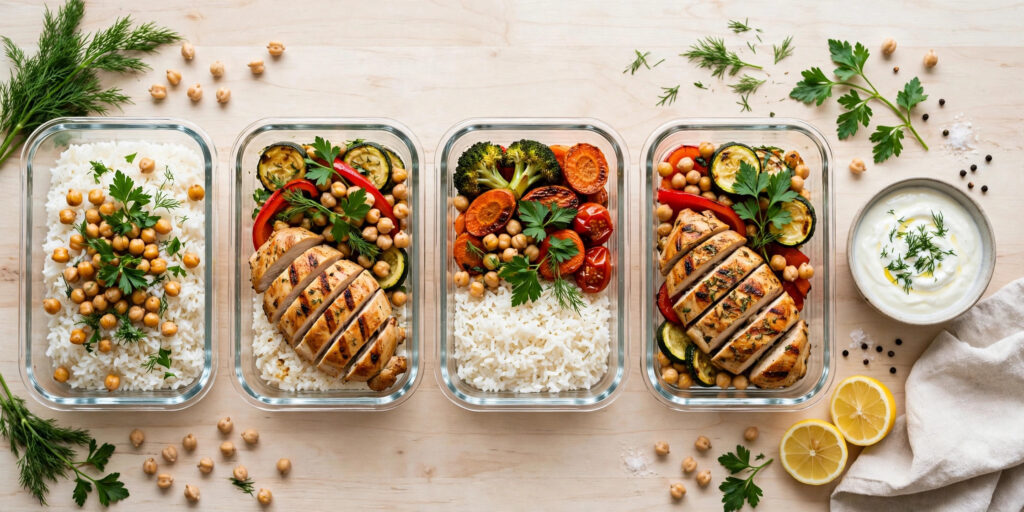
Eating halal in America is not the hard part. Eating halal, on a budget, every single day, without spending your whole Sunday in the kitchen — that is the part nobody talks about. If you have ever stood in a halal butcher shop on a Friday evening, looked at the price of boneless chicken breast, and quietly put half of it back, you already know the problem. Halal meat costs more than conventional meat, the good butcher is a drive away, and the weeknights when you are too tired to cook are exactly the nights when a takeout order sneaks in and costs you fifteen dollars for one meal.
Halal meal prep is the fix, and it is simpler than the internet makes it look. It means cooking a few big batches of halal food once or twice a week, portioning it into containers, and eating well all week without making a fresh decision — or a fresh purchase — every evening. No subscription box, no fancy equipment, no cooking skills beyond a sheet pan and a pot of rice. The same chicken, lentils, and rice you already buy, cooked in bigger quantities, seasoned differently across the week, and stored properly so nothing goes to waste.
This guide is for anyone who eats halal and wants the food budget to behave: families feeding four or five people, students living on a part-time income, young professionals who come home tired, and anyone who has noticed that the halal takeout habit is quietly eating a few hundred dollars a month. It covers what halal meal prep actually costs in 2026, where to buy halal meat for less, which proteins give you the most for your money, three complete weekly plans at fifty, seventy-five, and one hundred dollars, and how to store and reheat everything safely. Every price in this guide comes from a published source found in this session — the USDA, the Bureau of Labor Statistics, or real halal butcher listings — and every price is flagged as a range, because prices vary by city and store. Always check before you go.
If you like practical food guides written for real kitchens, our Food Guides hub has more in the same spirit, from halal restaurant guides to city food crawls. Halal meal prep is not about eating less or eating boring food. It is about spending once, cooking once, and eating well five or six times — and keeping the money you save for the things that actually matter.
Quick answer: Halal meal prep means batch-cooking halal meals once or twice a week and portioning them for the days ahead. One person can prep a week of halal lunches and dinners for roughly $50 to $75, compared with $12 to $15 per takeout lunch. This guide covers costs, the cheapest halal proteins, where to shop, three weekly plans, and safe storage.
What Is Halal Meal Prep?
Halal meal prep is exactly what it sounds like: preparing your meals in advance, with every ingredient halal. The meat is halal-sourced, there is no pork anywhere in the cooking, and no alcohol goes into a sauce, a marinade, or a dessert. The prep part is the system around it — cooking in batches, portioning into containers, and planning the week before you shop, so that the food you buy becomes the food you eat instead of the food you throw away.
In practice, most people prep in one of three ways, and you should pick the one that fits your life rather than the one that looks best in a photograph. The first is full batch cooking: on Sunday you cook two or three big dishes — a pot of chicken curry, a tray of roasted chicken thighs, a pot of lentil soup — and portion them with rice and vegetables into containers for the week. The second is ingredient prep: you cook the building blocks — a big batch of rice, a tray of grilled chicken, roasted vegetables, a pot of chickpeas — and assemble different meals from them through the week, so Monday is a chicken rice bowl and Wednesday is a wrap with the same chicken. The third is freezer prep: you cook double quantities of soups, stews, and curries, and freeze half in portions, so there is always a home-cooked halal meal two minutes from the microwave.
None of these requires special equipment. A large pot, a sheet pan, a rice cooker if you have one, and a set of containers are enough to start. The people who stick with meal prep are rarely the people with the prettiest containers. They are the people who found a routine that takes ninety minutes on a Sunday and saves them five tired weeknight decisions. If you have never meal prepped before, start with lunches only — five lunches, one recipe, one shopping trip — and add dinners once the lunch habit feels easy.
There is also a halal-specific reason to prep that has nothing to do with money. When you cook at home, you control the sourcing completely. You know which butcher the chicken came from, you know there is no cross-contact with pork in your own kitchen, and you know the stock, the sauces, and the marinades are halal, because you bought them yourself. Eating out halal takes vigilance: reading menus, asking questions, checking certifications. Eating at home from your own prep takes none of that, because the whole week is already decided. That peace of mind is part of the value, and it is free.
One more thing to get straight before the numbers start. Meal prep is not a diet plan, and this guide is not one. The plans below include rice, bread, potatoes, and desserts, because real people eat those things. The goal is a week of halal food that costs less, wastes less, and tastes good on Thursday — not a week of plain chicken and sadness. If a plan feels too strict, it is wrong for you, whatever it saves.
How Much Does Halal Meal Prep Cost Per Week?
The honest answer is that it depends on who you are feeding and how much meat you want, but the range is narrower than most people expect. For one person cooking at home, do-it-yourself meal prep typically runs $30 to $70 a week, or about $3 to $6 per meal, according to a 2026 cost comparison of home cooking against meal kits and delivery services. Meal kits, where the ingredients arrive measured out, run $8 to $15 per serving, and fully prepared delivered meals run $12 to $25 or more per serving. A takeout lunch, for comparison, runs $12 to $15 — and a five-day week of takeout lunches alone is $60 to $75, before a single dinner.
The USDA gives a useful benchmark for the whole grocery bill. Its September 2026 food plans — the monthly cost of a nutritious diet cooked entirely at home — put a family of four at $236.30 a week on the Thrifty plan, the lowest-cost plan, or about $2.81 per person per meal including snacks. A single woman aged 20 to 50 comes to roughly $70 a week on the same plan after the USDA’s one-person household adjustment. These are national averages for all food at home, not halal-specific numbers, and halal meat costs more than conventional meat — but they tell you the shape of the budget: a home-cooked week is measured in tens of dollars per person, while an eating-out week is measured in hundreds.
Halal meat is the line that moves the total most. In November 2026 listings from real halal butchers in the United States, boneless chicken breast ran $5.49 to $6.49 per pound, boneless thighs $4.49 to $6.49, drumsticks $3.89 to $3.99, leg quarters $3.79, and whole chickens around $3.99 per pound. Compare that with the Bureau of Labor Statistics national average for conventional boneless chicken breast in October 2026, $4.10 per pound, and you can see the halal premium clearly: roughly a dollar or two more per pound on chicken, and more on beef and lamb. Ground beef averaged $6.76 per pound nationally in October 2026 for conventional beef, and halal ground beef is typically higher still — check before you go, because the premium varies a lot by city.
That premium is real, but it is not the whole story. The biggest savings in halal meal prep do not come from finding cheaper meat. They come from three places: buying the right cuts, building meals around cheap halal proteins like lentils, chickpeas, and eggs, and — above all — stopping the takeout habit. Swapping five restaurant lunches a week at $12 to $15 each for prepped meals at $3 to $5 each saves $35 to $50 a week, or roughly $1,800 to $2,600 a year. That is the number that matters, and it swamps any difference between two butcher shops.
| How you eat | Cost per meal | Five lunches a week | Notes |
|---|---|---|---|
| DIY halal meal prep at home | $3–$6 | $15–$30 | 2026 cost comparison; halal meat pushes toward the higher end |
| Meal kit (ingredients delivered) | $8–$15 | $40–$75 | 2026 cost comparison; few kits offer certified halal meat |
| Fully prepared delivered meals | $12–$25+ | $60–$125+ | 2026 cost comparison; halal options are limited and pricey |
| Takeout or restaurant lunch | $12–$15 | $60–$75 | 2026 cost comparison; delivery fees add more |
| USDA Thrifty plan, all food at home | About $2.81 | About $14 | September 2026, family of four, all meals and snacks, national average |
Two warnings about the numbers in this guide. First, every price here is a planning range from a published source found in this session, and prices change — sometimes weekly. A butcher in Dearborn and a butcher in Dallas will not charge the same price, and a sale can cut a pound of chicken by a dollar overnight. Treat the figures as a way to compare options, not as quotes. Second, the weekly plans later in this guide are built for one person eating lunches and dinners from prep, with breakfasts kept simple — oats, eggs, or leftovers — and they assume you already own basics like oil, salt, and spices. If you are starting from an empty pantry, the first week costs more, and every week after it costs less.
Where Do You Buy Halal Meat for Less?
Where you buy halal meat matters almost as much as what you buy. The same chicken breast can cost twice as much at a small speciality butcher as it does in a bulk case at a warehouse club, and the gap between the cheapest and the most expensive halal chicken in the listings found for this guide was more than four dollars a pound. You do not need to chase the absolute lowest price in your city — you need a system with two or three sources, each used for what it is good at.
The local halal butcher is your first source, and for most families it should stay that way for at least part of the shop. A good halal butcher knows where the meat comes from, will tell you whether it is zabiha and who certified it, and will cut to order — whole chickens broken down, kebab meat cubed, stewing beef cut the way your family likes it. In November 2026 listings, halal butchers in Georgia and North Carolina were selling boneless chicken breast at $5.49 to $6.49 per pound, thighs at $4.49 to $6.49, and whole chickens at about $3.99 per pound, while a halal meat shop in Plano, Texas listed whole chicken at $2.29 per pound and boneless breast at $2.99. That spread is the whole lesson: halal butcher prices vary enormously by city, by shop, and by whether the meat is a premium cut or a whole bird. The butcher is also where you build a relationship, and a regular customer who buys a whole chicken every week often gets told about the sale before it is advertised. Check before you go, and compare two butchers in your area before you settle on one.
Ethnic grocery stores are the second source, and they are the most underrated. South Asian, Middle Eastern, Turkish, and North African grocers usually sell halal meat at the back of the store, and they sell the pantry that goes with it — basmati rice in twenty-pound bags, lentils and chickpeas by the kilo, spices for a fraction of the supermarket price. A twenty-pound bag of basmati rice costs far less per pound than the small bags at a mainstream supermarket, and the same is true of dried lentils, chickpeas, and cooking oil. If you meal prep, the ethnic grocer is where your staples should come from, even if you buy your meat elsewhere. Chicago’s Devon Avenue corridor, for example, is famous for exactly this combination of halal butchers and South Asian grocers in one street — our halal food in Chicago guide covers the restaurants there, and the same neighbourhoods that feed the restaurants feed the home cooks too.
Warehouse clubs are the third source, and they come with a warning label. Costco does not have a dedicated halal meat section, and its famous $4.99 rotisserie chicken is not halal — it is conventionally processed, with no halal certification, and there is no halal version at any US Costco location as of 2026. What Costco does carry, at some warehouses and online, is certified halal meat from brands like Crescent Foods — ground chicken, beef grilling boxes, and lamb locker packs sold in multi-pound boxes — and a halal leg of lamb under the Kirkland label at some locations. The catch is availability: halal stock at Costco rotates, varies by warehouse, and is strongest in cities with large Muslim populations. Call the meat department at your local warehouse before you drive there, ask which halal brands they currently carry, and read the certification on the pack yourself. Sam’s Club is similar — halal availability varies by location and is not guaranteed. Neither club is a reliable single source for halal meat, but either one is excellent for the things around the meat: rice, oil, eggs, frozen vegetables, and containers, all at bulk prices.
Restaurant-supply stores are the fourth source, and they are the one most home cooks never try. Stores like Restaurant Depot sell to businesses, but many locations offer day passes or memberships to the public, and their bulk prices are the lowest found in this session: in an August 2026 in-store price list, halal boneless chicken breast in forty-pound cases was listed at about $1.45 per pound, and halal boneless thighs at about $1.59. Forty pounds of chicken is far too much for one household, but it is exactly right for two or three families splitting a case, or for a family that cooks, portions, and freezes a month of chicken in one afternoon. If you have freezer space and a friend or relative to split with, a restaurant-supply run once a month can cut your meat bill by a third or more. Prices vary by location and change often, so check before you go — and bring a cooler, because forty pounds of chicken does not ride home well in a warm car.
The practical system, for most people, is this: buy your weekly chicken and meat from a halal butcher or ethnic grocer you trust, buy your rice, lentils, chickpeas, spices, and oil from the ethnic grocer in bulk, and use a warehouse club or a restaurant-supply run once a month for the big-ticket bulk buys — with a friend, splitting the case. And whatever you do, do not buy halal meat from a source that cannot tell you where it came from. A pack with no certification, no supplier name, and a price that seems too good to be true is not a bargain. It is a question you cannot answer, and halal is one area where an unanswered question is a reason to walk away.
What Are the Cheapest Halal Proteins?
Protein is the most expensive part of a halal meal, so it is also where the biggest savings live. The trick is to stop thinking of protein as a single thing called “meat” and start thinking of it as a ladder, with a price per serving at every rung. Chicken thighs sit near the top of the value ladder. Lentils, chickpeas, and eggs sit near the bottom — and they are not a compromise. A chickpea curry, a daal, or a shakshuka is a proper meal, not a punishment for being broke, and in many Muslim households these dishes are the food people actually ask for.
Start with the meat, because that is where the money goes. Chicken thighs are the best-value halal meat in most American cities: cheaper than breast by a dollar or two a pound, more forgiving to cook, and better in curries, tray bakes, and rice dishes, where breast can dry out by Thursday. Drumsticks and leg quarters are cheaper still — around $3.79 to $3.99 per pound at the halal butchers listed for this guide — and they are the right cut for roasting in bulk and for families with children, who will eat a drumstick before they eat a sliced breast. Whole chickens are the cheapest way to buy chicken of all: at about $3.99 per pound at some halal butchers, and as low as $2.29 at others, a whole chicken gives you breast meat for one meal, dark meat for another, and a carcass for stock, which is a free pot of soup hiding inside your dinner. Ground chicken, at $5.49 to $7.79 per pound in the listings found, is useful for kebabs and keema but is not a budget cut — buy it when a recipe needs it, not as your default.
Beef and lamb are the expensive rungs, and they should be used like a spice: a little, for flavour, not as the base of every meal. Conventional ground beef averaged $6.76 per pound nationally in October 2026, and halal ground beef runs higher, so a week built on beef will cost roughly twice a week built on chicken thighs and lentils. That does not mean giving up beef. It means using it once a week — a keema on Sunday, a small amount of stewing beef stretched through a pot of daal or a vegetable curry — instead of every night. Lamb is further up the ladder again, and it belongs in the same category: a treat for a weekend meal, not a weekday staple.
Then there are the plant proteins, and this is where halal meal prep quietly becomes cheap. Dried lentils and chickpeas cost very little per serving — roughly thirty to fifty cents a serving when cooked at home, though prices vary by store and brand, so check your local price before you plan around them — and they keep for months in the pantry, cook in big batches, and freeze beautifully. A pot of daal costs almost nothing, feeds four people, and reheats better on day three than it tasted on day one. Eggs are the other bargain: the national average was $2.32 a dozen in October 2026, down sharply from the year before, and two eggs with toast and vegetables is a complete, high-protein breakfast for about fifty cents. Canned tuna is another cheap halal protein — usually around a dollar or two a can, though the price varies by brand and store — and it needs no cooking at all, which makes it the emergency lunch for the week you did not prep.
| Protein | Approx. price per lb | Approx. cost per serving | Notes |
|---|---|---|---|
| Dried lentils (cooked at home) | Roughly $1–$2 | About $0.30–$0.50 | Not verified in this session — check your store; cheapest protein here |
| Dried chickpeas (cooked at home) | Roughly $1–$2 | About $0.30–$0.50 | Not verified in this session — check your store; freezes well |
| Eggs | $2.32 per dozen | About $0.40 for two | BLS October 2026 national average; sale prices were lower |
| Canned tuna (in water) | About $5–$8 | About $1–$2 per can | Not verified in this session — varies by brand and store |
| Chicken leg quarters | $3.79 | About $1.50–$2 | Halal butcher listing, November 2026, Georgia |
| Chicken drumsticks | $3.89–$3.99 | About $1.50–$2 | Halal butcher listings, November 2026, Georgia and North Carolina |
| Whole chicken | $2.29–$3.99 | About $1.50–$2.50 | Halal butcher listings, November 2026; wide range by city |
| Chicken thighs (boneless) | $4.49–$6.49 | About $2–$3 | Halal butcher listings, November 2026, Georgia and North Carolina |
| Chicken breast (boneless) | $5.49–$6.49 | About $2.50–$3.50 | Halal butcher listings, November 2026; conventional average is $4.10 |
| Ground chicken | $5.49–$7.79 | About $2.50–$3.50 | Halal butcher listings, November 2026, Georgia and North Carolina |
| Ground beef | $6.76 (conventional) | About $3–$3.50 | BLS October 2026 national average; halal ground beef runs higher |
| Lamb (cuts vary) | Not verified | Highest on this list | Use as a weekend treat, not a weekday staple |
The serving costs above assume a serving is roughly a quarter pound of meat, or a cup of cooked lentils or chickpeas, which is a reasonable portion for one meal alongside rice and vegetables. They are planning estimates, not promises: your butcher, your city, and your sales will move them. But the order of the ladder barely moves at all. Lentils, chickpeas, and eggs are always the cheapest halal proteins. Chicken thighs, drumsticks, and whole chickens are always the cheapest halal meats. Breast, ground meat, beef, and lamb are always more. Build your week from the bottom of the ladder up, use meat as the flavour rather than the bulk, and the budget takes care of itself.
How Do You Plan a Halal Meal Prep Week?
A meal prep week that works is planned before it is shopped, and shopped before it is cooked. The people who fail at meal prep usually fail at the first step, not the cooking: they buy ingredients without a plan, cook without a list, and end up with a fridge full of good intentions and a takeout order on Wednesday. The system below takes about twenty minutes, and it is the same system whether your budget is fifty dollars or a hundred.
Step one is to check what you already have. Open the fridge, the freezer, and the pantry, and write down what needs using: the half bag of rice, the frozen chicken thighs from last month, the chickpeas, the onions going soft. Meal prep starts with using what is there, because food you already own is the cheapest food you will ever eat. Step two is to pick your proteins for the week — two or three, no more. One chicken dish, one lentil or chickpea dish, and eggs for breakfast is a complete week. Three proteins give you variety; five give you a shopping list you will not finish and leftovers you will not eat.
Step three is to choose two or three base recipes that share ingredients. A chicken curry and a chickpea curry share onions, tomatoes, garlic, ginger, and spices. A tray of roasted chicken thighs and a pot of rice share the oven and the rice cooker. When two recipes share their shopping list, you buy less, waste less, and cook faster, because you are chopping one onion for two dishes instead of two onions for two dishes. Step four is to write the shopping list from the recipes, not from memory, and to shop from it — no extras, no impulse buys, no third protein because it looked good. The list is the budget, and the budget only works if you follow it.
Step five is the cook session itself. Pick one block of time — Sunday afternoon is the classic, but any ninety minutes works — and cook in this order: start the thing that takes longest first, usually rice or a slow curry, then roast the chicken while the curry simmers, then chop and portion the vegetables while everything cooks. Let everything cool before you pack it, and pack it in single-meal containers, not one big tub, because a single-meal container is a lunch you can grab, while a big tub is a chore you will put off. Label each container with the dish and the date, put the first three days in the fridge, and freeze anything meant for Thursday or Friday.
Step six is the midweek reset, and it is the step most guides skip. On Wednesday evening, spend fifteen minutes checking what is left, what is getting tired, and what needs using. Move a frozen portion to the fridge for Thursday, turn leftover rice into fried rice with an egg, and throw out anything that has passed its time — the food-safety section below tells you exactly when that is. A meal prep week is not a single heroic Sunday. It is a Sunday cook plus a Wednesday check, and the Wednesday check is what stops the food from going bad in the back of the fridge.
Finally, keep a running note of what worked. A phone note with three lines — what you cooked, what it cost, what you would change — is worth more than any meal plan template, because after three or four weeks you will have a personal menu of six or eight dishes you know how to cook, know how much they cost, and know your family actually eats. That is the real goal: not one perfect week, but a rotation you can repeat without thinking.
What Does a $50 Weekly Halal Meal Prep Plan Look Like?
Fifty dollars a week for one person is the tightest of the three plans in this guide, and it is honest about what it is: lunches and dinners from prep, simple breakfasts, and a menu built firmly on the bottom of the protein ladder. It is not a week of deprivation. It is a week of lentils, chickpeas, eggs, chicken thighs, rice, and seasonal vegetables — the food that most of the world eats most of the time — cooked well and varied enough that Thursday does not taste like Monday. Prices below are planning estimates based on the verified prices in this guide, and they will move with your city and your sales, so check before you go.
The shape of the week is two big batches plus breakfast. On Sunday you cook a pot of chicken curry from thighs, a pot of masoor daal, and a large batch of rice. That covers lunches and dinners for the first three or four days, with eggs and toast for breakfast. On Wednesday evening you cook a second, smaller batch — chickpea curry, or a tray of roasted drumsticks with potatoes — to carry you through the weekend. The menu below is one person’s week, and it assumes you already own oil, salt, and basic spices; if you do not, the first week costs a little more and the pantry lasts for months afterwards.
| Day | Lunch | Dinner | Approx. cost |
|---|---|---|---|
| Monday | Chicken thigh curry with rice | Masoor daal with rice and salad | About $7 |
| Tuesday | Chicken thigh curry with rice | Masoor daal with roti | About $7 |
| Wednesday | Egg fried rice with vegetables | Chickpea curry with rice | About $7 |
| Thursday | Chickpea curry with rice | Roasted drumsticks with potatoes | About $7 |
| Friday | Roasted drumstick with rice | Leftover chickpea curry with roti | About $7 |
| Saturday | Shakshuka with bread | Chicken curry (from freezer) with rice | About $7 |
| Sunday | Daal with rice and salad | New cook session | About $8 |
Breakfasts all week are the cheapest part of the plan: oats with milk and a banana, or two eggs with toast, each costing well under a dollar a day at the verified October 2026 prices. The weekly shop behind this plan is roughly: two pounds of chicken thighs, a pound of drumsticks, a bag of rice, a bag of dried lentils, a bag of dried chickpeas, a dozen eggs, onions, tomatoes, garlic, ginger, and seasonal vegetables. If fifty dollars feels too tight in your city, the first thing to change is not the plan — it is the shop. Buy the whole chicken instead of the thighs, buy the dried chickpeas instead of the canned ones, and check the ethnic grocer before the supermarket. Those three moves can save five to ten dollars a week without changing a single meal.
What Does a $75 Weekly Halal Meal Prep Plan Look Like?
Seventy-five dollars a week is where halal meal prep starts to feel comfortable rather than careful. It is close to the USDA Thrifty plan figure for one adult — about $70 a week — and it buys you the two things the fifty-dollar plan cannot: chicken breast for the meals where it matters, and a beef dish once in the week. The structure is the same as the fifty-dollar plan — a Sunday cook, a Wednesday reset — but the menu is wider, the portions are more generous, and there is room for fruit, yoghurt, and a dessert.
The week below uses three proteins: chicken breast for grills and salads, chicken thighs for curries, and ground beef for one keema night, with lentils and chickpeas filling the gaps. The extra twenty-five dollars also buys convenience: a bag of frozen vegetables for the nights you do not want to chop, a tub of yoghurt for raita and breakfast, and a box of dates or a small dessert for the end of the week. If you want inspiration for the sweet finish, our best halal desserts guide lists ten real halal bakeries and dessert cafes across the United States.
| Day | Lunch | Dinner | Approx. cost |
|---|---|---|---|
| Monday | Grilled chicken breast with rice and salad | Chicken thigh curry with roti | About $10 |
| Tuesday | Chicken breast wrap with yoghurt sauce | Keema with peas and rice | About $11 |
| Wednesday | Keema with rice and salad | Chickpea curry with rice | About $10 |
| Thursday | Chickpea curry with rice | Grilled chicken breast with roasted vegetables | About $11 |
| Friday | Leftover chicken with fried rice | Masoor daal with rice and salad | About $10 |
| Saturday | Shakshuka with bread and fruit | Chicken thigh curry (from freezer) with rice | About $11 |
| Sunday | Daal with rice, salad and yoghurt | New cook session | About $12 |
The shopping list behind this plan is roughly: two pounds of chicken breast, two pounds of chicken thighs, a pound of halal ground beef, dried lentils and chickpeas, rice, a dozen eggs, onions, tomatoes, vegetables, yoghurt, fruit, and frozen vegetables. At $75 a week, you are spending about $10 to $11 a day for three meals — roughly $3 to $4 a meal — against $12 to $15 for a single takeout lunch. That is the comparison that matters. Nobody needs to eat perfectly. But when a home-cooked week costs less than five takeout lunches, the takeout habit is hard to defend on price alone.
What Does a $100 Weekly Halal Meal Prep Plan Look Like?
One hundred dollars a week for one person is a generous halal meal prep budget, and it is worth saying plainly that most people do not need it. But it is the right plan for two situations: a household of two sharing the prep, or a single person who wants variety, premium cuts, and a proper weekend meal without breaking the budget. At this level, the week includes lamb once, fish once, chicken breast and thighs, and enough variety that no dish repeats more than twice. It also includes the small luxuries that make a week feel like eating well rather than eating cheap: fresh herbs, good olive oil, a proper dessert, and fruit every day.
The structure changes slightly at this budget. Instead of two big batches, you cook three smaller ones: a Sunday cook for the first half of the week, a Wednesday cook for the second half, and a Friday cook for the weekend, when there is time for a slower dish like a lamb curry or a baked fish. The weekend meal is the point of the hundred-dollar plan — it is the meal you would otherwise have bought at a restaurant, cooked at home for a third of the price, and it is the meal that makes the whole week feel like a choice rather than a chore.
| Day | Lunch | Dinner | Approx. cost |
|---|---|---|---|
| Monday | Grilled chicken breast salad bowl | Lamb curry with rice | About $14 |
| Tuesday | Lamb curry with roti | Baked fish with rice and vegetables | About $14 |
| Wednesday | Chicken thigh curry with rice | Chickpea and spinach curry | About $14 |
| Thursday | Chickpea curry with rice | Grilled chicken breast with roasted vegetables | About $14 |
| Friday | Keema with rice and salad | Weekend cook: slow lamb or chicken biryani | About $15 |
| Saturday | Biryani leftovers with raita | Shakshuka with bread, salad and dessert | About $14 |
| Sunday | Daal with rice and salad | New cook session | About $15 |
The shopping list behind this plan is roughly: two pounds of chicken breast, two pounds of chicken thighs, a pound of lamb, a pound of fish, a pound of halal ground beef, dried lentils and chickpeas, rice, eggs, vegetables, herbs, yoghurt, fruit, and dessert ingredients. Two things to note. First, the fish and lamb prices in this plan are not verified in this session — fish and lamb prices vary so much by city, season, and cut that any single number would be misleading, so check your local price before you plan around them. Second, this plan works best as a shared plan: if two people split the cooking and the cost, a hundred-dollar week feeds two people generously, at fifty dollars each, which is the same as the tightest plan above but with far better food. And if the weekend biryani is for guests rather than just for you, our halal catering guide covers what a catered event costs when the guest list grows beyond what one kitchen can handle.
How Do You Store and Reheat Halal Meal Prep Safely?
This is the section that matters most, because a meal prep week that makes you sick is a week you will never repeat. The rules below come from the USDA’s Food Safety and Inspection Service, and they are simple enough to remember: cook food to the right temperature, cool it quickly, eat it within three to four days or freeze it, and reheat it properly. Everything else is detail.
Start with cooking temperatures, because storage cannot fix food that was undercooked in the first place. Chicken and turkey need to reach 165°F (74°C) all the way through — use a food thermometer, and check the thickest part, not the edge. Ground meat needs 160°F (71°C). Whole cuts of beef and lamb need 145°F (63°C), and fish needs 145°F as well. These are not suggestions. They are the temperatures at which the bacteria that cause food poisoning are killed, and a thermometer costs less than one takeout meal.
Cooling is the step most people get wrong. Hot food should go into the fridge within two hours of cooking — one hour if the room is above 90°F — and the USDA recommends putting hot food directly into the refrigerator rather than waiting for it to cool on the counter. The danger zone is 40°F to 140°F, the range in which bacteria grow quickly, and food sitting in that range for hours is food you should throw away. The practical way to cool a big pot is to divide it into shallow containers, which cool far faster than one deep pot, and to leave the lids slightly open until the food is cool, then seal them. Cooked rice deserves a special mention: it should be cooled quickly and refrigerated within two hours, and it keeps four to six days in the fridge according to USDA FoodKeeper data, but it should never sit out overnight.
The fridge timeline is the rule that governs the whole week. Cooked leftovers — meat, poultry, fish, casseroles, soups, and stews — keep three to four days in a refrigerator at 40°F or below. That is the USDA’s number, and it is the reason the plans in this guide are built around a Sunday cook and a Wednesday cook: food cooked on Sunday is for Sunday through Wednesday, and food cooked on Wednesday is for Wednesday through Saturday. Anything meant for later than four days belongs in the freezer, where cooked meat keeps two to three months, cooked poultry up to four months, and soups and stews two to three months — those freezer times are about quality, not safety, because frozen food stays safe indefinitely at 0°F but loses flavour and texture over time.
| Food | Fridge (40°F or below) | Freezer (0°F) | Notes |
|---|---|---|---|
| Cooked chicken, meat or fish dishes | 3–4 days | 2–3 months | USDA FSIS; poultry up to 4 months frozen |
| Soups and stews | 3–4 days | 2–3 months | USDA FSIS; cool in shallow containers |
| Cooked rice | 4–6 days | 6 months | USDA FoodKeeper; cool quickly, within 2 hours |
| Cooked pasta | 3–5 days | 1–2 months | USDA FoodKeeper |
| Raw chicken or ground meat | 1–2 days | 3–4 months (ground); 9 months (pieces) | USDA FSIS; cook or freeze promptly |
| Hard-boiled eggs | 1 week | Does not freeze well | USDA FSIS; keep in shell until eating |
| Eggs in shell | 3–5 weeks | Do not freeze | USDA FoodKeeper |
| Gravy and meat broth | 3–4 days | 2–3 months | USDA FSIS; reheat to a boil |
Reheating has one rule: heat food to 165°F (74°C) all the way through, and reheat sauces, soups, and gravies to a boil. A microwave reheats unevenly, so stir halfway through, let the food stand for a minute after the microwave stops, and check that it is steaming hot throughout — cold spots are where bacteria survive. Thaw frozen portions safely, too: in the fridge overnight, in cold water, or in the microwave — never on the counter. And remember the rule that covers every doubt: when in doubt, throw it out. A container of four-day-old chicken is not worth a day of food poisoning, and the money you save by eating it is not real savings.
What Are the Best Halal Meal Prep Containers?
Containers are the least interesting part of meal prep and the part people argue about most, so here is the short version: glass is best, plastic is fine if it is the right kind, and the container you already own is better than the one you have not bought yet. Do not spend fifty dollars on containers before you have cooked a single week of food. Cook the week first, in whatever you have, and buy containers once you know what you actually need.
Glass containers with locking lids are the best option for most people. They do not stain from turmeric or tomato sauce the way plastic does, they do not hold smells, they can go from fridge to microwave to dishwasher, and they last for years. The downside is weight and price: a set of ten glass containers costs more than a set of plastic ones, and they are heavy in a work bag. Buy them one size — roughly three to four cups, the size of a full meal — rather than a set of many sizes, because a single size stacks neatly and you will reach for it every day.
Plastic containers are the practical alternative, and there is nothing wrong with them if you choose well. Look for BPA-free plastic, microwave-safe labelling, and lids that actually seal — a container that leaks curry into your bag will end your meal prep habit faster than any bad recipe. Avoid heating very oily or tomato-based food in plastic for long periods, because heat and acid are what stain and warp it, and replace plastic containers when they are scratched, cloudy, or no longer seal. The cheap disposable containers from the grocery store are fine for the freezer, where you want to stack portions flat and not worry about getting them back, but they are not a daily solution.
Two more pieces of equipment earn their place. The first is a set of small sauce containers, about two ounces each, for raita, chutney, hot sauce, and salad dressing. Keeping the sauce separate is the single easiest way to stop prepped food from going soggy by Thursday, and it costs almost nothing. The second is a roll of masking tape and a marker, for labelling. A container labelled “chicken curry, Monday” is a lunch. A container with no label is a mystery you will throw away on Friday. Freezer bags are the third quiet hero: lay a portion of curry flat in a bag, squeeze the air out, and freeze it flat, and you can stack a month of meals in the space of a few containers — and defrost one in cold water in twenty minutes.
How Do You Keep Halal Meal Prep From Getting Boring?
Boredom is the reason most people quit meal prep, and it is not a willpower problem. It is a planning problem. Eating the same chicken and rice five days in a row is boring, and no amount of discipline fixes a boring lunch. The fix is variety without extra work, and there are four ways to get it: change the sauce, change the format, change the cuisine, and change one thing a week.
Changing the sauce is the cheapest trick in this guide. Cook one batch of plain grilled chicken thighs on Sunday, and eat it five different ways: with a yoghurt and garlic sauce on Monday, with a chilli and lime dressing on Tuesday, in a curry sauce on Wednesday, with a tahini and lemon drizzle on Thursday, and in a wrap with hot sauce on Friday. The protein is the same, the cooking is the same, and the meal is different every day. Sauces are also where halal cooking shines, because the pantry is already full of them: raita, chutney, harissa, shatta, garlic toum, and a dozen chilli sauces that cost a few dollars and last for weeks. Keep three or four in the fridge, and no two days taste alike.
Changing the format is the second trick. The same chicken curry becomes a different meal when it is served over rice on Monday, in a wrap on Tuesday, and on top of a baked potato on Wednesday. The same chickpeas become a curry, a salad, and a roasted snack. The same rice becomes a bowl, a fried rice, and a soup base. Format changes cost nothing, take no extra cooking, and break the monotony that makes people abandon the plan.
Changing the cuisine is the third trick, and it is the one that suits halal cooking best, because halal food is not one cuisine — it is a standard that covers dozens of them. A week can move from a Pakistani curry to a Turkish grilled chicken to a Middle Eastern mezze plate to a Moroccan tagine, all from the same shopping list of chicken, onions, tomatoes, and spices, just seasoned differently. Our Food Guides hub has restaurant guides from cities across the United States, and they are a good source of ideas for the cuisines to try at home — a dish you enjoyed at a halal restaurant in Chicago is a dish you can learn to prep, and the restaurant version tells you what the home version should taste like.
Changing one thing a week is the habit that keeps the system alive for months. Every week, add one new recipe, one new spice, or one new vegetable, and retire the dish you are most tired of. After two months you will have a rotation of eight or ten dishes you like, and you will never cook the same week twice. And give yourself one free meal a week — a Friday dinner out, a takeaway, a meal at a friend’s house — because a system with no break in it is a system you will break out of. Meal prep is a tool for eating well on a budget, not a rule for eating the same thing forever.
Can You Meal Prep Halal on a Student Budget?
Yes — and students are the people halal meal prep helps most, because a student budget is exactly the budget it was designed for. The fifty-dollar plan in this guide is already a student plan in all but name: lentils, chickpeas, eggs, chicken thighs, rice, and vegetables, cooked twice a week. But student life has its own constraints — a shared fridge, a small freezer, no car, a part-time job — and the plan needs a few adjustments to survive them.
The first adjustment is to cook for the fridge you have, not the fridge you wish you had. A shared fridge in a student house might give you one shelf, and one shelf holds about five containers, not fifteen. So prep five lunches, not a full week, and cook the second batch on Wednesday. The second adjustment is to lean harder on the foods that do not need fridge space at all: dried lentils, chickpeas, rice, oats, and canned tuna live in a cupboard, and they are the cheapest foods in this guide. The third adjustment is to shop where students shop: the ethnic grocer near campus for rice and spices, the halal butcher for a whole chicken rather than pre-cut breast, and the supermarket sale aisle for whatever is reduced that day. A whole chicken, broken down at home, is the single best student buy in halal cooking — breast for one meal, thighs for another, drumsticks for a third, and stock from the bones.
The fourth adjustment is to share the work. Two or three students cooking together can split a bulk buy from a warehouse club or a restaurant-supply store, share the cost of a twenty-pound bag of rice, and take turns cooking the Sunday batch. Three students splitting a forty-pound case of halal chicken breast at bulk prices — about $1.45 a pound in the August 2026 price list found for this guide — are each paying less per pound than any of them would pay alone at a butcher, and they are cooking once for three people instead of three times for one. If your university has a Muslim Students Association, ask whether anyone already runs a shared cook or a bulk buy. Somebody usually does, and they are usually glad of one more person.
One honest note: a student budget and a halal diet can feel like they are pulling in opposite directions, especially on a campus where the cheap food is rarely halal. They are not. The cheapest foods in the world — lentils, chickpeas, rice, eggs, seasonal vegetables — are all halal, and they are the foods that every budget meal plan in the world is built on. The expensive part of eating halal is the meat, and the answer is not to give up meat. It is to eat less of it, less often, and to make the meals around it count. A student who eats chicken twice a week, lentils twice a week, and eggs for breakfast is eating well, eating halal, and spending less than the student eating takeout every night.
What Mistakes Waste Money in Halal Meal Prep?
Most of the money wasted in halal meal prep is wasted in the same five ways, and all five are avoidable. The first is buying too much meat. A family that buys five pounds of chicken breast because it was on sale, cooks two pounds, and throws three pounds away when it goes past its date has not saved money — it has paid for food nobody ate. Buy for the week you are actually going to cook, not the week you wish you were going to cook, and remember that raw chicken keeps only one to two days in the fridge. If you cannot cook it by then, freeze it the day you buy it.
The second mistake is buying the most expensive cut by default. Boneless, skinless chicken breast is the most expensive way to buy chicken, and it is the cut most meal prep guides recommend, because it photographs well and it is easy to portion. Thighs, drumsticks, and whole chickens are cheaper, taste better in the dishes most halal families actually cook, and survive reheating without drying out. Save the breast for the meals where it matters — a grilled salad, a wrap — and use thighs for everything else.
The third mistake is cooking too much of one dish. A pot of curry that feeds you for six meals sounds efficient until day four, when you cannot face it again and it goes in the bin. Cook two smaller batches of different dishes instead of one enormous batch of one dish, and freeze half of each. Variety is not a luxury in meal prep. It is the thing that stops food from being wasted.
The fourth mistake is forgetting the food you already have. Every household has a freezer with something in it that nobody remembers buying, and a pantry with half-used bags of rice and lentils. The weekly check — fridge, freezer, pantry, before you shop — is the cheapest habit in this guide, and it is the one most people skip. A meal planned around food you already own costs nothing to start.
The fifth mistake is buying equipment before you have a habit. A hundred dollars of glass containers, a vacuum sealer, and a label maker will not make you meal prep. Cooking one week of lunches in the containers you already own will. Buy the equipment after the habit, not before it, and buy it one piece at a time, when you know what you are missing. The same applies to subscriptions: a meal kit that delivers measured halal ingredients sounds convenient, but at $8 to $15 a serving it costs two to three times what cooking the same meal yourself costs, and few kits offer certified halal meat at all. Spend the money on a good butcher and a bag of rice instead.
Frequently Asked Questions About Halal Meal Prep
Is halal meal prep cheaper than eating out?
Yes, by a wide margin. A home-prepped halal meal costs roughly $3 to $6, while a takeout lunch costs $12 to $15, according to a 2026 cost comparison of home cooking against meal kits and delivery. Swapping five takeout lunches a week for prepped meals saves roughly $35 to $50 a week, or $1,800 to $2,600 a year. The savings come mostly from replacing takeout, not from finding cheaper meat — halal meat costs more than conventional meat, but a home-cooked week is still far cheaper than an eating-out week.
How long does halal meal prep last in the fridge?
Cooked halal meals keep three to four days in a refrigerator at 40°F or below, according to the USDA’s Food Safety and Inspection Service. That is why the plans in this guide use two cook sessions a week: food cooked on Sunday is for Sunday through Wednesday, and food cooked on Wednesday carries you through the weekend. Anything meant for later than four days should be frozen, where cooked meat keeps two to three months and cooked poultry up to four months. When in doubt, throw it out.
Can I meal prep halal without a freezer?
Yes, but you need to cook more often. Without a freezer, your food lasts three to four days, so you need two or three cook sessions a week instead of one or two — a Sunday cook, a Wednesday cook, and a Friday cook, each smaller. Pantry staples help: dried lentils, chickpeas, rice, and oats need no fridge or freezer at all, and canned tuna is a no-cook backup for the week you do not prep. A small freezer, even a single drawer, makes a real difference, because it lets you freeze half of every batch.
Where can I buy halal meat in bulk?
Three places, depending on how much you want. A warehouse club like Costco carries certified halal meat from brands like Crescent Foods at some warehouses and online, but availability varies by location and its rotisserie chicken is not halal, so call the meat department first. A restaurant-supply store like Restaurant Depot sells halal chicken in forty-pound cases at the lowest prices found for this guide — about $1.45 a pound for boneless breast in an August 2026 price list — but forty pounds is a lot for one household, so split it with family or friends. And a local halal butcher or ethnic grocer is the best place for a weekly shop, with whole chickens and bulk rice, lentils, and spices at the lowest per-pound prices. Prices vary by city and store, so check before you go.
Is halal meal prep healthy?
It can be, and it usually is healthier than the alternative, because you control the ingredients. A week built on chicken, lentils, chickpeas, rice, and vegetables, with sauces you made yourself, has less salt, less sugar, and less oil than the same week bought as takeout. But meal prep is not automatically healthy — a week of fried food in large portions is still fried food. The healthy version is the one in this guide: lean proteins, plenty of vegetables, whole grains where you can, and sauces used for flavour rather than drowned over everything.
How do I meal prep halal for a family?
Scale the plans in this guide, not the work. A family of four does not need four times the cooking — it needs bigger pots. Cook the same two or three dishes in larger quantities, portion them into family-sized containers rather than single-meal ones, and let everyone serve themselves. The USDA’s September 2026 Thrifty plan puts a family of four at $236.30 a week for all food at home, which is a useful benchmark, though halal meat pushes it higher. For a big family event rather than a weekly shop, a caterer is the better tool — our halal catering guide covers costs, menus, and ten verified halal caterers across the United States.
What if I get bored of eating the same food?
Change the sauce, not the cooking. One batch of plain grilled chicken becomes five different meals with five different sauces — yoghurt and garlic, chilli and lime, curry sauce, tahini and lemon, hot sauce in a wrap. Change the format too: the same curry over rice, in a wrap, or on a baked potato. Change one thing every week — a new recipe, a new spice, a new vegetable — and give yourself one free meal a week, a dinner out or a takeaway, so the system has a break built into it. Boredom is a planning problem, and the plan above fixes it.
Halal meal prep is not a project, and it is not a diet. It is a habit: one shop, one cook, one check, repeated every week until it is as automatic as the grocery run itself. Start small — five lunches, one recipe, one Sunday — and let the habit grow from there. The money you save is real, the food is better than the takeout it replaces, and the quiet part is the best part: a fridge full of food you already know is halal, waiting for you on the tired evenings when you need it most. If you run a restaurant, a catering kitchen, or a food brand and want to reach the readers of this guide, we would love to hear from you — visit our Work With Us page to start the conversation.

I’m Lila Spoonbelle, your host on this flavorful ride through food, fun, and fearless puns. Let’s turn every bite into a burst of laughter!