
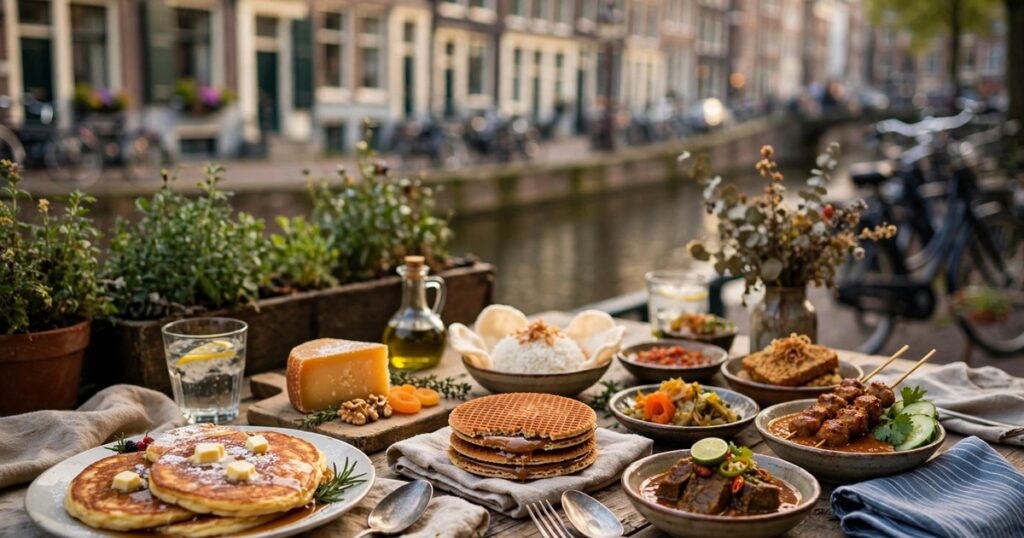
Amsterdam is one of Europe’s most enjoyable cities to eat in, and one of its most surprising. Beyond the postcard canals and bicycle bells, the Dutch capital serves a food scene shaped by centuries of trade: Indonesian rijsttafel beside traditional brown cafés, Surinamese roti shops next to cheese rooms, and some of the best street snacks in Europe sold from tiny stands. It is also a city where eating well does not have to mean spending a fortune — some of the best meals here cost less than a museum ticket.
This guide answers the question every first-time visitor asks — where to eat in Amsterdam — neighbourhood by neighbourhood, dish by dish, and budget by budget. Use it to plan one perfect food day along the canals, or to eat your way through a whole long weekend in the Netherlands’ capital.
Quick Answer: The best places to eat in Amsterdam are the Jordaan for cozy Dutch restaurants and brown cafés, De Pijp for markets and world food, and Amsterdam Oost for Indonesian rijsttafel and Surinamese roti. Try a stroopwafel, raw herring, and a rijsttafel on your first day.
What Should You Eat First in Amsterdam?
If you eat only a handful of things in Amsterdam, make them the city’s classics. First, the stroopwafel: two thin waffles glued together with warm caramel syrup, best eaten fresh from a market stall or a street vendor, when the syrup is still soft and the waffle is warm in your hands. Supermarket stroopwafels are fine, but they are a different food entirely from one pressed to order.
Second, Dutch herring, sold from haring stands across the city. The traditional way to eat it is holding the fillet by the tail, tilting your head back, and taking a bite, with chopped onion and pickles on the side. If that feels too adventurous, ask for it in a soft white roll — a broodje haring — which is how many locals eat it for lunch.
Third, Indonesian rijsttafel, the “rice table”: a feast of many small dishes — satay, rendang, gado gado, sambal, and more — served around a mound of rice. It is a legacy of the Dutch colonial era in Indonesia, and Amsterdam does it better than anywhere outside Indonesia itself. A rijsttafel is a meal to share, so go hungry and go with friends.
Fourth, Dutch cheese. Gouda, aged Edam, and smoky cumin cheeses are sold in cheese shops all over the centre, usually with free tastings. A cheese tasting, followed by a picnic of bread, cheese, and fruit bought at a market, is one of Amsterdam’s simplest and best lunches.
What Are Amsterdam’s Must-Try Dishes?
Amsterdam’s table is Dutch at its core and international by habit. These are the dishes to prioritise:
- Stroopwafel: warm caramel-syrup waffles, best fresh from a market stall, with the syrup still melting.
- Raw herring (haring): lightly cured fish with onion and pickles, eaten from a stand or in a roll.
- Indonesian rijsttafel: a shared feast of many small dishes around rice — satay, rendang, and sambal included.
- Bitterballen: deep-fried, crispy meat croquettes, the classic snack with a drink in a brown café.
- Dutch pancakes (pannenkoeken): large, thin pancakes with sweet or savoury toppings, from apple and bacon to cheese and ham.
- Poffertjes: tiny, fluffy mini-pancakes dusted with powdered sugar and butter, sold at markets and festivals.
- Surinamese roti: flatbread wrapped around curried chicken or vegetables with potatoes and long beans.
- Fries with toppings (patat): thick-cut fries with mayonnaise, satay sauce, or the “patatje oorlog” combination of mayo, satay sauce, and raw onion.
- Apple pie (appeltaart): Dutch apple pie with a crumbly crust, served warm with whipped cream in old cafés.
- Cheese: aged Gouda, cumin cheese, and farmhouse varieties — taste before you buy in any cheese shop.
Where Are the Best Neighbourhoods to Eat in Amsterdam?
Amsterdam’s food map follows its canals and its markets. Each district has its own price level and speciality, and choosing the right one matters more than chasing a single famous restaurant.
| Neighbourhood | Best for | Vibe and prices |
|---|---|---|
| Jordaan | Dutch restaurants, brown cafés, apple pie | Charming and canal-side; mid-range |
| De Pijp | Albert Cuyp Market, world food, casual dining | Lively and local; good value |
| Amsterdam Oost (East) | Indonesian rijsttafel, Surinamese roti, Turkish food | Diverse and relaxed; excellent value |
| Centre / Dam Square area | Street snacks, quick lunches, cheese shops | Busy and touristy; watch prices |
| Amsterdam Noord (North) | Creative restaurants, breweries, waterfront dining | Modern and spacious; mid-range |
| Oud-West | Foodhallen food hall, brunch, international restaurants | Trendy and young; mid-range |
| Amsterdam West / Bos en Lommer | Turkish, Moroccan, and Middle Eastern food | Local and affordable; great for lunch |
Why Is the Jordaan the Best First-Night Choice?
The Jordaan, the old working-class district west of the centre, is Amsterdam’s most atmospheric place to eat on your first night. Narrow streets, canal views, and small restaurants serving Dutch classics make it feel like the Amsterdam of postcards — without the crowds of Dam Square. Book a table for a Dutch dinner of stamppot (mashed potato with vegetables and sausage) or a hearty stew in winter, or a lighter meal of fish and seasonal vegetables in summer, and finish with apple pie in a brown café. Prices run a little higher than in Oost or De Pijp, so treat the Jordaan as your special-evening neighbourhood and save everyday eating for the markets.
What Makes De Pijp Special?
De Pijp is Amsterdam’s everyday eating heart, built around the Albert Cuyp Market, the city’s largest street market. By day, graze the market for stroopwafels, cheese, Surinamese roti, and fresh produce. By evening, the surrounding streets fill with casual restaurants from every cuisine — Middle Eastern, Asian, Latin American, and Dutch — at prices well below the centre. The area is walkable, young, and unpretentious, and it is the easiest place in Amsterdam to eat well without a reservation.
Where Should You Go for Indonesian Food?
Amsterdam’s Indonesian food is a national treasure, and it deserves a dedicated evening. A rijsttafel is the classic choice: many small dishes, mild to fiery, served family-style around rice. Order one rijsttafel for two people to share, rather than one each — the portions are generous, and sharing lets you taste more dishes. If you prefer a single plate, nasi goreng (Indonesian fried rice) or a satay plate with peanut sauce is a safer introduction.
Two tips make the experience better. First, tell the restaurant how spicy you like your food — Indonesian sambal ranges from gentle to seriously hot. Second, book ahead for the best-known Indonesian restaurants, especially on Friday and Saturday nights, when they fill early. Amsterdam Oost has the highest concentration of Indonesian restaurants, and many of the best are small, family-run rooms rather than grand dining halls.
What About Amsterdam’s Markets and Food Halls?
Markets are the best way to taste Amsterdam in one stop. The Albert Cuyp Market in De Pijp runs six days a week (closed Sundays) and sells everything from stroopwafels and cheese to Surinamese roti, Turkish bread, and fresh fish. Go hungry, graze from stall to stall, and build a picnic from what looks best that day.
Foodhallen, the indoor food hall in Oud-West, is the rainy-day alternative: a dozen stalls under one roof serving everything from Dutch bitterballen and burgers to dim sum and vegetarian bowls, with a bar in the middle. It is livelier in the evening, when locals gather for drinks and small plates. Both the market and the food hall are at their best when you treat them as a grazing lunch rather than a formal meal — order a little, walk, and order again.
Where to Eat in Amsterdam on a Budget?
Amsterdam has a reputation for being expensive, but its best-value meals are also its most characteristic. Follow local habits and you will rarely need to spend much.
- Eat the street snacks: herring, fries, and a stroopwafel cost a few euros each and taste more Amsterdam than a sit-down dinner.
- Shop the markets: Albert Cuyp sells picnic supplies — cheese, bread, fruit, and Surinamese roti — for a fraction of restaurant prices.
- Use lunch menus: many restaurants offer a fixed-price lunch that is much cheaper than the same dishes at dinner.
- Try Oost and West for dinner: Indonesian, Turkish, and Moroccan restaurants outside the centre are excellent value.
- Drink Dutch beer: local lager and craft beer are usually cheaper than imported wine by the glass.
- Follow the brown cafés: old Amsterdam pubs serve simple, hearty food — soup, sandwiches, bitterballen — at honest prices, especially at lunch.
Where Should You Go for a Special Occasion?
For a celebration, Amsterdam offers everything from canal-house fine dining in the Jordaan and the centre to creative tasting menus in Noord. The smart move is to book early — the best rooms fill days ahead, especially on weekends — and to choose a place that leans into Dutch and Indonesian ingredients: North Sea fish, aged Gouda, seasonal vegetables, and Indonesian spices will taste far more Amsterdam than an international menu with a Dutch accent.
If a full tasting menu feels too much, book a smarter restaurant in the Jordaan or Oost and order the local classics done exceptionally well: a starter of herring or cheese, a main of seasonal Dutch cooking or rijsttafel, and Dutch apple pie for dessert. Dress smartly but not formally — Amsterdam dining is polished without being stiff — and allow a long evening. A special meal here is not rushed.
How Much Should You Budget for Food in Amsterdam?
Food costs in Amsterdam vary by neighbourhood and time of day, but these ranges will help you plan. Prices below are per person in euros, excluding tip — in the Netherlands, tipping is not obligatory, but rounding up or adding 5 to 10 percent for good service is common.
| Meal | Budget | Mid-range | Splurge |
|---|---|---|---|
| Coffee + pastry breakfast | €5–8 | €8–14 | €15+ |
| Market / street lunch | €8–15 | €15–25 | €25+ |
| Casual dinner (main + drink) | €20–35 | €35–60 | €60+ |
| Rijsttafel for two (per person) | €25–40 | €40–60 | €60+ |
| Fine-dining tasting menu | — | €90–140 | €150+ |
When Should You Eat in Amsterdam?
Amsterdam eats on a relaxed schedule, closer to northern Europe than to the Mediterranean. Lunch runs from about 12 pm to 2 pm; dinner starts around 6 pm, with locals arriving from 7 pm onwards. Many kitchens close between lunch and dinner, so a 4 pm search for a full meal can disappoint — that is the hour for coffee, apple pie, or a market wander instead.
Season matters enormously. Spring is tulip season and the best time for a first visit — terraces reopen and markets fill with asparagus and strawberries. Summer is festival season, when the canals are at their liveliest and food trucks multiply. Autumn brings mushrooms, game, and hearty stews to menus. Winter is stamppot, pea soup (erwtensoep), and cozy brown cafés, when a warm apple pie after a cold canal walk tastes better than anything else in the city.
What Are the Best Day Trips for Food Lovers?
Amsterdam is a superb base for food day trips. Haarlem, twenty minutes by train, offers cheese shops, breweries, and a lovely Saturday market in one of the Netherlands’ prettiest small cities. Utrecht, half an hour away, has canal-side restaurants at water level — a dining experience Amsterdam itself cannot offer. And the fishing villages of Volendam and Marken, to the north, are the place to eat smoked eel and fresh fish by the harbour, and to see the traditional Dutch fishing culture that still shapes Amsterdam’s seafood. Each trip pairs easily with a morning stroopwafel in De Pijp and a late dinner back in Amsterdam.
How Do You Avoid Tourist Traps in Amsterdam?
The busiest streets around Dam Square and the Red Light District hold some of the city’s worst value restaurants: picture menus in many languages, waiters calling you in from the street, and dishes that look Dutch but taste generic. Walk a few blocks in any direction — into the quieter streets of the Jordaan, over to De Pijp, or across the IJ river to Noord — and the cooking improves and the prices fall. Other warning signs include a menu with no prices, a long list of dishes from every cuisine on earth, and a room with no Dutch voices in it. A short menu, a busy local crowd, and a server who asks what you like rather than pushing the most expensive dish are the opposite signals.
Frequently Asked Questions About Eating in Amsterdam
What is the most famous food in Amsterdam?
Stroopwafels, raw herring, and Indonesian rijsttafel are the city’s three most famous foods. Try all three on your first visit — a warm stroopwafel at a market, herring from a stand, and a rijsttafel shared in Amsterdam Oost.
Is Amsterdam expensive for food?
It can be, but it does not have to be. Market food, street snacks, and restaurants in Oost and De Pijp keep costs low; canal-house fine dining and centre restaurants are where prices climb fastest.
Do I need reservations in Amsterdam?
For popular restaurants and rijsttafel rooms, yes — book a few days ahead, and weeks ahead for weekends and special occasions. For market stalls, brown cafés, and casual lunch spots, you can usually walk in.
What time is dinner in Amsterdam?
Dinner starts around 6 pm, with most locals eating from 7 pm onwards. Lunch runs from about 12 pm to 2 pm, and many kitchens close in between.
Where is the best rijsttafel in Amsterdam?
Amsterdam Oost has the highest concentration of Indonesian restaurants, and the best are usually small, family-run rooms rather than large tourist restaurants. Order one rijsttafel for two to share, and tell the restaurant how spicy you like your food.
What is a brown café?
A brown café (bruin café) is a traditional Dutch pub with dark wood, low light, and a cozy, lived-in feel. They serve beer, coffee, and simple hearty food such as bitterballen, soup, and sandwiches, and they are among the most atmospheric places to eat and drink in Amsterdam.
Is Amsterdam good for vegetarians?
Yes, with a little planning. Indonesian gado gado, Surinamese vegetable roti, market produce, and cheese are excellent meat-free options, and most restaurants in De Pijp and Oud-West offer vegetarian dishes. Traditional Dutch menus can be meat-heavy, so check the menu before sitting down.
Plan Your Amsterdam Food Trip
Amsterdam rewards the traveller who eats like a local: one warm stroopwafel, one herring from a stand, one shared rijsttafel, and one market wander. Start in De Pijp, spend an evening in the Jordaan, and save a second day for the district you liked best. For more city food guides, see our Food Guides hub, plus Where to Eat in Paris and Where to Eat in Rome, and our newest European guide, Where to Eat in Madrid. Amsterdam is not Europe’s loudest food city — it is one of its most flavourful, and one good meal here tends to turn into a return trip.

I’m Lila Spoonbelle, your host on this flavorful ride through food, fun, and fearless puns. Let’s turn every bite into a burst of laughter!