
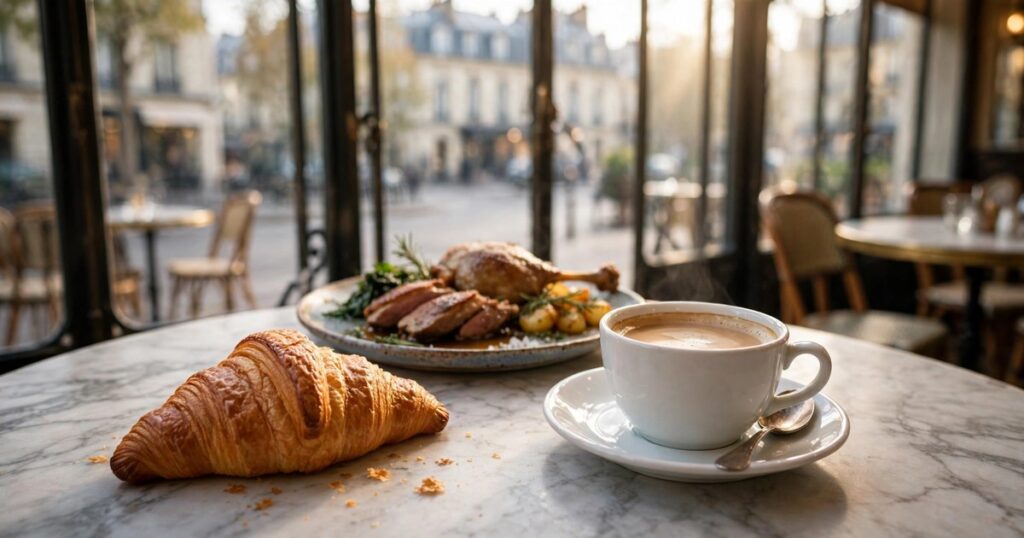
Paris is the one city where a simple lunch can ruin every lunch that comes after it. This is the city that invented the restaurant — the brasserie, the bistro, the bouillon — and three hundred years later it still sets the standard for how the world eats. Every arrondissement has its own personality at the table: the food-obsessed Marais, the old-money brasseries of Saint-Germain, the wine bars of Bastille, the village-like streets of Batignolles. Here’s how to eat your way through it without wasting a single meal.
Quick Answer: The best places to eat in Paris range from legendary bakeries like Du Pain et des Idées and Utopie to affordable classics like Bouillon Chartier and Bouillon Pigalle, plus food-obsessed bistros like Le Servan, street food at L’As du Fallafel and Breizh Café, and markets like Marché d’Aligre and Marché des Enfants Rouges. Spend your mornings at boulangeries, your lunches at brasseries, and at least one evening at a modern bistro — that’s the perfect Paris day.
Before you book a single table, browse our Food Guides hub for more city-by-city eating guides built the same way: neighborhood by neighborhood, with the tourist traps filtered out.
What is the difference between a bistro, a brasserie, and a bouillon?
This is the first thing to learn, because these three words describe very different meals. A bistro is a small, intimate neighborhood restaurant — maybe thirty seats, a short handwritten menu that changes with the market, the chef’s mother in the kitchen. Bistros are where you find the best duck confit and the coziest dinners.
A brasserie is the grand, bustling, open-late institution: high ceilings, mirrors, mosaic floors, hundreds of seats, and a huge menu — choucroute, steak frites, oysters, onion soup — served from breakfast to midnight. Brasseries are perfect when you’re hungry at odd hours and want the full Paris theater.
A bouillon is Paris’s best-kept secret: the 19th-century workers’ canteens, now revived, serving classic French dishes at shockingly low prices. Boeuf bourguignon for €12, oeufs mayonnaise for €2. Bouillon Chartier (the Grands Boulevards original, gorgeous Belle Époque dining room) and Bouillon Pigalle are both institutions — expect a wait, but dinner for two can come in under €40.
Which Paris neighborhoods are best for food lovers?
Paris rewards neighborhood-level exploration. You could plan a whole trip around eating your way from the Marais to Montmartre without ever taking the metro.
- Le Marais (3rd/4th) — The food-nerd heart of Paris. L’As du Fallafel on Rue des Rosiers, Breizh Café for galettes, Libi for modern Israeli, Jacques Genin for chocolate. Historic streets, endless wandering, and arguably the densest concentration of great casual eats in the city.
- Saint-Germain-des-Prés (6th) — The classic Left Bank: grand brasseries (Le Procope, one of the world’s oldest restaurants), the literary cafés (Les Deux Magots, Café de Flore), and the Bon Marché food hall, La Grande Épicerie, for edible souvenirs.
- Montmartre (18th) — Tourist-crowded around Sacré-Cœur, but a few streets away it’s a real neighborhood. Boulangeries, wine bars, and sunset views. Bouillon Pigalle anchors the southern edge with its bargain French classics.
- Bastille (11th) — The young, buzzy restaurant quarter: modern bistros, natural wine bars, some of the city’s most exciting cooking right now. Le Servan is here — a must-book for serious eaters.
- Batignolles (17th) — The village-y, local-feeling neighborhood north of Parc Monceau: market streets, fromageries, and bistros where the staff remember your name. A taste of how actual Parisians eat daily.
- Belleville (20th) — Multicultural and affordable: excellent Vietnamese, Chinese, and North African food, plus the hipster wine-bar scene along Rue de Belleville. Great budget territory.
| Neighborhood | Best for | Budget level | Book ahead? |
|---|---|---|---|
| Le Marais | Casual eats, falafel, bakeries | €€ | No for lunch, yes for dinner spots |
| Saint-Germain | Grand brasseries, literary cafés | €€€ | Yes for brasseries |
| Montmartre | Bistro lunches, views | €€ | Rarely needed |
| Bastille | Modern bistros, wine bars | €€ | Yes — these fill up |
| Batignolles | Local markets, fromageries | €–€€ | No |
| Belleville | Budget multicultural food | € | No |
Where can I find the best croissants in Paris?
The croissant is Paris’s daily miracle, and the best ones are worth planning your morning around. Du Pain et des Idées in the 10th arrondissement is the legend — the pain des amis and escargot pistache-chocolat alone are worth crossing town for. Utopie in the 11th does a famously flaky, deeply caramelized croissant. For the ultimate French-Japanese fusion, Sadaharu Aoki in the 6th is a pastry laboratory.
One insider note: in Paris, a croissant and a pain au chocolat are viennoiseries, not bread — they’re made by lamination, not fermentation. Go before 9 a.m. for the best selection, and don’t be surprised when a proper boulangerie sells out by noon.
What classic French dishes should I try in Paris?
Some dishes you can only truly understand in Paris, made properly. Work through this list:
- Duck confit — The bistro classic: salt-cured duck leg cooked low and slow in its own fat until the meat falls off the bone. Try it at any good bistro, or at Le Servan where the modern take is superb.
- Steak frites — Not just any steak and fries: the brasserie version means a proper entrecôte with a peppery sauce and twice-cooked frites. Le Relais de Venise is the cult favorite.
- Boeuf bourguignon — Burgundy beef stew, slow-braised in red wine. Best at a bouillon (Bouillon Chartier does a solid one for almost nothing) or a classic brasserie.
- Ratatouille — The Provençal vegetable stew, elevated to art in a good bistro. In season (summer), it’s everywhere and wonderful.
- Coq au vin — Chicken braised in red wine with mushrooms and lardons. Order it at a traditional brasserie like Le Procope.
- Escargots — Order them once at a classic place, in garlic-herb butter, with bread. You’ll either love them or have a great story.
- Oeufs mayonnaise — The €2 bouillon appetizer that’s become a Paris obsession: a halved hard-boiled egg with house-made mayonnaise. Simplicity done perfectly.
What are the best food markets in Paris?
Parisian markets are half the reason to visit. Two are essential.
Marché d’Aligre (12th) is the city’s great covered-and-street market combo: the Beauvau covered hall plus the sprawling outdoor stalls on Rue d’Aligre. Cheese, charcuterie, produce, North African and Middle Eastern stalls — this is where real Parisians shop. Go on a weekend morning.
Marché des Enfants Rouges (3rd, in the Marais) is Paris’s oldest covered market (1615), now a fantastic lunch hall: Moroccan, Italian, Japanese, Lebanese, and French stalls around communal tables. Arrive hungry around noon and graze.
Honorable mentions: Marché Bastille (Thursday/Sunday, one of the biggest street markets), Rue Mouffetard (the famous market street in the Latin Quarter), and La Grande Épicerie at Le Bon Marché for luxury food shopping and gifts.
How can I eat well in Paris on a budget?
Paris has a reputation for expense, but the budget food is genuinely excellent — you just have to know where it hides.
- Bouillons — The cheapest real French meal in the city. Full dinner at Bouillon Chartier or Bouillon Pigalle: €15–25 per person with wine.
- Boulangerie lunches — A fresh baguette sandwich (jambon-beurre: ham, butter, cornichons — Paris’s perfect sandwich) plus a pastry: under €10.
- Falafel on Rue des Rosiers — L’As du Fallafel in the Marais: a legendary falafel pita for under €10. The line moves fast.
- Galettes at Breizh Café — Buckwheat crêpes with serious fillings (the Andouille de Guéméné galette is famous), lunch for around €12–15.
- Marché lunches — Marché des Enfants Rouges: a full, delicious lunch from the stalls for €12–18.
- Formule midi — Many bistros offer a fixed lunch menu (starter + main, or main + dessert) for €18–28. Always ask for the formule.
Can I experience fine dining in Paris without the huge bill?
Yes — Paris has cracked the code on accessible fine dining. The lunch menu is the key: many Michelin-starred and neo-bistro restaurants offer formule déjeuner (fixed lunch menus) at a fraction of dinner prices — often €45–85 for three courses at restaurants that charge €150+ at dinner.
Le Servan (Bastille) is the current darling: the weekday lunch menu is one of the best deals in Paris, with brilliant modern cooking. Ernest and Substance in the 17th offer serious chef cooking at neighborhood prices. And Helmut Newcake plus Chambelland prove that Paris’s gluten-free pastry scene is world-class too.
For the full grand experience on a relative budget, book Septime (one Michelin star) far ahead — or its casual sibling Septime la Cave. Planning matters more than spending: the best deals book out weeks ahead.
What is the difference between a boulangerie and a pâtisserie?
A boulangerie makes bread — legally, the designation means they bake their bread on-site from raw dough. Look for the sign artisan boulanger: it guarantees the bread is made in-house, not from frozen industrial dough. Your morning baguette and croissant come from here.
A pâtisserie makes sweets — cakes, tarts, éclairs, macarons. The great ones are temples: Cédric Grolet (the trompe-l’œil fruit desserts), Pierre Hermé (the macaron master, and his ispahan is famous), Jacques Genin (chocolates and caramels in the Marais).
Many shops do both (boulangerie-pâtisserie), and in the best of them, you can build a perfect breakfast or afternoon goûter without going anywhere else.
What café etiquette should visitors know?
Parisian café culture runs on unwritten rules, and knowing them makes everything smoother. Terrasse vs. salle vs. comptoir: sitting at the terrace or in the dining room (salle) costs more than standing at the counter (comptoir) — the price list literally shows three different prices. For a quick espresso, stand at the comptoir like a local.
Order a café (espresso) after meals, never a milky coffee — cappuccinos and café crèmes are morning drinks. Say bonjour when entering any shop; it’s considered rude not to. Service is included in French restaurants (service compris), so tipping is optional — rounding up or leaving a few euros for great service is the norm, not 15–20%.
And the golden rule: nobody will rush you. A single coffee buys your table for as long as you like. That unhurried hour on the terrasse, watching Paris go by, is one of the city’s great free pleasures.
How much does food cost in Paris per day?
It depends entirely on how you play it, but here are honest daily food budgets for 2026:
- Budget (€35–60/day): Boulangerie breakfast (€5), market or falafel lunch (€10–15), bouillon or crêperie dinner (€15–25).
- Mid-range (€80–140/day): Café breakfast (€10), formule midi lunch at a bistro (€20–30), brasserie dinner with wine (€40–70).
- Splurge (€180–300+/day): Grand café breakfast, Michelin lunch formule (€60–90), fine-dining dinner (€120–200+).
The sweet spot for most visitors: splurge on one great dinner, eat lunch at bistros (the formule midi is always the value play), and let boulangeries handle breakfast. You’ll eat extremely well for €70–90 a day.
How do I avoid tourist traps when eating in Paris?
The traps are predictable once you know the signs. Red flags: a tout outside beckoning you in, laminated menus in six languages with photos of the food, a location directly facing a major monument (the Louvre-facing cafés, the Champs-Élysées strip), and “menu touristique” boards shouting in English.
The fixes: walk one or two streets behind the monument — the quality jumps and prices drop immediately. Eat where the menu is only in French (or French plus one translation). Follow the lunch crowd of office workers at noon — they never eat badly. And remember: a great Paris meal rarely needs a view. The tiny bistro on the side street almost always beats the terrace facing the tower.
If you’re still building your food-travel skills, our guide to where to eat in Nashville uses the same neighborhood-by-neighborhood method for a very different food city — the technique travels well.
Frequently Asked Questions
What is the best area to stay in Paris for food?
The Marais (3rd/4th) for the densest casual-eats scene, Bastille (11th) for modern bistros and wine bars, or Saint-Germain (6th) for grand brasseries and classic cafés. Any of the three puts great food within a ten-minute walk.
Do I need to book restaurants in Paris in advance?
For popular bistros (Le Servan, Septime) and weekend dinners: yes, days or weeks ahead. For brasseries, bouillons, and lunch: usually not, though bouillons have queues at peak hours — go early or late.
Is Paris expensive for food?
It can be, but excellent budget options exist: bouillons (€15–25 dinners), boulangerie lunches (under €10), and market food (€12–18). A great day of eating costs €70–90 if you use the lunch formule and skip the monument-facing cafés.
What should I eat for breakfast in Paris?
A croissant or pain au chocolat from a proper artisan boulangerie, with a café crème. Du Pain et des Idées, Utopie, and Libi are top picks. Skip hotel breakfasts — the corner bakery is always better and cheaper.
Where do locals actually eat in Paris?
Neighborhood bistros in Batignolles and Belleville, bouillons like Bouillon Chartier, market lunches at Marché des Enfants Rouges, and wine bars in the 11th. The rule: follow office workers at lunch and avoid anywhere with a tout outside.
What is the most famous dessert in Paris?
The croissant is breakfast, not dessert — for dessert, try the Paris-Brest, opéra cake, tarte tatin, or Pierre Hermé’s ispahan. For the full spectacle, Cédric Grolet’s trompe-l’œil fruit pastries are the current icons.
Can I drink tap water in Paris restaurants?
Yes — Paris tap water is excellent and safe. Ask for une carafe d’eau (a carafe of water) and it’s free by law. Never feel pressured to buy bottled water; ordering tap water is completely normal, even at nice restaurants.
However you eat your way through the city — one boulangerie at a time, one brasserie terrace at a time — Paris rewards the curious. Skip the line at the monument-facing café, turn down the side street, and order the thing you can’t pronounce. As a final comparison for your food-travel instincts, see our guide to where to eat in New Orleans — a city with its own centuries-deep food culture and the same love of eating well for its own sake.
I’m Lila Spoonbelle, your host on this flavorful ride through food, fun, and fearless puns. Let’s turn every bite into a burst of laughter!