
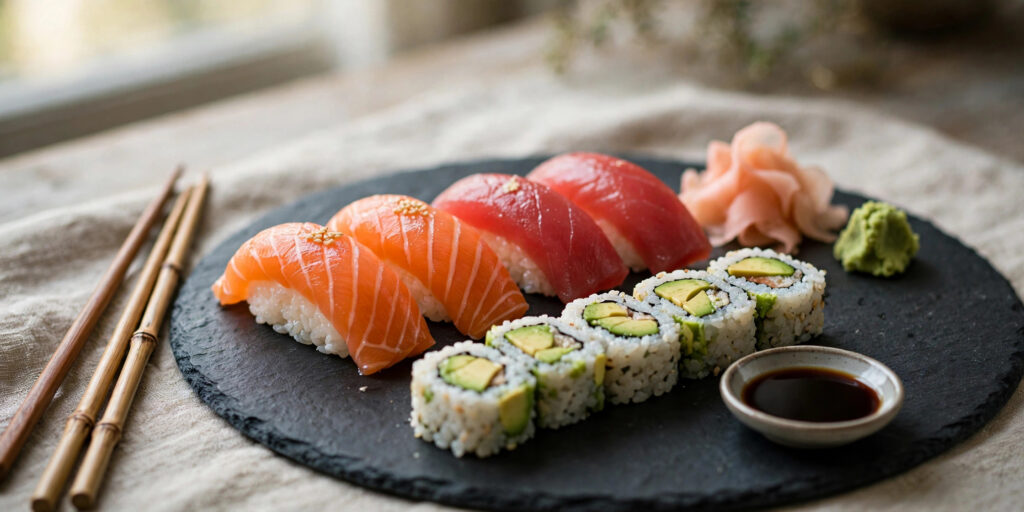
Sushi is one of the most loved foods in America — and one of the most confusing for halal eaters. At first glance it looks like the safest cuisine in the world: fresh fish, rice, seaweed and vegetables, with no pork in sight. But ask “is sushi halal?” and the answer is never a simple yes or no. The fish is usually fine. The trouble hides in the rice seasoning, the sauces, the imitation crab and the shared cutting board. This halal sushi guide explains exactly what makes sushi halal, what to watch out for, and where to find verified halal sushi restaurants across the United States in 2026 — from a fully halal Japanese grill in California to a halal sushi bar in Queens.
Is Sushi Halal?
Yes, sushi can be halal — but not every roll on every menu is. The core of sushi is fish and seafood, and fish is generally considered halal in Islam, so a simple piece of salmon nigiri or a tuna roll made with plain ingredients is halal for most Muslims. The problems start with what goes around the fish. Sushi rice is traditionally seasoned with a mixture that often includes mirin, a sweet rice wine that contains alcohol. Many sauces — spicy mayo, eel sauce, ponzu and some soy-based glazes — can contain alcohol, mirin or sake. Imitation crab, the pink-and-white filling in California rolls, is a processed fish product that often contains non-halal additives, flavourings or pork-derived ingredients. And in a busy sushi kitchen, your halal roll may be cut on the same board, with the same knife, as a roll containing pork, non-halal meat or alcohol.
That is why the honest answer to “is sushi halal?” is always “it depends on the roll and the restaurant.” At a fully halal sushi restaurant, the whole kitchen is set up to avoid these problems: the rice is seasoned without mirin, the sauces are alcohol-free, the imitation crab is replaced with real crab or a halal alternative, and nothing non-halal ever touches the prep surfaces. At a regular sushi bar, you have to check roll by roll — and some rolls will simply be off the menu for you. If you are new to eating halal in American cities, our halal food guide to Dearborn is a useful starting point, because Dearborn has one of the most developed halal dining scenes in the country.
What Makes Sushi Not Halal?
Four things can turn an otherwise innocent-looking roll into something a halal eater should skip. Knowing them by name makes ordering far easier, because you can ask about each one directly instead of relying on a vague “is this halal?”
- Mirin and sake in the rice and sauces: Mirin is a sweet cooking wine made from rice, and it is the classic seasoning for sushi rice, teriyaki glaze, eel sauce and many marinades. Sake, or rice wine, shows up in sauces, soups and some cooked dishes. Both contain alcohol, and both are used in most mainstream sushi restaurants. A halal sushi kitchen replaces mirin with a halal rice-vinegar seasoning instead — this is the single most important question to ask.
- Alcohol in sauces and dressings: Spicy mayo is usually fine, but eel sauce, ponzu, some soy sauces and house dressings can contain mirin, sake or other alcohol. Always ask whether the sauce on a roll is alcohol-free, and skip the sauce if the server is unsure.
- Imitation crab (kani): The crab sticks in California rolls, crab salads and many “crab” rolls are not crab at all. They are surimi — processed fish paste — and the recipe often includes non-halal flavourings, additives and sometimes pork-derived ingredients. Real crab is fine; imitation crab needs checking every time.
- Non-halal meat and cross-contamination: Some rolls contain chicken, beef, pork belly or bacon, and some kitchens cook halal and non-halal items on the same grill, the same cutting board or with the same knife. Even a fish-only roll can pick up traces if the board was just used for a pork roll. Fully halal restaurants solve this by keeping non-halal ingredients out of the kitchen entirely.
The practical rule is simple: check roll by roll, not just by restaurant name. A restaurant can serve perfectly halal salmon nigiri and, on the same menu, a roll you should never order. The table below summarises the most common sushi ingredients so you can scan a menu with confidence.
Which Sushi Ingredients Are Safe — and Which Are Risky?
Use this table as a quick reference when you read a sushi menu. “Safe” means the ingredient is normally halal; “check first” means it depends on the recipe or the supplier; “risky” means it usually contains alcohol or non-halal ingredients and you should ask before ordering.
| Ingredient | Typical Status | Why |
|---|---|---|
| Fresh fish (salmon, tuna, yellowtail, snapper) | Safe | Fish and seafood are generally halal; the risk is in the sauces and prep, not the fish itself |
| Shrimp, crab (real), scallops, squid | Safe | Seafood is generally halal, though some scholars differ on shellfish — follow your own school |
| Seaweed (nori), rice, cucumber, avocado, vegetables | Safe | Plain plant ingredients with no hidden alcohol or animal products |
| Sushi rice seasoning | Check first | Often made with mirin (rice wine); halal kitchens use a mirin-free rice vinegar instead |
| Soy sauce | Check first | Most soy sauce is fine, but some varieties are brewed with alcohol — ask or check the label |
| Spicy mayo, eel sauce, ponzu | Check first | May contain mirin, sake or alcohol-based flavourings depending on the house recipe |
| Imitation crab (kani / surimi) | Risky | Processed fish paste that often contains non-halal flavourings or pork-derived ingredients |
| Mirin, sake, cooking wine | Risky | Alcohol-based; used in rice seasoning, glazes, marinades and soups at most mainstream sushi bars |
| Chicken, beef or pork in rolls | Check first | Only halal if the meat is zabiha halal; pork is never halal, and beef or chicken must be certified |
| Tempura batter and frying oil | Check first | Usually fine, but ask whether the oil is shared with non-halal items or whether the batter contains alcohol |
How Can You Tell If a Sushi Restaurant Is Really Halal?
“Halal” on a sign or a delivery listing does not always mean the same thing. Some restaurants are certified by a recognised halal body, some buy certified meat but hold no restaurant-level certificate, and some simply describe themselves as halal. None of that automatically makes a place bad — but it does mean you should check in a way that matches your own standards. Here is a routine that takes about two minutes:
- Look for a certificate or a clear statement on the website. The best halal sushi restaurants say so plainly on their own site — Wakatobi, for example, states it is 100% halal and that its beef and chicken are zabiha hand-slaughtered. A restaurant that hides its halal claim in a footnote is worth a phone call.
- Ask about the rice. “Do you use mirin in your sushi rice?” is the single most revealing question you can ask at a sushi bar. A halal kitchen will answer immediately — usually that it uses a halal rice vinegar instead — while a mainstream kitchen may not even know what is in its seasoning mix.
- Ask about the imitation crab. If the restaurant uses imitation crab, ask what is in it and whether it is halal-certified. Better still, order rolls made with real crab, salmon, tuna or shrimp instead.
- Ask about the sauces. Eel sauce, ponzu and house dressings are the usual hiding places for mirin and sake. If the server cannot confirm a sauce is alcohol-free, order the roll without it.
- Ask about meat and cross-contamination. If the menu includes chicken or beef, ask whether it is zabiha halal, and ask whether the sushi is prepared on a separate board from any pork or non-halal items. At a partially halal restaurant, ask the chef to clean the grill or board before your order — some places, like Tokyo Hibachi in Queens, do exactly that on request.
- Use the community apps. Zabihah and HalalTrip list user-verified halal spots and flag when a claim is the business’s own statement rather than a third-party certification. Reviews from other Muslim diners are often the fastest way to find out what a restaurant actually does.
One more honest note: even at a fully halal restaurant, it is worth asking whether alcohol is served. Some fully halal kitchens serve no alcohol at all, while others serve it alongside halal food. If an alcohol-free environment matters to you, check the drinks menu or call ahead before visiting.
Where Can You Find Halal Sushi in the US?
Below are the halal sushi spots we verified for this guide. Every entry is based on the restaurant’s own website, a review that reports its halal status, or both — and where a spot’s certification is less clear-cut, we say so. A few of these are fully halal Japanese restaurants; one is only partially halal, and we flag it clearly. Addresses, hours and menus change, so check first before making a special trip. For more halal eating in the biggest cities, see our best halal restaurants in New York City and our halal food guide to Chicago.
1. Wakatobi Japanese Grill — Newark & Seaside, California
Address: 35201 Newark Blvd Suite F, Newark, CA 94560, (510) 894-6155; second location at 1130 Fremont Blvd Suite 102A, Seaside, CA 93955, (831) 713-2223 | What to order: Wanci, Kaledupa, Tomia or Binongko sushi platters (chef’s-choice nigiri and rolls)
The benchmark for halal sushi in America. Wakatobi’s official site states the restaurant is 100% halal: its beef and chicken are zabiha hand-slaughtered, no pork is served, and no alcohol is served or used in cooking. That last point matters more at a sushi bar than almost anywhere else, because it means the rice seasoning and the sauces are made without mirin or sake. The sushi platters — named Wanci, Kaledupa, Tomia and Binongko after Indonesian islands — are chef’s-choice selections of nigiri and rolls, and they are the order to get if you want to taste the range of the kitchen. Hours are listed as Monday to Thursday 12:00–11:00 PM, Friday 3:00–11:30 PM, and Saturday to Sunday 12:30–11:30 PM — check first, as hours can change.
2. Eve’s Sushi & Hibachi — Woodhaven, Michigan
Address: Woodhaven, Michigan | What to order: the 24k Roll (salmon, tuna, yellowtail, avocado, spicy mayo, 24k edible gold leaf), fresh sushi rolls, hibachi, ramen
A modern Japanese restaurant in the Detroit area with a fully halal menu — the restaurant’s official site describes its menu as 100% halal. Alongside the sushi, Eve’s serves hibachi and ramen, which makes it a good pick for a group where not everyone wants raw fish. The signature is the 24k Roll: salmon, tuna, yellowtail and avocado with spicy mayo, finished with 24k edible gold leaf. It is a showpiece, but the everyday fresh rolls are the reason to come back. Confirm the exact address and current hours on the restaurant’s site before you go, as listings can change.
3. Isuka Hibachi Express and Sushi — Indianapolis, Indiana
Address: 32 E 16th St, Indianapolis, Indiana | What to order: specialty rolls, nigiri, sashimi, tempura, hibachi platters, noodle bowls
One of the only halal sushi menus in Indiana, and a genuinely useful find for anyone travelling through the Midwest. Isuka’s chicken and meat are certified halal, and — helpfully — non-halal items on the menu are marked clearly, so you can see at a glance what is safe. The menu covers specialty rolls, nigiri, sashimi, noodle bowls, tempura and hibachi platters, so it works for a full family meal rather than just a sushi snack. Weekday hours start from 11 AM Monday to Thursday, with a later opening on Friday and midday starts at the weekend — check first for the current schedule.
4. Nori Island — Peachtree Corners, Georgia
Address: 5145 Peachtree Pkwy STE 455, Peachtree Corners, GA 30092 | What to order: Island Crunch Roll (crab salad, cucumber, avocado, crispy onion), Spicy Salmon Roll, Shrimp Tempura Roll, halal beef ramen
Atlanta’s answer to halal sushi: Nori Island is 100% halal across its hibachi, ramen and sushi menus. The Island Crunch Roll — crab salad, cucumber, avocado and crispy onion — is the house signature, and the Spicy Salmon Roll and Shrimp Tempura Roll are the safe, crowd-pleasing orders. The halal beef ramen is worth ordering too, especially if someone in your group is not in a sushi mood. Delivery and pickup are available, which makes it an easy weeknight option for the Peachtree Corners area.
5. Saka Sushi and Asian Cuisine — Jamaica, Queens, New York
Address: 83-34 Parsons Blvd, Jamaica, NY 11432 | What to order: crazy dragon roll, unicorn roll, tuna scallion rolls, chicken teriyaki bento
Reviewers report that this Queens sushi spot is now completely halal, with a halal sticker on the window and no pork on the menu. The specialty rolls are the draw — the crazy dragon roll and the unicorn roll are the ones regulars name first — along with tuna scallion rolls and a chicken teriyaki bento that comes in under $20. Hours are listed as Monday closed, Tuesday to Thursday 11:30 AM–9:30 PM, Friday to Saturday 11:30 AM–10 PM, and Sunday 12:30–9:30 PM; check first, as the bento price and hours can change. Pair a visit with our best halal restaurants in New York City guide for the rest of the day.
6. Halal Hibachi Bites — Jamaica, Queens, New York
Address: 180-06 Hillside Ave, Jamaica, NY 11432 | What to order: shrimp tempura roll, dragon roll, spider roll, chicken karaage, hibachi with shrimp, salmon, chicken or steak
A new halal Japanese hibachi and sushi spot in Queens, and a sign of how fast the halal sushi scene is growing. The menu runs from hibachi — shrimp, lobster, salmon, chicken or steak — to sushi rolls including the shrimp tempura roll, dragon roll and spider roll, plus chicken karaage for the table. The drinks are alcohol-free by design: virgin mango daiquiri, virgin pina colada and Ramune, the Japanese marble soda. It is a small, new operation, so check its social pages or call ahead for current hours before you visit.
7. Bonsai Hibachi and Sushi — Sugar Land & Cypress, Houston, Texas
Address: Sugar Land (and Cypress), Houston, TX | What to order: spicy Philly cheesesteak roll, Copperfield roll, shaggy dog, house delight, hibachi beef or chicken with fried rice
Houston’s fully halal hibachi and sushi restaurant, with locations in Sugar Land and Cypress. The rolls get the most praise from reviewers — the spicy Philly cheesesteak roll, the Copperfield roll, the shaggy dog and the house delight are the ones to ask for — and the hibachi beef and chicken with fried rice are the hearty alternative. Happy hour runs all day, and the mocktails (pina colada, mango and lychee) are alcohol-free. Two practical notes: grill seating requires at least two hibachi entrees, and the restaurant has been reported as BYOB while awaiting a liquor licence — so check first on the current alcohol policy if an alcohol-free environment matters to you.
8. Wu’s House (Wus House) — Naperville, Illinois
Address: Naperville, IL (Chicagoland) | What to order: sushi, hibachi, Chinese and Thai dishes, boba
A Chicagoland favourite that covers sushi, hibachi, Chinese and Thai food under one roof — useful when a group cannot agree on one cuisine. A TikTok review reports that everything at Wu’s House is halal certified, and that the certificate can be shown on request, which is exactly the kind of transparency to look for. The live hibachi cooking at the table is the experience to book, and the boba drinks round out the meal. If you are in the Chicago area, read our halal food guide to Chicago for the wider scene, and ask in store to see the certificate if you need it.
9. Tokyo Hibachi Steak House & Sushi — Fresh Meadows, Queens, New York
Address: 184-16 Horace Harding Expressway, Fresh Meadows, NY 11365, (718) 463-2999 | What to order: halal meat hibachi or sushi — only after asking first
Important: this one is only partially halal, so read this entry carefully. Tokyo Hibachi does offer halal meat on request — it sources zabiha meat from the halal shop next door, and the chef cleans the grill before cooking halal orders. But alcohol is served here, and not everything on the menu is halal, so this is an “ask first” restaurant, not a fully halal one. If you go, tell the staff clearly that you need halal meat, confirm which dishes can be made halal, and ask them to clean the grill or board before your order. For a fully halal meal in Queens, the two Jamaica spots above are the safer choice.
10. Maki Ramen — Halal Sushi Policy (Check Your Nearest Location)
Address: No verified street address from our research — check the chain’s site for your nearest location | What to order: sushi rolls, ramen
Maki Ramen is included here not as a single address but as a chain-wide policy worth knowing about. The chain’s halal inserts state: “All of our sushi is halal. The vinegar and mirin we use in our sushi is all halal!” That is exactly the kind of specific, ingredient-level statement halal eaters should look for — it names the rice seasoning, which is the usual problem. Because we could not verify a single street address for the chain from our research, we are not listing one: check first for your nearest location, confirm the halal policy still applies there, and ask in store before ordering.
| Restaurant | City | Halal Status | What to Order |
|---|---|---|---|
| Wakatobi Japanese Grill | Newark & Seaside, CA | 100% halal; zabiha hand-slaughtered meat; no pork, no alcohol | Wanci, Kaledupa, Tomia or Binongko sushi platters |
| Eve’s Sushi & Hibachi | Woodhaven, MI | Fully halal menu, per the restaurant | 24k Roll, fresh sushi rolls, hibachi, ramen |
| Isuka Hibachi Express and Sushi | Indianapolis, IN | Chicken and meat certified halal; non-halal items marked | Specialty rolls, nigiri, sashimi, hibachi platters |
| Nori Island | Peachtree Corners, GA | 100% halal hibachi, ramen and sushi | Island Crunch Roll, Spicy Salmon Roll, halal beef ramen |
| Saka Sushi and Asian Cuisine | Jamaica, Queens, NY | Completely halal, per reviewers; halal sticker on window | Crazy dragon roll, unicorn roll, chicken teriyaki bento |
| Halal Hibachi Bites | Jamaica, Queens, NY | Halal Japanese hibachi & sushi spot | Shrimp tempura roll, dragon roll, chicken karaage |
| Bonsai Hibachi and Sushi | Sugar Land / Cypress, TX | Fully halal; check first on alcohol / BYOB policy | Spicy Philly cheesesteak roll, Copperfield roll, hibachi |
| Wu’s House | Naperville, IL | Everything halal certified, per review; certificate on request | Sushi, live hibachi, Chinese and Thai dishes, boba |
| Tokyo Hibachi Steak House & Sushi | Fresh Meadows, Queens, NY | PARTIALLY halal — halal meat on request only; alcohol served | Ask first; halal meat hibachi or sushi only |
| Maki Ramen | Chain — check nearest location | Chain states all sushi is halal; verify per location | Sushi rolls, ramen |
Which US Cities Are Best for Halal Sushi?
Halal sushi is still a young scene, and it clusters where large Muslim communities meet a strong Japanese food culture. Here is how the map looks in 2026:
- New York City — the deepest bench. Queens alone has three entries in this guide: Saka Sushi and Halal Hibachi Bites in Jamaica, plus the partially halal Tokyo Hibachi in Fresh Meadows. Add the city’s wider halal restaurant base — see our best halal restaurants in New York City — and New York is the best city in the country for halal sushi right now.
- Houston, Texas — the rising scene. Bonsai in Sugar Land and Cypress gives Houston a proper fully halal hibachi and sushi restaurant, and the city’s enormous halal food scene — including the halal tacos in our best halal tacos in the US guide — makes it an easy food-trip destination.
- San Francisco Bay Area — the benchmark. Wakatobi in Newark (and its Seaside location) sets the standard for what a fully halal Japanese restaurant should be: 100% halal, zabiha meat, no pork and no alcohol in cooking. It is the single most trustworthy halal sushi spot in this guide.
- Detroit area, Michigan — the community pick. Eve’s Sushi & Hibachi in Woodhaven serves the Detroit area’s large Muslim community, and Dearborn — one of the most halal-friendly cities in America — is a short drive away. Start with our halal food guide to Dearborn if you are planning a trip.
- Chicago area, Illinois — the suburban find. Wu’s House in Naperville is the Chicagoland pick, and the city’s wider halal scene is covered in our halal food guide to Chicago.
- Atlanta, Georgia — the newcomer. Nori Island in Peachtree Corners is a strong single entry, and proof that halal sushi is spreading beyond the biggest coastal cities.
- Indianapolis, Indiana — the gap-filler. Isuka is one of the only halal sushi menus in the state, which makes it valuable precisely because the Midwest has so few options. If you live in a city with no halal sushi restaurant at all, the home recipe section below is for you.
For a broader look at where to eat halal across the country, browse the rest of our Food Guides — including city guides for Dearborn, New York and Chicago, and our halal travel guide for eating halal on the road.
What Should You Order at a Halal Sushi Restaurant?
If it is your first time at a halal sushi restaurant, these are the safest and most rewarding orders — and the ones most likely to be made with halal-safe ingredients:
Salmon and Tuna Nigiri
The simplest test of a sushi kitchen: a slice of fresh fish over seasoned rice. At a fully halal restaurant the rice is seasoned without mirin, so nigiri is the cleanest order on the menu. If the fish tastes fresh and the rice is lightly seasoned rather than sweet, the kitchen is doing it right.
Spicy Salmon and Spicy Tuna Rolls
The most popular rolls in America, and safe at a halal sushi bar as long as the spicy mayo is alcohol-free — ask once and you will know for the whole menu. The heat comes from sriracha and mayo, not from any hidden wine.
California Roll — With Real Crab
The classic California roll is only safe if it is made with real crab. At a halal sushi restaurant, ask whether the crab is real or imitation: a good halal kitchen will either use real crab or a verified halal alternative. If the answer is vague, order a salmon or tuna roll instead.
Tempura Rolls
Shrimp tempura rolls and soft-shell crab rolls are a good choice when the batter and oil are clean — ask whether the frying oil is shared with non-halal items. The crunch of tempura against cool avocado and cucumber is one of the best textures in sushi.
Hibachi and Ramen as a Backup
Not everyone in your group will want raw fish, and that is fine: most halal sushi restaurants also serve hibachi and ramen. At Wakatobi, Eve’s, Isuka, Nori Island and Bonsai, the hibachi and ramen are made in the same halal kitchen, so a mixed group can eat together without anyone compromising.
Can You Eat Sushi at a Regular (Non-Halal) Restaurant?
Sometimes — but only with care, and only if you are comfortable asking questions. Here is how to think about it:
Plain fish nigiri and simple salmon or tuna rolls are the lowest-risk orders at a mainstream sushi bar, because the fish itself is halal. The risks are the rice seasoning (often mirin), the sauces (eel sauce and ponzu often contain mirin or sake), the imitation crab, and the shared cutting board and knife. Some mainstream restaurants will make a roll without sauce, or prepare it on a clean board if you ask — but many will not, or will not know what is in their seasoning mix. If the staff cannot answer your questions confidently, that is your answer: order something else, or eat elsewhere.
A few practical rules help. Eat at the sushi bar counter where you can see the chef work, rather than ordering delivery where you cannot ask anything. Order the simplest rolls, skip the special rolls with elaborate sauces, and avoid anything with chicken, beef or pork unless the restaurant can prove the meat is halal. And remember that “the fish is halal” is not the same as “the roll is halal” — the roll includes the rice, the sauce and the board it was cut on. When in doubt, the fully halal restaurants in this guide are always the safer choice.
How Do You Make Halal Sushi at Home?
No halal sushi restaurant near you? Homemade halal sushi is easier than it looks, and it gives you total control over every ingredient. The essentials:
- Buy sushi-grade fish from a trusted fishmonger and tell them it is for sushi — salmon and tuna are the easiest starting points. Keep it cold, use it the same day, and freeze it first if your fishmonger recommends it.
- Season the rice without mirin. Cook short-grain sushi rice, then season it while it is warm with rice vinegar, sugar and salt — no mirin, no sake. This is the exact swap halal sushi restaurants make, and it is the most important step.
- Skip the imitation crab. Use real crab meat, cooked shrimp, salmon, tuna or vegetables instead. A salmon-and-avocado roll needs nothing more than good fish, ripe avocado, cucumber and nori.
- Make your own spicy mayo. Mix mayonnaise with sriracha and a little lime juice — no alcohol, no hidden ingredients, and it tastes better than most bottled versions.
- Use a bamboo rolling mat and a sharp, wet knife. Roll the nori shiny-side down, spread the rice thinly, add the filling in a line, and roll firmly. Slice with a wet knife so the roll does not squash.
- Serve with plain soy sauce, pickled ginger and wasabi. Check the soy sauce label for alcohol, and you have a fully halal sushi meal at home for a fraction of restaurant prices.
Frequently Asked Questions About Halal Sushi
Is sushi halal?
Sushi can be halal when the fish, rice, seaweed and seasonings all meet halal rules. Plain fish sushi is generally halal, but the rice seasoning often contains mirin (rice wine), some sauces contain alcohol, and imitation crab may contain non-halal ingredients. The safest choice is a fully halal sushi restaurant; elsewhere, check each roll before ordering.
Is raw fish halal?
Yes — fish and seafood are generally considered halal in Islam, including raw fish served as sushi or sashimi. The halal question for sushi is not about the fish itself, but about the rice seasoning, sauces, imitation crab and cross-contamination in the kitchen.
What is mirin, and why does it matter for sushi?
Mirin is a sweet Japanese cooking wine made from rice, and it contains alcohol. It is the traditional seasoning for sushi rice and appears in teriyaki glaze, eel sauce and many marinades. Halal sushi restaurants replace it with a halal rice-vinegar seasoning. Always ask whether a restaurant uses mirin in its sushi rice.
Is imitation crab halal?
Usually not — or at least, not without checking. Imitation crab is surimi, a processed fish paste, and the recipe often includes non-halal flavourings, additives or pork-derived ingredients. Real crab is fine. At a halal sushi restaurant, ask whether the crab is real or imitation before ordering a California roll.
Can Muslims eat sushi at a regular Japanese restaurant?
Sometimes, with care. Plain salmon or tuna nigiri and simple rolls are the lowest-risk orders, but the rice may contain mirin, sauces may contain alcohol, and the cutting board may be shared with non-halal items. Ask about the rice, the sauces and the board — and if the staff cannot answer confidently, eat elsewhere. Fully halal sushi restaurants are always the safer choice.
Is halal sushi more expensive?
Often, slightly. Halal-certified meat costs more to source, and fully halal sushi restaurants are usually small independent businesses rather than big chains, so expect to pay a little more than at a mainstream sushi bar. Most diners find the difference small and worth it for a kitchen they trust — and the fish itself costs the same either way.
Where is the best halal sushi in the US?
The best halal sushi in the US is at Wakatobi Japanese Grill in Newark, California (100% halal, no alcohol in cooking), with strong options in Queens, New York (Saka Sushi and Halal Hibachi Bites), Houston (Bonsai Hibachi and Sushi), Woodhaven, Michigan (Eve’s Sushi & Hibachi), Peachtree Corners, Georgia (Nori Island), Indianapolis (Isuka) and Naperville, Illinois (Wu’s House). New York City has the deepest choice, while Wakatobi is the single most trustworthy spot in this guide.
The Last Bite
Halal sushi is no longer a contradiction — it is a small but growing scene, and the restaurants in this guide prove it can be done properly. The 24k Roll at Eve’s, the chef’s-choice platters at Wakatobi, the Island Crunch Roll at Nori Island and the dragon rolls in Queens are not good “for halal food.” They are simply great sushi, made by kitchens that care about both their craft and their faith. Start with the fully halal spots, learn the four questions — mirin in the rice, alcohol in the sauce, real or imitation crab, and a clean board — and you will never have to guess at a sushi counter again.
Found a halal sushi spot we missed? Tell us in the comments — we update this guide as new places open. Planning a wider halal food trip? Our halal travel guide covers eating halal on the road. And if you run a restaurant, food brand or halal business, Restaurant brand? Get featured — Work With Us.

I’m Lila Spoonbelle, your host on this flavorful ride through food, fun, and fearless puns. Let’s turn every bite into a burst of laughter!