
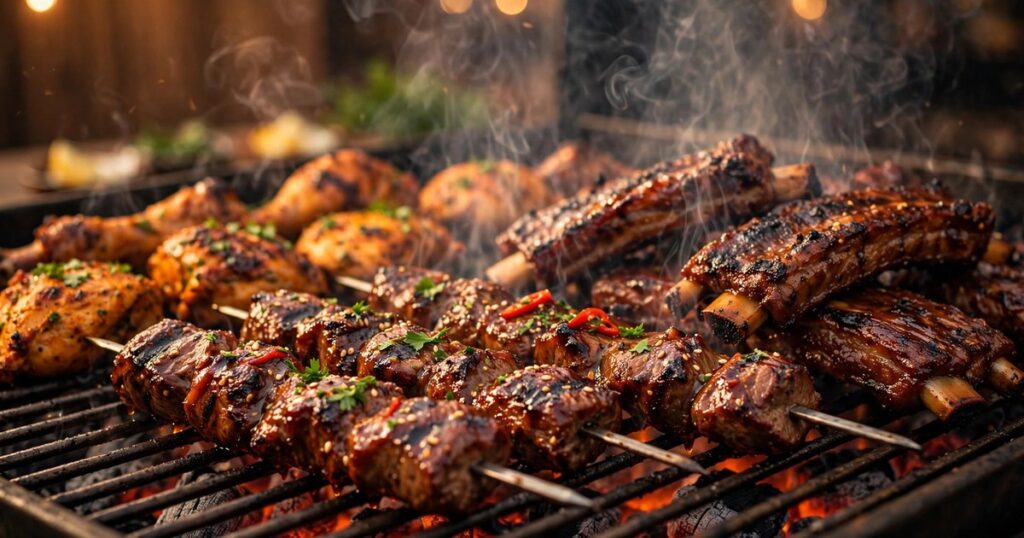
There is a particular kind of heartbreak that comes with loving BBQ and eating halal. You are driving past a roadside smokehouse, the oak smoke is rolling, and your mouth waters on instinct — and then the question lands: is any of this actually halal? For most of my life, the honest answer was “probably not, and nobody at the counter can tell you.” Halal BBQ meant your uncle’s backyard grill and a bag of charcoal.
That has changed fast. Over the past few years I have watched halal BBQ go from a backyard workaround to one of the most exciting corners of American halal dining: Texas-style smokehouses running fully halal pits, Korean BBQ halls with certified meat, desi grill houses doing smoked short ribs next to their seekh kebabs. This guide covers what actually makes BBQ halal, the main styles in the US, how to verify a joint before you spend a dollar, typical 2026 prices, the strongest city scenes, and how to order like a regular.
Quick Answer: Halal bbq means certified halal meat smoked or grilled with zero pork cross-contamination — separate pits, utensils, and pork-free sides. From Texas brisket to Korean BBQ, the US scene has exploded. Search Google Maps for “halal bbq” plus your city, check reviews for certification, and explore more food guides for halal dining ideas.
What Makes BBQ Halal Anyway?
Halal BBQ is regular BBQ with two non-negotiables: the meat must come from a halal (zabiha) slaughter, and nothing haram can touch it from slaughter to serving. The first part is about sourcing. The second part is where BBQ gets tricky, because a smokehouse is basically a cross-contamination obstacle course.
Here is what has to check out for BBQ to genuinely qualify as halal:
- Halal-certified meat sourcing: The beef, chicken, lamb, or turkey must be slaughtered according to Islamic requirements. Many diners prefer hand-slaughtered (zabiha by hand); others accept machine slaughter. Good joints will tell you which one they use and name their supplier or certifier without hesitation.
- A pork-free pit: This is the big one. In a traditional smokehouse, pork ribs and brisket share the same smoker, the same cutting boards, the same knives, and sometimes the same gloves. A halal BBQ operation needs a dedicated pit — or at minimum, a rigorously separated cooking process. “We clean the smoker” is not the same as “this pit has never cooked pork.” Ask which one it is.
- Pork-free sides and prep: The sides are where halal diners get ambushed. Baked beans with bacon, collard greens cooked with ham hock, mac and cheese topped with bacon bits, cornbread made with lard, flour tortillas made with lard — all standard at traditional BBQ joints. A halal BBQ spot either reformulates these or flags them clearly.
- No alcohol in the process: Beer-based mops, bourbon glazes, and whiskey barbecue sauces are common in the BBQ world. Marinades matter too — some Korean BBQ marinades use rice wine (mirin). Halal kitchens substitute or skip these.
- Separate utensils, boards, and fryers: Even in a fully halal kitchen, cross-contact awareness matters if the operation also handles anything questionable. Dedicated tongs, cutting boards, and fryer oil are the standard you should expect.
Why is this harder than verifying a shawarma shop? Most shawarma shops are Muslim-owned and halal by default. BBQ joints, historically, are built around pork: ribs, pulled pork, and bacon are core menu items. A halal BBQ joint swims upstream against the cuisine’s traditions, which is exactly why verification matters more here. The good news: the joints doing it right tend to be obsessive about it, because their entire customer base is watching.
What Are the Main Halal BBQ Styles in the US?
Halal BBQ is not one cuisine — it is several grilling traditions that have all found a halal expression in America. Knowing the styles helps you know what to order and what to watch for.
| Style | Signature Meats | Cooking Method | Order This First | Halal Watch-Outs |
|---|---|---|---|---|
| Texas-Style Smoke | Brisket, beef ribs, smoked turkey, beef sausage | Low-and-slow in an offset smoker over oak or post oak, 10–16 hours | Fatty (moist) brisket by the pound | Shared pit with pork ribs is the classic risk; bacon-laced sides; pork sausage next to beef sausage |
| Korean BBQ | Bulgogi, galbi (short ribs), chadol (brisket), marinated chicken | Tabletop grill, cooked by diners | Galbi and chadol brisket | Pork belly is the star at non-halal spots; shared grills; mirin/rice wine in marinades |
| Middle Eastern Mashawi | Shish tawook, kebab halabi, lamb chops, kofta, whole grilled fish | Charcoal grill, high heat, quick cook | The mixed grill platter | Usually fully halal by default — the easiest win on this list |
| Desi Tikka & Botī BBQ | Chicken tikka, malai boti, seekh kebab, bihari boti, smoked short ribs (new wave) | Tandoor, charcoal grill, and increasingly real smokers | Mixed grill with seekh kebab and malai boti | Usually halal by default; confirm beef sourcing at fancier spots |
| Brazilian Churrasco | Picanha, fraldinha, lamb, chicken hearts | Skewers slow-roasted over open flame, carved tableside | Picanha, medium-rare | Bacon-wrapped items and pork sausage circulate in the same rotation; confirm a halal-only skewer lineup |
Which style should you try first?
If you have never had real halal BBQ, start with Texas-style brisket at a fully halal smokehouse — bark, smoke ring, rendered fat, the whole experience in one bite. If you come from a desi or Middle Eastern food background, the mashawi and tikka styles will feel like home with a smoky upgrade, and they are the easiest to verify since those kitchens are almost always fully halal.
How Do You Verify Halal at a BBQ Joint?
This is the most important section of this guide, so let me give you the exact script I use. Verification at a BBQ joint takes more work than at a shawarma counter, but it follows a pattern:
- Look for certification before you walk in: Serious halal BBQ operations display their halal certification — on the door, the menu, or the website. Some name the certifying body. A joint that invested in a dedicated halal pit wants you to know about it; silence is a yellow flag.
- Ask the pit question directly: “Is your smoker pork-free, or has it ever cooked pork?” This is the single most revealing question you can ask. A dedicated halal pit is the gold standard. A shared pit that gets “cleaned between cooks” is a judgment call only you can make — but you deserve an honest answer, not a dodge.
- Ask about the sides: “Do any of your sides have bacon, pork, ham, or lard?” Beans, greens, mac and cheese, and cornbread are the usual suspects. Good halal joints have already reformulated these and will say so proudly.
- Ask about sauces and marinades: “Do any sauces or marinades contain beer, whiskey, or wine?” Bourbon glazes and beer mops are BBQ staples. Halal spots use alternatives — and the good ones will tell you what they use instead.
- Check utensils and fryers: “Do you use separate cutting boards and utensils for the halal meats?” and “Is the fryer shared with anything non-halal?” Quick, reasonable questions. Defensive or vague answers are your signal to leave.
- Search reviews for “halal”: Before you go, search the restaurant’s Google reviews for the word “halal.” Muslim diners are thorough reviewers — they confirm certification, name certifiers, and flag problems. A dozen reviews saying “fully halal, certified” is worth more than any sign on the door.
One more distinction: there is a difference between a fully halal BBQ joint and a regular BBQ joint with halal options. The first built its whole operation around halal — dedicated pit, halal supply chain, trained staff. The second added a halal brisket to a menu still running pork ribs through the same smoker. Know which one you are walking into. For a general framework on vetting any halal restaurant, our best halal food near me guide covers the certification questions that apply across cuisines.
What Does Halal BBQ Cost in 2026?
Halal BBQ runs slightly above regular BBQ prices — the halal beef supply chain costs more, and most halal smokehouses operate at a smaller scale than the big pork-centric joints. That said, it remains a generous, shareable meal. Typical US ranges:
- Brisket by the pound: $28–$40/lb. The headline item; order at least half a pound per person if it is the main event.
- Beef ribs by the pound: $30–$44/lb. Rich, dramatic, and filling — a quarter pound per person is plenty alongside other meats.
- Smoked turkey or chicken: $20–$28/lb. The value play, and genuinely good at serious smokehouses.
- Two- or three-meat plates: $18–$28, with sides included. The best introduction for a first visit.
- Family trays and platters: $60–$130, feeding 4–8 people depending on the spread. Almost always better value than individual plates.
- Korean BBQ (all-you-can-eat): $28–$48 per person at halal-certified spots, with premium cuts sometimes extra.
- Churrasco rodizio: $50–$80 per person for the full skewer experience at halal-friendly steakhouses.
- Desi mixed grill platters: $25–$45, usually feeding two generously.
Rule of thumb: budget $25–$40 per person for a proper halal BBQ meal, more at churrascarias. Prices run highest in New York and LA, friendliest in Houston and Dallas. If a halal brisket costs a few dollars more per pound than the conventional joint across town, that is the certification and the dedicated pit you are paying for.
Where Can You Find Great Halal BBQ in the US?
Halal BBQ follows Muslim population density and BBQ culture simultaneously, which is why Texas dominates. These are the scenes I point people to — described as neighborhoods and archetypes, because the honest truth is that the best joint in any city changes when the pitmaster changes.
Houston, Texas
The capital of halal BBQ in America. Houston pairs one of the country’s largest Muslim communities with deep Texas BBQ culture: dedicated halal smokehouses, desi-owned BBQ fusion spots, and Yemeni and Pakistani grill houses all competing. The Hillcroft corridor and southwest Houston are the hunting ground. Weekend lines are the quality signal — if the local community is queuing at 11 AM, the pit is doing something right.
Dallas–Fort Worth, Texas
DFW is Houston’s ambitious younger sibling. The Irving and Richardson corridors have a growing halal smokehouse presence alongside strong desi grill houses, and competition keeps quality high. If you are in North Texas, search the halal corridors rather than downtown — the good pits are where the community is.
Chicago, Illinois
Chicago runs on two tracks: the Devon Avenue desi grill corridor, where tandoors and charcoal grills have turned out tikka and seekh kebab for decades, and a newer wave of halal smokehouses doing Texas-style brisket. The Southwest Side and suburbs like Bridgeview are also worth searching. Devon prices remain among the friendliest in the country.
Dearborn, Michigan
Dearborn is less about Texas smoke and more about the Levantine grill tradition at an extremely high level — Warren Avenue’s charcoal-fired mashawi joints, shish tawook, and lamb chops. If your idea of BBQ leans flame-grilled rather than slow-smoked, Dearborn might be America’s best halal BBQ city. Almost everything here is halal by default, which makes verification refreshingly simple.
Los Angeles, California
LA’s scene is scattered but deep: halal-certified Korean BBQ halls, halal smokehouses across the metro, and strong Middle Eastern grill corridors in Glendale, Anaheim’s Little Arabia, and the San Gabriel Valley. You will pay more than in Texas, but the variety — Korean, Persian, Levantine, and Texas-style in one metro — is hard to beat.
New York City, New York
NYC’s halal BBQ lives in Queens — Astoria, Jackson Heights, and Jamaica have the grill houses, while dedicated halal smokehouses keep popping up across the boroughs. Expect the highest prices on this list, but relentless competition keeps the serious joints honest. Brooklyn’s Middle Eastern corridors are strong for the mashawi style.
Honorable mentions: the DC–Maryland–Virginia corridor has a quietly excellent halal grill scene, Atlanta’s options have grown fast, and the Bay Area has solid halal Korean BBQ if you search the South Bay. No scene near you? College towns with a sizable Muslim student population increasingly have at least one halal grill or smokehouse worth trying — apply the verification script above and you will rarely go wrong.
How Do You Order at a Halal BBQ Joint Like a Regular?
Walking into a smokehouse with confidence changes what lands on your tray. Here is the regular’s playbook:
- Order by the pound, not by the plate: Plates are convenient, but the pitmaster’s best work is sold by weight at the counter. Half a pound of brisket and a quarter pound of ribs, sliced to order, beats any pre-assembled plate.
- Ask for “moist” or “fatty” brisket: Brisket comes as lean (from the flat) or moist (from the point, with rendered fat). First-timers often default to lean and wonder what the fuss is about. Ask for moist, or a mix.
- Go early for burnt ends: The caramelized, bark-heavy cubes from the brisket point sell out fast. If they are on the menu, they are gone by mid-afternoon — call ahead or arrive at opening.
- Ask what came off the smoker most recently: “What just came off?” is the highest-value question in BBQ. Fresh-sliced brisket cut minutes ago is a different food from brisket sliced at noon and held for dinner.
- Do the tray math for groups: Three or more people? Skip individual plates and order a family tray or a few pounds of mixed meats. Cheaper per person, and you taste more of the menu.
- Take the sides seriously: At a halal joint the sides are safe by design, so explore. The pickles and onions are not garnish — their acidity cuts the smoke and fat.
- For takeout, keep it whole: Ask for brisket unsliced or in large pieces and slice at home. Pre-sliced brisket dries out in the container. Reheat wrapped in foil with a splash of beef broth at low heat.
And if smoked beef is your thing beyond the BBQ joint, the fancy end of the spectrum is worth exploring too — our halal steakhouse guide covers where to find properly certified steaks for a sit-down night out.
Can You Get Good Halal BBQ Delivered?
Yes — BBQ is one of the best delivery foods in existence. Unlike fried food, which dies in a container, smoked meats hold their texture and reheat beautifully. A few rules:
- Stay within a 20–30 minute radius: Smoked meat tolerates travel, but an hour in a sealed box steams the bark soft. Closer is better.
- Order by the pound and slice at home: Whole or large pieces survive the trip; thin slices dry out.
- Ask them to vent the container: Trapped steam is the enemy of bark. A slightly vented container keeps the crust intact.
- Reheat low and slow: Wrapped in foil with a splash of broth, 250°F for 20–30 minutes, and day-old brisket eats like it just came off the pit. Never microwave it.
- Sauce on the side, always: Separate containers keep everything crisp. Texas purists will tell you great brisket needs no sauce at all — try it naked first, then decide.
Frequently Asked Questions
Is brisket halal?
Brisket is beef, and beef is halal when the animal was slaughtered according to Islamic requirements and the meat never contacted pork or alcohol during processing, smoking, or serving. Halal brisket absolutely exists — but “brisket” on a menu does not automatically mean halal brisket. Verify sourcing and ask the pit question before you order.
Can a BBQ restaurant be halal if it also serves pork?
It depends on your standards. Some restaurants run a fully separate halal operation — dedicated pit, separate prep areas, separate utensils — alongside a conventional menu. Others cook halal brisket in the same smoker as pork ribs, which most diners would not accept. Ask exactly how separation works; when in doubt, choose a fully halal joint where the question never arises.
Is Korean BBQ halal?
It can be, but standard Korean BBQ restaurants are built around pork belly and marinades that may contain rice wine. Look specifically for halal-certified Korean BBQ halls in major metros, and confirm the grill, utensils, and marinades are pork- and alcohol-free. At a non-certified spot, even the beef can pick up cross-contact from a shared grill.
What is the difference between halal BBQ and regular BBQ?
The flavor and technique are the same — the difference is entirely sourcing and separation. Halal BBQ uses certified halal-slaughtered meat, a pork-free cooking process, pork-free sides, and alcohol-free sauces. A blind taste test of great halal brisket versus great conventional brisket would come down to the pitmaster’s skill, not the certification.
Why does halal BBQ cost more than regular BBQ?
Halal-certified beef costs more through the supply chain, dedicated halal pits and separate prep add operational cost, and most halal smokehouses operate at a smaller scale. Expect roughly 10–20% more per pound — you are paying for the certification, the dedicated equipment, and the peace of mind.
What should I ask before ordering at a new BBQ joint?
Use the three-question script: (1) “Is your meat halal-certified, and who certifies it?” (2) “Has your smoker ever cooked pork, or is it a dedicated halal pit?” (3) “Do any sides, sauces, or marinades contain pork, bacon, lard, or alcohol?” A good joint answers all three immediately. Evasive answers are your cue to leave.
Halal BBQ in America has never been better than it is right now — dedicated pits, serious pitmasters, and a community that holds its joints to a high standard. Find your city’s scene, run the verification script once, and then eat with total confidence. The smoke ring does not care about your dietary restrictions; it just needs a pitmaster who respects them.

I’m Lila Spoonbelle, your host on this flavorful ride through food, fun, and fearless puns. Let’s turn every bite into a burst of laughter!