
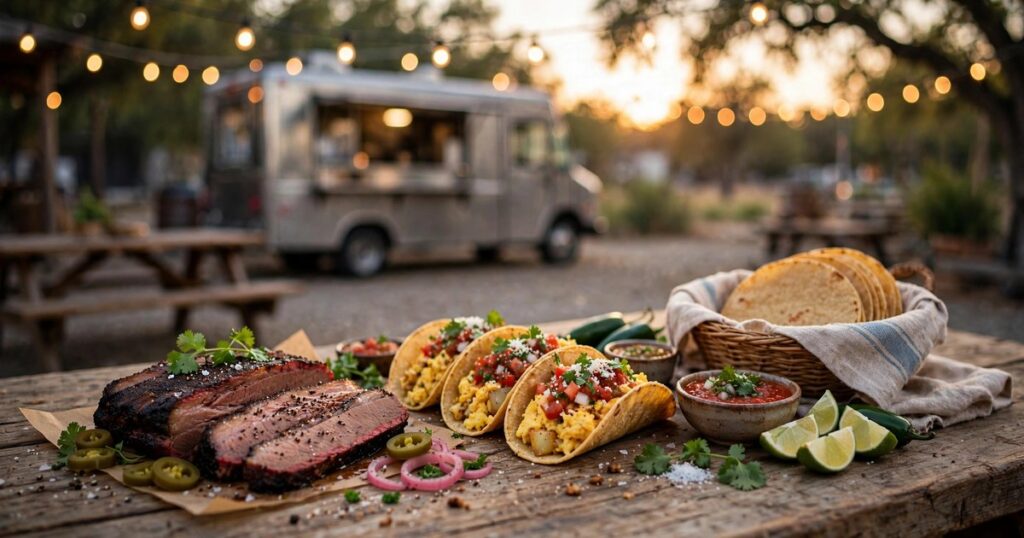
Austin does not do food quietly. It does it in smoke and salsa verde: brisket that took fourteen hours to cook, a breakfast taco eaten on a curb at 8am, a food truck line that moves faster than it looks, and a margarita on a patio while a band tunes up next door. If you are trying to figure out where to eat in Austin, the good news is that the city is built for grazing — the best meals here are often casual, cheap, and found in the neighbourhood you are already standing in.
This 2026 guide is built for first-time visitors and returning food lovers alike. It covers the barbecue Austin is famous for, the breakfast tacos that start every good day here, the food trucks that invented half the city’s best dishes, the neighbourhoods that matter, and the budget tricks that keep a food trip affordable. Whether you have two days or two weeks, start here.
Quick Answer: The best places to eat in Austin include Franklin Barbecue and Terry Black’s for brisket, Veracruz and Torchy’s for breakfast tacos, South Congress for classic Austin cafés, and East Austin for food trucks and modern restaurants. Don’t miss Texas barbecue, breakfast tacos, Tex-Mex, and a food-truck meal on Rainey Street.
What food is Austin famous for?
Austin’s most famous food is Texas barbecue, and brisket is the dish that defines it. Central Texas barbecue means beef brisket, rubbed with salt and pepper, cooked low and slow over post oak smoke until the bark is dark and the meat pulls apart with a gentle tug. The best brisket needs nothing on it — no sauce, no fork, barely any chewing. Franklin Barbecue made it a national obsession, but the city’s barbecue bench is deep, and some of the best plates now come from newer pits in East Austin.
Then there is the food Austin invented or made its own. Breakfast tacos — eggs, potatoes, cheese, and bacon or chorizo folded into a flour tortilla — are the city’s true daily ritual, eaten at taco trucks, taquerias, and counter spots from dawn. Tex-Mex, the cheesy, salsa-heavy cousin of Mexican food, is everywhere: queso, enchiladas, and margaritas on patios. And food trucks are not a side show in Austin — they are where many of the city’s most-loved restaurants started, and where some of the best cooking in town still happens.
Where should first-time visitors eat in Austin?
If this is your first trip, base your eating around these three areas.
South Congress (SoCo) is the classic Austin start. The avenue is lined with cafés, taco spots, food trucks, and old-school restaurants, and it is the best place to get a first taste of the city in one walkable stretch. Come for breakfast tacos, stay for the people-watching, and end the day with a margarita on a patio.
East Austin is where the city’s most exciting food lives now. Once-quiet streets are now packed with food trucks, modern Texas restaurants, barbecue pits, and taquerias. It is the best neighbourhood for a food crawl: you can eat barbecue, tacos, Thai food, and ice cream within a few blocks of each other.
Downtown and Rainey Street suit an evening out. Rainey Street’s converted bungalows now house bars and food trucks, and the area is the city’s liveliest place to eat and drink after dark. Downtown has the fine-dining end of the spectrum, from sushi counters to tasting menus.
Which Austin neighbourhoods are best for food lovers?
Each neighbourhood has its own eating personality. Use this table to pick your base — or to plan a day around a single area.
| Neighbourhood | Best for | Don’t miss | Budget feel |
|---|---|---|---|
| South Congress | Classic Austin, cafés, tacos | Breakfast tacos, Jo’s Coffee, patios | $$ |
| East Austin | Food trucks, barbecue, modern Texas | Franklin Barbecue, Veracruz, food trucks | $$ |
| Downtown | Fine dining, sushi, cocktails | Uchi, Emmer & Rye, happy hours | $$$ |
| Rainey Street | Evening food trucks, bars | Food-truck courts, bungalow bars | $$ |
| South Lamar | Tex-Mex, casual favourites | Queso, enchiladas, margaritas | $$ |
| North Loop / Hyde Park | Neighbourhood cafés, brunch | Quack’s Bakery, diners, coffee | $ |
| Zilker / Barton Springs | Picnic food, casual cafés | Food trucks, park picnics | $ |
| Mueller | Family-friendly, farmers market | Sunday farmers market, brunch | $$ |
East Austin and South Congress deserve a special note. East Austin is where Austin eats most like itself right now — brisket, tacos, and food-truck cooking in a neighbourhood that still feels local. South Congress is where the city shows off its classic side: old signs, big patios, and the Austin of a decade ago. If you want to understand what Austinites actually eat on a normal Friday night, start in one of these two neighbourhoods rather than in a hotel restaurant downtown.
Where can I find the best barbecue in Austin?
The honest answer is that the best barbecue is rarely the place with the shortest line — it is the place where the meat is cooked right that day. A good barbecue joint will tell you what came off the smoker that morning, and the brisket will be sliced to order while you watch.
For a classic experience, start with Franklin Barbecue in East Austin. It is the most famous barbecue spot in America, and the brisket lives up to it — but be prepared to queue. The line opens early and the meat sells out, so arrive before 10:30am, order the brisket and the pulled pork, and treat the wait as part of the experience.
Terry Black’s Barbecue, on Barton Springs Road, is the best no-queue alternative: a big, lively dining room, brisket sliced to order, beef ribs worth the splurge, and a full bar. La Barbecue in East Austin is another local favourite, known for its brisket and its elotes (Mexican street corn), while Micklethwait Craft Meats, a food-trailer-turned-destination, serves excellent brisket and jalapeño cheese grits in a relaxed yard setting.
Order like a local: brisket by the half-pound (order more than you think you need), beef ribs if they are on the board, pork ribs for variety, and sides of coleslaw, pinto beans, and potato salad. Sauce is optional — great brisket does not need it. And go for lunch: most of the best pits sell out by mid-afternoon.
Where are the best breakfast tacos in Austin?
Breakfast tacos are Austin’s daily bread, and the city takes them seriously. The formula is simple — eggs, potatoes, cheese, and a protein in a flour tortilla — but the quality of the tortilla, the freshness of the salsa, and the balance of the fillings separate the great from the ordinary.
Start with Veracruz All Natural, the beloved taco truck with locations in East Austin and beyond. Its migas poblanas — eggs scrambled with crispy tortilla strips, poblano, and cheese — is the taco that made the truck famous, and the fresh salsas are worth the trip alone. Torchy’s Tacos, which started as a food truck and is now an Austin institution, is the fun, creative end of the spectrum: the Democrat, with barbacoa, avocado, and queso, is the signature order.
For old-school taqueria style, Juan in a Million in East Austin serves the famous Don Juan taco — a plate-sized breakfast taco stuffed with eggs, potatoes, cheese, and bacon — and Tacodeli is the reliable neighbourhood favourite, with the Cowboy Taco (eggs, potatoes, bacon, and cheddar) as its calling card.
Breakfast taco tip: order two different tacos rather than two of the same, ask for salsa verde if you like heat, and eat them hot — a breakfast taco that has sat for ten minutes is a different, lesser thing. Most taco spots are busiest before 10am on weekends, so an early start buys you shorter queues.
What is the Austin food truck scene like?
Food trucks are not a novelty in Austin — they are a founding institution. Many of the city’s best-known restaurants started as trucks, and the truck courts of East Austin, South Congress, and Rainey Street are still where much of the most interesting cooking happens.
East Austin is the heart of it. Trucks cluster along East 6th and the surrounding streets, serving everything from Thai-Korean fusion to wood-fired pizza to vegan tacos. South Congress has its own truck courts, perfect for a grazing lunch between shops. Rainey Street comes alive in the evening, when the trucks outside the bungalow bars serve late-night tacos, burgers, and fried chicken to the bar crowds.
Truck etiquette is simple: order at the window, pay at the window, and find a picnic table. Most trucks are cashless now, menus change with the seasons, and the best trucks sell out — if a truck has a line, it is usually worth joining. And don’t overlook the trucks at breweries: Austin’s brewery taprooms, especially in East Austin, pair local beer with food trucks in the yard, which is one of the city’s best cheap evenings out.
Where can I eat Tex-Mex in Austin?
Tex-Mex is Austin’s comfort food, and the city does it better than almost anywhere. The essentials: queso (melted cheese dip, ideally with a little heat), enchiladas smothered in sauce, fajitas sizzling on a cast-iron skillet, and a frozen margarita on a patio.
Matt’s El Rancho on South Lamar is the classic — an old-school dining room, huge portions, and the Bob Armstrong dip (queso, taco meat, and guacamole) that regulars swear by. Chuy’s, which started in Austin, is the fun, colourful end of the spectrum, with the Elvis Presley Memorial Combo and free creamy jalapeño dip. For a more modern take, Suerte in East Austin serves refined Tex-Mex and mezcal cocktails in a stylish dining room — book ahead.
Tex-Mex tip: lunch is often the best value, with combo plates that cover enchiladas, tacos, and rice and beans for under $15. And if a place offers queso as a starter, order it — it is the fastest way to judge a Tex-Mex restaurant’s quality.
Where can I eat on a budget in Austin?
Austin has a reputation for affordable food, and for the most part it is deserved — but downtown and the trendiest spots can be pricey. The good news is that the city’s best food is often its cheapest.
- Eat breakfast tacos and food trucks. A filling breakfast taco costs $3–$5, and a food-truck lunch is usually $10–$15.
- Head to East Austin and South Lamar. The same quality a few streets from a major attraction often costs 20–30% less.
- Look for happy hour. Many good restaurants, especially downtown and on Rainey Street, offer discounted tacos, small plates, and margaritas from 3–6pm.
- Try lunch over dinner. Barbecue and Tex-Mex are lunch foods in Austin — the same plate costs less at noon than at 7pm.
- Use grocery stores and farmers markets. The Mueller farmers market on Sundays and H-E-B’s prepared foods are local secrets for cheap, good eating.
- Drink tap water and happy-hour beer. Austin tap water is safe and free, and happy-hour beers at brewery taprooms are among the cheapest drinks in the city.
Where should I go for a special occasion in Austin?
For a birthday, anniversary, or once-in-a-lifetime dinner, Austin’s fine-dining scene is quietly excellent. Uchi, the Japanese-farmhouse-style restaurant on South Lamar, is the city’s most famous special-occasion spot — inventive sushi, shared small plates, and a sake list worth exploring. Book as early as you can: top tables often open reservations weeks ahead.
Emmer & Rye downtown is the tasting-menu experience — a constantly changing menu built around Texas ingredients, served in a warm, modern dining room. Odd Duck on South Lamar is the more casual, farm-to-table option, with shared plates that change with the seasons and a lively bar.
A tasting menu in the city typically runs $85–$200 per person before wine, so treat it as the centrepiece of a day, not an add-on after a long day of sightseeing. If the full tasting menu is out of reach, many of the same restaurants offer a shorter lunch tasting menu or a bar menu at a lower price — one of the best value splurges in the city.
What are Austin’s best coffee shops and sweet spots?
Jo’s Coffee on South Congress is the famous one — the “i love you so much” mural outside is the city’s most photographed wall, and the iced coffee inside is the classic order. But the coffee Austinites actually drink every day comes from independent roasters and neighbourhood cafés: Houndstooth Coffee, Merit Coffee, and Cosmic Coffee + Beer Garden (which pairs coffee with a beer garden and food trucks) are all respected by serious coffee drinkers.
For something sweet, Austin’s dessert scene is underrated. Veracruz does excellent pan dulce, Quack’s Bakery in Hyde Park is the neighbourhood institution for pastries, and Lick Honest Ice Creams serves seasonal, Texas-inspired flavours. On a hot day, a paleta (Mexican ice pop) from a South Congress vendor is the perfect afternoon stop.
How much does eating out in Austin cost?
Prices vary widely by neighbourhood and format, but these ranges give a realistic sense of what to budget per person in 2026.
| Meal type | Typical cost per person | Where |
|---|---|---|
| Breakfast tacos (2 tacos) | $6–$10 | Taco trucks, taquerias |
| Food-truck lunch | $10–$16 | East Austin, South Congress, Rainey |
| Barbecue plate (brisket, 2 sides) | $18–$30 | Franklin, Terry Black’s, La Barbecue |
| Tex-Mex dinner (2 courses) | $20–$35 | South Lamar, East Austin |
| Casual restaurant dinner | $25–$45 | South Congress, East Austin |
| Happy hour small plates | $6–$12 per dish | Downtown, Rainey Street |
| Fine-dining tasting menu | $85–$200 | Downtown, South Lamar |
Drinks add up fast in Austin — a margarita in a central restaurant is often $10–$14, and craft cocktails run $12–$16 — so budget for drinks separately. A 20% tip is standard in sit-down restaurants, and food trucks usually have a tip option on the card reader — a dollar or two is the norm.
What mistakes should tourists avoid when eating in Austin?
First, don’t skip the queue at Franklin Barbecue and then complain about it — the line is part of the experience, but if you don’t want to wait, go to Terry Black’s or Micklethwait instead. Austin’s barbecue bench is deep, and the second-best brisket in the city is still extraordinary.
Second, don’t eat only on Sixth Street. The famous entertainment strip has bars and late-night food, but the best restaurants are in East Austin, South Congress, and South Lamar. Walk a few streets away from the noise and the quality usually jumps while prices fall.
Third, don’t order barbecue at dinner and expect the full menu. The best pits sell out by mid-afternoon, and by 6pm the brisket is often gone. Barbecue is a lunch food in Austin — plan accordingly.
Fourth, don’t underestimate the Texas heat. In summer, eat lunch early or late, drink water between margaritas, and choose shaded patios or air-conditioned dining rooms for the middle of the day. Food-truck meals are best enjoyed in the cooler morning or evening hours.
Finally, don’t assume everything is open late. Austin’s late-night eating is concentrated on Sixth Street and Rainey Street, and many of the best restaurants close by 10pm. If you arrive late, head to those areas rather than settling for the nearest fast-food outlet.
Frequently Asked Questions About Eating in Austin
What is the best area to stay in Austin for food?
South Congress is the best all-round base — walkable, full of cafés and taco spots, and close to downtown. East Austin is the best alternative if you prefer food trucks and modern restaurants.
Is Austin expensive for food?
It can be, but it doesn’t have to be. Breakfast tacos cost $3–$5 each, food-truck lunches $10–$16, and casual dinners $25–$45. Fine dining is the expensive end — budget $85–$200 per person for a tasting menu.
Where do locals eat in Austin?
Locals eat in their own neighbourhoods: East Austin for barbecue and food trucks, South Lamar for Tex-Mex, Hyde Park for cafés and brunch, and Rainey Street for evenings out. Follow local queues rather than tourist menus.
Do I need reservations in Austin?
For popular restaurants, yes — especially on Friday and Saturday nights. Book a day or two ahead for casual spots and weeks ahead for fine dining like Uchi or Emmer & Rye. Barbecue pits and food trucks never need reservations — just arrive early.
What should I eat in Austin for the first time?
Start with the classics: brisket from Franklin Barbecue or Terry Black’s, breakfast tacos from Veracruz, queso and enchiladas at a South Lamar Tex-Mex spot, and a food-truck meal in East Austin. Then add a margarita on a South Congress patio.
When is the best time to visit Austin for food?
Late autumn through spring (October to April) is best — mild weather for patios and food trucks, and the barbecue lines are shorter. Summer is hot but cheaper, and South by Southwest in March brings pop-ups and special menus.
Is Austin good for vegetarians and vegans?
Yes — Austin is one of the most vegetarian-friendly cities in Texas. Almost every restaurant offers a serious plant-based main, the food-truck scene is full of vegan options, and Veracruz and other taco trucks serve excellent vegetarian tacos.
Austin’s food scene rewards curiosity more than money. A $4 breakfast taco eaten on a curb can be just as memorable as a $200 tasting menu — because Austin’s best meals are the ones that taste like the city itself: smoky, spicy, a little loud, and endlessly generous. Plan one good meal a day, leave room for serendipity, and eat your way across the map.
For more city food guides, explore our Food Guides, including Where to Eat in Houston and Where to Eat in Nashville — and if you run a restaurant or food brand, check out our Work With Us page.
I’m Lila Spoonbelle, your host on this flavorful ride through food, fun, and fearless puns. Let’s turn every bite into a burst of laughter!