
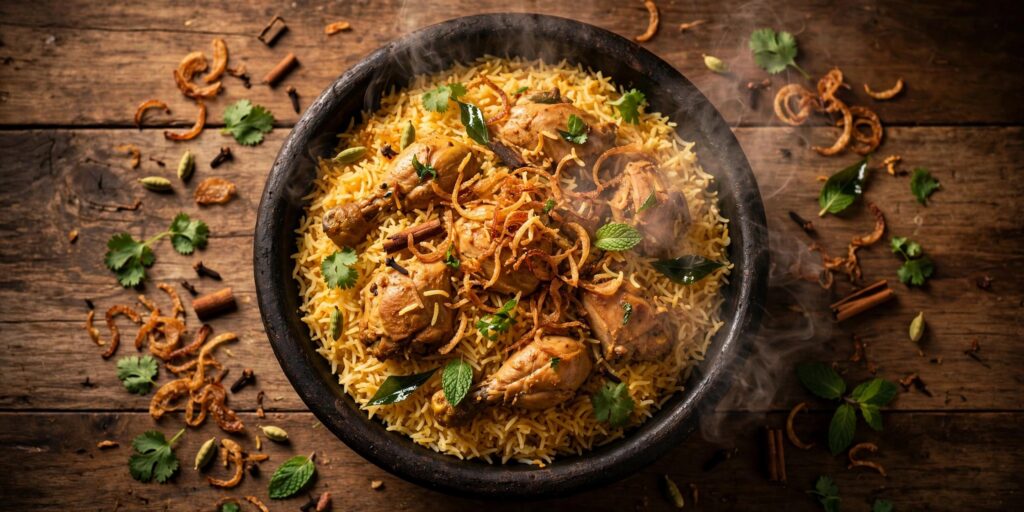
There’s a particular kind of craving that only biryani satisfies. It’s not just hunger — it’s the memory of steam rising off a handi, that first whiff of saffron and fried onion, the way the rice falls apart in long, fragrant strands while the meat underneath stays impossibly tender. Once the craving hits, “best biryani near me” becomes the most important search of your day.
The problem? Not all biryani is created equal, and a five-star rating on Google doesn’t always tell you what you’re getting. After eating my way through biryani joints across a dozen American cities — and asking way too many uncles for their opinions — I’ve put together the guide I wish I’d had: how to judge biryani before you order, the main styles worth knowing, what you should pay, and where to find standout bowls city by city.
Quick Answer: The best biryani near you comes down to style and freshness: look for dum-cooked rice with distinct grains, tender marinated meat, and a fragrant (not greasy) masala. Hyderabadi and Karachi styles dominate US cities; expect to pay $12–$20 for a plate. Check Google Maps reviews that mention “dum,” “fresh,” and “masala,” and browse more of our food guides for similar city-by-city finds.
What Actually Makes Biryani Great?
Before we get to cities, let’s calibrate your palate. Biryani is a layered dish, and each layer has to earn its place. Here’s what to look for when that first plate lands in front of you.
How can you tell if biryani was cooked fresh?
Fresh biryani has personality. The rice grains stand apart from each other — long, separate, slightly glossy from ghee but never swimming in oil. When you dig your spoon in, you should see the layering: white rice on top giving way to saffron-stained grains below, then the masala-coated meat at the bottom. If everything arrives as one uniform orange mass, it was likely tossed together in a hurry or reheated from a big batch.
Steam is your best evidence. A proper dum biryani arrives sealed or freshly opened from a handi, and the aroma should hit you before the plate even touches the table. If it smells mostly of plain rice with a vague curry note, manage your expectations.
Why does the rice matter more than the meat?
This sounds like heresy, but hear me out: anyone can cook tender chicken. The rice is where biryani lives or dies. Aged basmati is the gold standard — older grains are drier, longer, and absorb flavor without turning mushy. A good cook uses rice aged at least a year, parboils it to about 70% doneness, then layers it over the meat so it finishes steaming in the dum.
The tell-tale sign of quality: each grain is distinct, slightly chewy at the core, and fragrant on its own. If the rice alone (before you even reach the meat) tastes amazing, you’re in the right place.
What should the masala taste like?
Great biryani masala is a slow burn of complexity, not a single-note chili blast. You should taste warmth from whole spices — cardamom, clove, cinnamon, bay — rounded out by browned onion sweetness, yogurt tang, and the gentle heat of green chilies.
One practical test: after a few bites, your mouth should feel warm and satisfied, not scorched or greasy. If you’re reaching for water after every spoonful because of raw chili heat rather than layered spice, the kitchen leaned on heat instead of technique.
What Are the Main Biryani Styles?
Ordering “biryani” in America usually gets you one of a handful of regional styles, and knowing the difference helps you order exactly what you’re craving. Here’s the lineup you’re most likely to encounter.
| Style | Origin | Flavor Profile | Heat Level | Best For |
|---|---|---|---|---|
| Hyderabadi Dum | Hyderabad, India | Saffron, mint, fried onion; raw marinated meat layered with rice | Medium–High | Spice lovers; the most common style in the US |
| Lucknowi / Awadhi | Lucknow, India | Delicate, aromatic; kewra water and rose; gentle spices | Low–Medium | First-timers; people who prefer fragrance over fire |
| Karachi / Sindhi | Karachi, Pakistan | Bold, tangy; potatoes, plums (aloo bukhara), sharp heat | High | Pakistani-food fans; maximum flavor intensity |
| Malabar | Kerala, India | Short-grain kaima rice; coconut, curry leaf, fried onion notes | Medium | Something different; pairs beautifully with raita |
| Kolkata | Kolkata, India | Subtle spices with a signature potato and boiled egg | Low | Mild palates; the potato is non-negotiable |
| Kacchi / Teheri | Bangladesh | Raw meat dum-cooked; mustard oil depth; teheri is the simpler cousin | Medium | Adventurous eaters; deeply savory |
Which style should you try first?
If you’ve never had biryani beyond the generic restaurant version, start with Hyderabadi dum — it’s the most widely available, and when done well it’s the full biryani experience: drama, aroma, heat, satisfaction. If you lean toward milder food, Lucknowi is your gateway. And if you’re the kind of person who puts hot sauce on everything, find a Karachi-style spot and prepare to be humbled.
Handi vs. Family Platter: How Should You Order?
What is a handi, and is it worth it?
A handi is the traditional wide-mouthed pot biryani is dum-cooked in, and many restaurants now serve individual portions in mini handis. It’s not just theater — serving in the cooking vessel keeps the rice steaming hot and the aroma trapped until the moment you lift the lid. For a solo diner or a couple, a single handi is usually the freshest option on the menu.
When does a family platter make sense?
Family platters (usually serving 3–5) are the move for groups, and they’re almost always better value per person. The catch: platters are often assembled from the same batch pots, so ask whether the platter is made fresh to order. A good sign is when the restaurant quotes you a 20–30 minute wait for a large platter — that means they’re actually cooking it, not scooping it.
Should you get raita and salan?
Yes, always. Raita (cool yogurt with cucumber or onion) is the essential counterpoint to biryani’s richness. Salan, the thin peanut-sesame curry served alongside Hyderabadi biryani, adds a tangy, nutty dimension — if a Hyderabadi spot doesn’t offer salan, that’s a minor red flag.
How Do You Check If the Meat Is Halal?
This matters to a lot of biryani lovers, and it’s a question worth asking directly — most restaurants that serve halal meat are proud of it and say so clearly.
- Look for it on the menu or website first. Halal-certified spots almost always advertise it; it’s a selling point. If the menu is silent, that’s your cue to ask.
- Ask specifically, not vaguely. “Is your chicken halal?” gets a clearer answer than “Is everything halal?” Some places serve halal chicken but not halal beef or goat — worth confirming per protein.
- Check for certification signage. Many restaurants display a halal certificate near the register or on their website. Its absence doesn’t prove anything, but its presence is reassuring.
- Read reviews from Muslim diners. Search the restaurant’s Google reviews for “halal” — regulars often confirm it in their reviews, and any controversy shows up there too.
- When in doubt, go vegetarian. A vegetable or paneer biryani sidesteps the question entirely, and a kitchen that makes great meat biryani usually makes a great veg version too.
What Should Biryani Cost in the US?
Biryani is one of the best value propositions in American dining — a full, satisfying meal that rarely breaks the bank. Here’s what to expect in 2026:
- Chicken biryani: $12–$17 for a generous plate; $15–$22 served in a handi.
- Goat or lamb biryani: $16–$24, reflecting the higher meat cost. Worth it when the meat is genuinely tender.
- Beef biryani: $14–$20, more common at Pakistani and Bangladeshi spots.
- Shrimp or fish biryani: $17–$26, a specialty item — order only where seafood is clearly a strength.
- Vegetable or paneer biryani: $11–$15, often the sleeper hit of the menu.
- Family platters: $35–$60, typically feeding 3–5 people.
Prices run higher in Manhattan and the Bay Area, lower in Houston and Chicago’s Devon Avenue corridor.
How Do You Find the Best Biryani Near You on Google Maps?
Searching “best biryani near me” is just the starting point. The real skill is reading the results like a detective.
What search terms work better than “biryani near me”?
Try style-specific searches: “Hyderabadi dum biryani near me,” “Karachi biryani near me,” or “chicken dum biryani near me.” These surface specialists instead of generic Indian restaurants that happen to have biryani on page three of the menu. Adding your neighborhood or a known ethnic corridor (“biryani Devon Avenue,” “biryani Hillcroft Houston”) narrows it further.
How do you read reviews for biryani specifically?
Ignore the star rating for a moment and search within reviews for the words that matter: “dum,” “fresh,” “aromatic,” “tender,” “masala,” “saffron.” A review that says “the dum flavor comes through and the chicken falls off the bone” tells you more than fifty generic five-star reviews. Photos are even better — look for user photos showing distinct rice grains, visible layering, and generous meat portions. If every photo shows a uniform orange pile, keep scrolling.
Should you trust “best biryani” listicles?
They’re a decent starting point but treat them as leads, not verdicts. Cross-check any listicle pick against recent Google reviews (last 3–6 months) — biryani quality is notoriously inconsistent, and a spot that was great in 2023 may have changed cooks twice since then. Recency beats reputation.
Where Is the Best Biryani, City by City?
America’s biryani map follows its South Asian diaspora, which means a handful of corridors punch far above their weight. Here’s where to look in the major hubs — described as archetypes and neighborhoods rather than specific endorsements, because the honest truth is that the “best” spot changes with the cook, not the signboard.
New York City
NYC’s biryani scene is really two scenes. In Manhattan and Brooklyn, you’ll find polished restaurants doing refined Hyderabadi and Lucknowi versions at sit-down prices. But the soul of the city’s biryani lives in Queens — Jackson Heights, Jamaica, and Hicksville are dense with Bangladeshi, Pakistani, and Hyderabadi kitchens where $13 gets you a plate that would cost $22 downtown. Queens deserves its own deep dive: our dedicated guide to the best biryani in Queens, NY covers the neighborhood’s standout corridors in detail.
Houston
Houston might be America’s most underrated biryani city. The Hillcroft corridor is lined with Pakistani restaurants where Karachi-style biryani — fiery, tangy, studded with potatoes — is the default, not the exception. Weekend specials are the thing to watch for: many spots do a Friday or Sunday dum biryani that’s visibly fresher than the weekday version.
Dallas–Fort Worth
DFW’s South Asian population has exploded, and the biryani scene along corridors in Irving and Richardson has kept pace. You’ll find a strong Hyderabadi presence here — look for the family-run spots advertising “authentic dum” with lunch crowds of desi office workers. That’s your quality signal: when the lunch rush is aunties and uncles rather than tourists, the kitchen isn’t cutting corners.
Chicago
Devon Avenue is Chicago’s biryani headquarters and has been for decades. The Pakistani kitchens here have been perfecting Karachi-style biryani since before it was trendy, and the competition keeps prices honest — $12–$15 for a plate that feeds you twice. Look for the older, family-run spots with lines out the door on weekends; the newer, shinier places on the same street are hit-or-miss.
San Francisco Bay Area
The Bay Area’s biryani scene skews toward the tech-corridor lunch crowd, which means excellent Hyderabadi takeout: fast, consistent, generous. Sunnyvale, Santa Clara, and Fremont are the corridors to search. Prices run higher here ($16–$22), but portions tend to be large. The Malabar-style options are a Bay Area sleeper — Kerala-run kitchens in the South Bay do a fragrant short-grain biryani worth seeking out.
Edison, New Jersey
Edison’s Oak Tree Road is the East Coast’s answer to Devon Avenue — a dense, competitive strip where Hyderabadi, Karachi-style, and Bangladeshi biryani all compete within a few blocks. Competition is the diner’s friend here. If you’re in Central Jersey, this corridor alone justifies the trip.
How Do You Order Biryani Like a Regular?
Walking in with confidence changes what lands on your table. Here’s the regular’s playbook:
- Ask what’s fresh today. “Which biryani did you just make?” beats “What’s good here?” every time. Kitchens will steer you to the freshest handi.
- Order the house specialty, not the menu’s greatest hits. If the sign says Hyderabadi, order the Hyderabadi dum — not the “special mixed grill biryani fusion” the menu added for tourists.
- Request “extra masala” or “on the spicier side” if that’s your thing. Most kitchens will happily dial it up; they just default to crowd-pleasing mild.
- Time your visit. Biryani peaks at lunch (fresh batch) and early dinner. Late-night biryani is reheated biryani — still good, rarely great.
- Take the raita seriously. Order extra raita if you’re sensitive to heat; it also tells the staff you know what you’re doing.
- For takeout, ask them to pack raita and salan separately and keep the biryani container vented slightly so the rice doesn’t steam itself soggy on the ride home.
What About Biryani Adjacent Cravings?
Sometimes the craving is biryani-shaped but not exactly biryani. If you find yourself wanting something in the same family — fragrant rice, bold spices, satisfying and halal-friendly — a shawarma plate scratches a similar itch with a completely different flavor profile. Our guide to the best shawarma near me covers how to judge that one too, city by city.
Frequently Asked Questions
What is the difference between biryani and pulao?
Biryani is layered — parboiled rice and marinated meat (or vegetables) are assembled in strata and slow-steamed together (dum), so each layer keeps its identity while absorbing flavor. Pulao is cooked in one pot where rice simmers in seasoned broth; it’s delicious but simpler, with the rice and protein mingling rather than layering. If the dish looks uniform throughout, it’s closer to pulao than biryani.
Is biryani healthy?
It’s a balanced meal in a bowl — protein, carbs, and vegetables with anti-inflammatory spices like turmeric. The watch-outs are portion size and ghee/oil quantity; restaurant biryani can run 800–1,200 calories a plate. Ordering raita instead of extra oil-heavy sides, choosing chicken over goat, and eating half now and half later are easy ways to keep it reasonable.
How long does leftover biryani last in the fridge?
Three to four days in an airtight container. Reheat it properly: sprinkle a tablespoon of water over the rice, cover, and warm it in the microwave or a covered pan on low — the steam revives the grains. Never reheat it dry or the rice turns to cardboard. Honestly, day-two biryani, reheated right, can taste even better as the flavors meld.
Why is restaurant biryani sometimes dry?
Dry biryani usually means it sat too long after cooking or the rice-to-masala ratio was off. Fresh dum biryani should glisten slightly. If yours arrives dry, ask for extra salan or raita — and consider it a data point about that restaurant’s batch timing.
Can you get good biryani delivered?
Yes, with caveats. Biryani travels better than most dishes because it’s self-contained, but steam trapped in a sealed container makes rice soggy over long deliveries. Choose restaurants within 20 minutes, ask them to vent the container, and reheat briefly at home with a sprinkle of water. Handi servings survive delivery best since the pot insulates without crushing the rice.
What do you drink with biryani?
Traditionally: salted lassi or sweet mango lassi — the yogurt cools the palate. Sparkling water with lemon is the modern minimalist pairing. A strong masala chai after the meal is the classic South Asian full stop.

I’m Lila Spoonbelle, your host on this flavorful ride through food, fun, and fearless puns. Let’s turn every bite into a burst of laughter!