
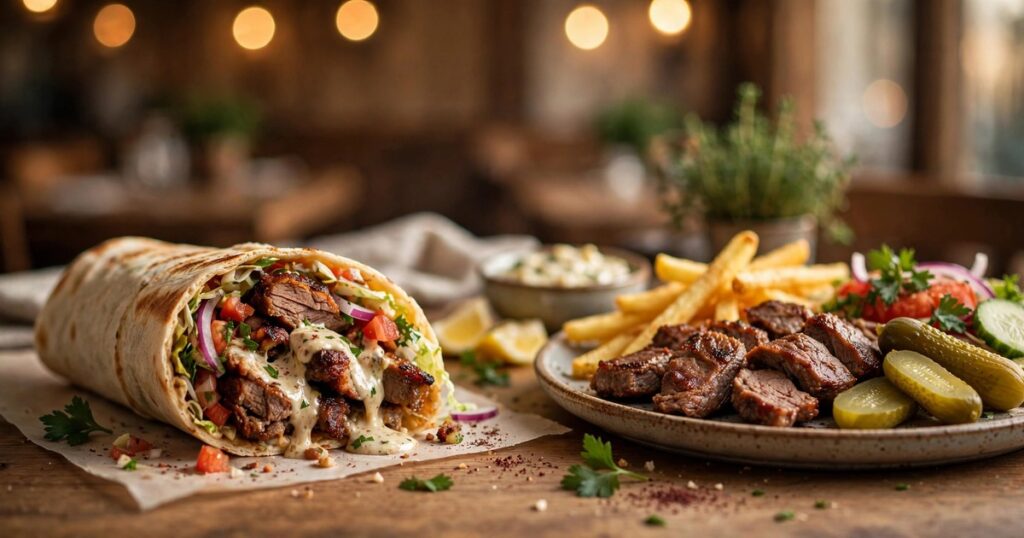
Type “best shawarma near me” into your phone and you will get forty pins on a map. Half of them will be gas-station rotisseries. A quarter will be closed. The rest? A mix of excellent family-run shops and places that should honestly just sell falafel instead.
Shawarma deserves better than a guess. Done right, it is one of the most satisfying foods on the planet — meat shaved off a slowly turning spit, wrapped warm with garlic sauce and pickles, the edges of the bread lightly crisped from the grill. Done wrong, it is dry chicken, stale pita, and a sauce from a squeeze bottle that tastes like regret.
This guide is for people who want the good version. It covers how to judge a shawarma spot before you order, the main shawarma styles (Lebanese, Turkish, Egyptian, and the Mexican al pastor connection), what to order — wrap, plate, or loaded fries — how to check whether the meat is halal, typical prices, and how to search Google Maps like a pro. We also include standout examples in five US cities with serious shawarma scenes, so you know what “great” looks like. For more dining ideas in this vein, browse our food guides.
Quick Answer: The best shawarma near you is the shop with a visible vertical spit turning all day, meat carved to order, warm bread, and fresh garlic sauce made in-house. Search Google Maps for “shawarma” plus your city, filter for ratings above 4.5 with 200+ reviews, and check recent photos for an actual rotisserie before you go.
What Does Great Shawarma Actually Look Like?
Before you search, it helps to know what you are hunting for. Shawarma is simple food — marinated meat stacked on a vertical rotisserie, roasted slowly as the spit turns, then shaved in thin ribbons and wrapped in flatbread with sauce, pickles, and vegetables. Because the ingredient list is short, quality is obvious. There is nowhere for a bad shop to hide.
Here is what a great shawarma spot has:
- A spit that is actually turning: The vertical rotisserie is the soul of shawarma. Good shops have meat on the spit during service hours, with a crisped, browned outer layer. If the spit is bare or wrapped in plastic at lunchtime, keep walking.
- Meat carved to order: The cook should shave the meat fresh as you order. Pre-sliced meat sitting in a steam tray loses its crisp edges and texture within minutes. Watch for the long knife and the satisfying shaving motion — it is the single best sign of a serious shop.
- Warm, fresh bread: Whether it is thin saj bread, pita, or lavash, it should be warm and pliable. Cold, cracking bread means the shop does not care enough — and the wrap will fall apart in your hands.
- Sauces made in-house: Real toum (Lebanese garlic sauce) is an emulsion of garlic, oil, lemon, and salt, whipped fresh. It is fluffy, bright, and intensely garlicky. If the garlic sauce is thin, watery, or tastes faintly of chemicals, it came from a jug.
- Fresh pickles and garnishes: Turnip pickles (the bright pink ones), cucumber pickles, fresh parsley, tomatoes, and onions should look alive, not tired. Pickles are not a side note in shawarma — their acidity cuts the richness of the meat.
And the warning signs: a menu with fifty unrelated items (shawarma plus pizza plus wings plus sushi is never a good sign), meat that looks gray instead of caramelized, bread that snaps instead of folds, and a garlic sauce you can see through. Trust the signs. Your dinner will thank you.
What Are the Main Shawarma Styles?
Shawarma traveled. The dish started in the Ottoman Empire — the vertical rotisserie technique is related to the Turkish döner kebab — and spread across the Middle East, each region making it its own. Then Lebanese immigrants carried it to Mexico in the early 1900s, where it became tacos al pastor. Knowing the styles helps you know what to expect when you walk in.
| Style | Typical Meat | Bread | Signature Sauce | Best For |
|---|---|---|---|---|
| Lebanese | Chicken or beef/lamb, marinated with warm spices | Thin saj or markouk flatbread | Toum (whipped garlic sauce); tahini for beef | The classic wrap experience — garlicky, juicy, perfect balance |
| Turkish (Döner) | Ground-and-formed lamb/beef or sliced chicken | Pide, lavash, or dürüm wrap | Yogurt-garlic sauce, spicy pepper sauce | Hearty wraps and plates; Iskender-style plates with tomato sauce and browned butter |
| Egyptian | Chicken or beef with vinegar-forward marinade | Baladi (whole-wheat) pita or Syrian bread | Tahini and pickled vegetables | A tangier, pickle-heavy wrap — great with extra turnips |
| Mexican (Al Pastor) | Pork (traditional) or chicken, achiote-and-chile marinated | Corn tortillas | Salsa, lime, cilantro, onion | Taco night — the shawarma technique applied to Mexican flavors |
A quick note on the Lebanese style, since it is what most Americans mean by “shawarma”: chicken shawarma gets the toum treatment, while beef or lamb shawarma traditionally pairs with tahini instead of garlic sauce. A shop that knows the difference is a shop that knows its food. Also note that traditional al pastor uses pork, so Muslim diners looking for a halal option should ask for the chicken version — many taquerias offer it.
Wrap, Plate, or Loaded Fries: What Should You Order?
The shawarma menu can look overwhelming the first time, but it really comes down to three formats. Each has its moment.
The wrap (sandwich)
The default, and usually the best test of a shop. A proper wrap is grilled or pressed after rolling, so the bread gets lightly crisped and the garlic sauce warms through. Ask for it “with everything” unless you have strong preferences — pickles, fries inside the wrap (the Lebanese way), and extra toum if you are feeling bold. Eat it immediately; a wrap that sits steams itself soggy.
The plate
Sliced shawarma meat over rice or fries with bread, salad, hummus, and extra sauce on the side. This is the move when you are very hungry or dining in — you get more meat than a wrap, and the components stay separate so textures survive. A good plate feeds one hungry person generously or works as a shared starter for two light eaters.
Loaded shawarma fries
The indulgent option: fries topped with chopped shawarma meat, garlic sauce, tahini or cheese sauce, pickles, and sometimes hot sauce. Some shops call these “shawarma poutine” or “mixed grill fries.” They are messy, enormous, and absolutely worth it once in a while. Order these to share.
If you are a first-timer at a new shop, order the chicken shawarma wrap. It is the dish every shop should do well, and it tells you everything about their standards. If the wrap is great, come back for the plate. If you are a vegetarian, ask about falafel or mushroom shawarma — many good shops offer them, and they are made with the same care as the meat.
Is the Shawarma Halal? How to Check
Most shawarma shops in the US are Muslim-owned and serve halal meat by default — but “most” is not “all,” and halal standards vary. Here is how to verify without making it awkward:
- Look for signage: Many shops display “100% Halal” on the door, menu, or window. Some name their certifying body. This is the easiest check and a good sign of transparency.
- Check the website or Google listing: Shops that serve halal meat almost always say so online, since it is a major draw for their core customers. If halal status is not mentioned anywhere, that is worth a question.
- Just ask: “Is your chicken halal?” is a completely normal question at a shawarma counter. Good shops answer immediately and specifically — some will even tell you whether it is hand-slaughtered (zabiha) or machine-slaughtered, and name their supplier.
- Ask about cross-contamination if it matters to you: If the shop also serves non-halal items, ask whether meats share the grill or fryer. Most dedicated shawarma shops are fully halal, so this is rarely an issue, but it never hurts to ask.
If halal dining is a priority for you generally, our best halal food near me guide covers how to find certified halal restaurants of every kind, and our halal steakhouse guide takes the same verification approach to a fancier night out.
How Much Does Shawarma Cost in 2026?
Shawarma remains one of the best value meals in American fast-casual dining. Prices have crept up with everything else, but a filling meal still costs less than most burger combos. Typical US price ranges:
- Chicken shawarma wrap: $9–$14, depending on city. New York and LA run higher; Dearborn and Houston run lower.
- Beef or lamb shawarma wrap: $11–$16. Mixed grill wraps (chicken + beef) usually sit at the top of this range.
- Shawarma plate: $14–$20. More meat, plus rice, salad, hummus, and bread — easily the best value per ounce of protein.
- Family platter: $40–$65, feeds 3–5 people. The smartest order for a group.
Rule of thumb: if a chicken wrap costs more than $16, the shop should be exceptional — or located in Manhattan. Under $10 in 2026 usually means smaller portions or a lunch special, not necessarily a red flag. And watch for the extras that add up: extra meat ($3–$5), premium sauces, and drinks can push a $12 wrap toward $20.
How Do I Find the Best Shawarma Near Me on Google Maps?
You already have the best shawarma-finding tool ever made in your pocket. Most people just use it badly. Here is how to search like someone who actually finds good food:
- Search “shawarma” — not “Middle Eastern restaurant”: The specific term filters out generic Mediterranean grills and lands you on dedicated shawarma shops. Add your neighborhood for precision: “shawarma Astoria” beats “shawarma Queens.”
- Filter for 4.5+ stars with 200+ reviews: A 5.0 rating with 12 reviews means the owner’s cousins all visited. A 4.6 with 1,500 reviews means the neighborhood keeps coming back. Volume of reviews matters more than a perfect score.
- Read the 3-star reviews: Five-star reviews are love letters; one-star reviews are grudges. Three-star reviews are where honest diners say “great meat, slow service” or “good but pricey.” That is actionable intelligence.
- Check the photos before the rating: Scroll to recent customer photos and look for the spit. Actual rotisserie photos from real customers tell you more than any review. Also look at the wrap cross-section shots — juicy meat and generous sauce are visible.
- Search in the right languages: In Dearborn, search “شاورما” too. In heavily Turkish neighborhoods, “döner” finds spots that “shawarma” misses. The best shop in an area is not always the one optimized for English search.
- Check hours and “popular times”: Shawarma shops have rhythms. The spit is fullest and freshest at lunch and dinner rushes. A shop that closes at 3 PM and reopens at 5 may be slicing fresh for the evening — or serving lunch leftovers. Popular-times data on Maps helps you time it.
Which US Cities Have the Best Shawarma Scenes?
Shawarma quality follows immigration patterns. The best scenes are in cities with large Middle Eastern communities, where competition is fierce and customers know the difference between good toum and a jug. These are well-known examples in each city — starting points, not an exhaustive ranking.
Dearborn, Michigan
The undisputed capital of Middle Eastern food in America. Warren Avenue is lined with Lebanese bakeries, butchers, and shawarma counters competing block by block, which keeps quality high and prices low — chicken wraps here often run $8–$11. If you are ever passing through metro Detroit, this is the pilgrimage.
New York City, New York
Astoria in Queens is the city’s shawarma heartland, with Egyptian and Lebanese shops side by side, while Bay Ridge in Brooklyn leans Lebanese and Palestinian. Expect $11–$15 for a chicken wrap. The density means you can comparison-shop within a few blocks — a luxury most cities do not offer.
Chicago, Illinois
Chicago’s shawarma scene runs on its Palestinian and Jordanian communities, strong on the Southwest Side and in the suburbs — Bridgeview is sometimes called Little Palestine. Chicken shawarma with extra garlic sauce is the local default order, and plates with yellow rice are a regional signature worth seeking out.
Houston, Texas
Houston’s enormous and diverse Muslim community supports one of the deepest halal shawarma scenes in the South, with Lebanese, Egyptian, Turkish, and Yemeni spots across the city. Prices are friendly ($9–$13 for a wrap), portions are Texas-sized, and late-night shawarma after midnight is easy to find.
Los Angeles, California
LA’s shawarma runs through its Armenian and Lebanese communities — Glendale and East Hollywood especially. The Armenian influence means excellent lavash wraps and strong kebab programs alongside the shawarma. You will pay a bit more ($12–$16), but the bread quality is consistently excellent.
No great shawarma scene near you? College towns and suburbs near any major metro usually have at least one family-run shop worth trying — apply the quality checklist from the first section and the Maps strategy above, and you will rarely go wrong.
Frequently Asked Questions
Is shawarma always halal?
Not always, but usually. Most shawarma shops in the US are Muslim-owned and serve halal meat as standard — many display “100% Halal” signage. However, some Mediterranean grills serve shawarma-style meat without halal certification, and traditional Mexican al pastor uses pork. When in doubt, ask: “Is your chicken halal?” is a normal question at any shawarma counter.
What is the difference between shawarma and gyros?
Both are meat cooked on a vertical rotisserie, but they come from different traditions. Gyros is Greek — typically pork or chicken, served in pita with tzatziki, tomatoes, onions, and fries. Shawarma is Middle Eastern — chicken, beef, or lamb with warm spices, served with garlic sauce (toum) or tahini, pickles, and thin flatbread. Similar technique, different flavor world.
How much does shawarma cost in the US?
In 2026, expect $9–$14 for a chicken shawarma wrap, $11–$16 for beef or lamb, $14–$20 for a plate, and $12–$17 for loaded shawarma fries. Family platters feeding 3–5 people run $40–$65. Prices are highest in New York and LA, lowest in Dearborn and Houston.
What is in a shawarma wrap?
A classic chicken shawarma wrap contains shawarma meat shaved from the rotisserie, garlic sauce (toum), pickles (cucumber and pink turnip), and sometimes fries and parsley, all rolled in warm flatbread and grilled or pressed. Beef shawarma wraps typically swap the garlic sauce for tahini. Every shop has its own formula — extra pickles and extra sauce are almost always free to request.
How do I find halal shawarma near me?
Search Google Maps for “halal shawarma” plus your city or neighborhood, then filter for 4.5+ stars with 200+ reviews. Check the listing and recent photos for halal signage, and confirm by asking the shop directly — good shops answer immediately and often name their supplier or certifier. Our halal food finder guide covers this in more depth for all cuisines.
What should I order at a shawarma spot for the first time?
Order the chicken shawarma wrap with everything. It is the dish every shawarma shop should do well, and it is the fastest way to judge their quality — the meat, the bread, the garlic sauce, and the pickles all have to be right. If the wrap impresses you, come back for the plate or the loaded fries next time.
Is shawarma healthy?
It can be. A chicken shawarma wrap is essentially grilled lean meat, vegetables, and pickles in flatbread — roughly 500–700 calories, with solid protein. The calorie traps are the garlic sauce (oil-based, so ask for light sauce), fries inside the wrap, and large plates with extra rice. Order sauce on the side and skip the fries-in-wrap if you are counting.
I’m Lila Spoonbelle, your host on this flavorful ride through food, fun, and fearless puns. Let’s turn every bite into a burst of laughter!