
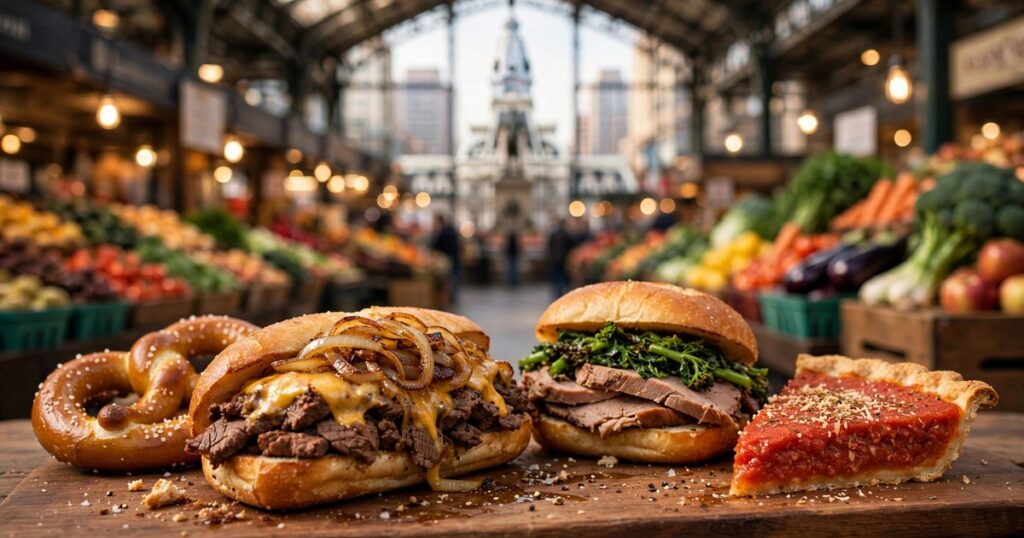
Philadelphia eats like a city that has nothing to prove and everything to feed you. This is the birthplace of the cheesesteak, the roast pork sandwich, the soft pretzel, and water ice — a city where a $12 sandwich from a corner shop can be just as memorable as a tasting menu at one of the best restaurants in America. Philadelphia’s food scene is proudly unpretentious: cash-only counters sit a few blocks from James Beard Award winners, and locals will happily argue for an hour about which cheesesteak is best while standing in line for one. Whether you are in town for a weekend of sightseeing or a week of eating, this guide will show you exactly where to eat in Philadelphia without wasting a single meal.
Philadelphia’s food is organized by neighborhood, and each one has its own flavor. Center City and Rittenhouse are home to the city’s fine dining and BYOB restaurants. South Philly holds the Italian Market and the famous cheesesteak intersection. Fishtown and Northern Liberties are the creative, chef-driven heart of the city. Old City mixes history with excellent brunch spots, and West Philadelphia brings global flavors near the universities. This guide covers all of them, plus what to order, what it costs, and how to plan a great eating day. It is part of our Food Guides series — if you are planning a food-focused trip, pair it with our guides to where to eat in Los Angeles and where to eat in Nashville.
Quick Answer: If you are wondering where to eat in Philadelphia, start with Zahav for modern Israeli fine dining, Vernick Food & Drink in Rittenhouse, Kalaya for Thai, John’s Roast Pork for cheesesteaks and roast pork, and DiNic’s at Reading Terminal Market. Expect $10–$20 per person for casual meals and $75–$150 for fine dining.
What Is Philadelphia Known for Food-Wise?
Philadelphia is known first for the cheesesteak, and for good reason. The sandwich was invented here in the 1930s, when Pat Olivieri, a hot dog vendor in South Philadelphia, grilled some beef and put it on an Italian roll. The cheesesteak has been the city’s signature dish ever since, and the rivalry between Pat’s King of Steaks and Geno’s Steaks — the two stands facing each other at 9th and Passyunk — is one of the great food debates in America. But the cheesesteak is only the beginning. Philadelphia’s roast pork sandwich, with sharp provolone and garlicky broccoli rabe, is beloved by many locals even more than the cheesesteak. The hoagie, Philadelphia’s version of the submarine sandwich, is a lunchtime institution. Soft pretzels, sold from street carts and corner stores, are the city’s everyday snack. Water ice — pronounced “wooder ice” by locals — is the frozen treat that gets Philadelphians through humid summers. And tomato pie, a room-temperature square of focaccia-like dough topped with tomato sauce, is the bakery staple that visitors often miss entirely.
Beyond the icons, Philadelphia is known for its markets. Reading Terminal Market, one of the oldest and largest public markets in America, has fed the city since 1893, and the Italian Market on South 9th Street is the oldest continuously operating outdoor market in the country. The city is also known for its BYOB culture: Pennsylvania’s liquor laws make restaurant liquor licenses expensive and scarce, so hundreds of small restaurants let you bring your own bottle of wine — a tradition that has shaped the city’s dining scene for decades. Add a world-class fine dining scene, a thriving food truck culture, and neighborhood restaurants that punch far above their weight, and Philadelphia is one of the most rewarding food cities in the United States.
Where Should First-Time Visitors Eat in Philadelphia?
If you only have one day to figure out where to eat in Philadelphia, start at Reading Terminal Market. Arrive hungry in the morning and work your way through the stalls: a roast pork sandwich at DiNic’s, a pretzel from a Pennsylvania Dutch bakery stand, and a scoop of water ice or ice cream for dessert. The market is a meal and a history lesson in one room, and it sits right next to the Convention Center in Center City, so it is easy to reach from anywhere downtown.
For lunch, head to South Philadelphia for the cheesesteak pilgrimage. Order a cheesesteak at Pat’s King of Steaks, then walk across the street and try one at Geno’s Steaks — that is how locals settle the debate, and you will have an opinion within ten minutes. If the lines look long, walk a few blocks to John’s Roast Pork, where the cheesesteak is often better and the roast pork sandwich is the real star. In the evening, book a table at Zahav in Old City, the modern Israeli restaurant that won the James Beard Award for Outstanding Restaurant. The tasting menu of salatim, hummus, and wood-fired meats is one of the best meals in America, and the dining room is warm, lively, and welcoming.
On your second day, explore the neighborhoods. Start with brunch in Rittenhouse Square — Vernick Food & Drink is a classic choice — then spend the afternoon wandering the Italian Market, stopping for coffee, cheese, and Italian pastries along South 9th Street. In the evening, head to Fishtown for dinner at one of the neighborhood’s many creative restaurants, then finish the night with a soft pretzel and a water ice from a corner shop. That is Philadelphia in a weekend: markets, sandwiches, fine dining, and neighborhoods that each taste like themselves.
What Are the Best Restaurants in Philadelphia by Neighborhood?
Philadelphia rewards visitors who explore by neighborhood. Each district has its own rhythm, its own specialties, and its own price range. Here is how they compare.
| Neighborhood | What to eat | Price range |
|---|---|---|
| Center City / Rittenhouse | Fine dining, BYOB, brunch, Reading Terminal Market | $$–$$$$ |
| Old City | Zahav, historic taverns, brunch | $$–$$$$ |
| Fishtown | Creative small plates, pizza, craft beer | $$–$$$ |
| South Philly | Cheesesteaks, roast pork, Italian Market, Mexican food | $–$$ |
| Northern Liberties | Modern American, cafes, brunch | $$–$$$ |
| West Philly / University City | Global flavors, Ethiopian, Vietnamese, food trucks | $–$$ |
| Chestnut Hill / Manayunk | Neighborhood bistros, brunch, riverside dining | $$–$$$ |
Center City is the easiest base for a first visit. Rittenhouse Square is the city’s prettiest dining district, with sidewalk cafes, wine bars, and fine dining restaurants clustered around the park. Old City, a short walk east, mixes colonial history with some of the city’s best restaurants, including Zahav and Amá. Fishtown, just north of Old City, is where the city’s young chefs open their first restaurants — expect creative menus, natural wine, and walk-in-friendly dining rooms. South Philly is where the food icons live: the cheesesteak stands, the Italian Market, and some of the best Mexican food in the city. Northern Liberties and West Philadelphia reward explorers with global flavors and lower prices, while Chestnut Hill and Manayunk offer a quieter, neighborhood feel with excellent bistros and brunch spots.
Where Is the Best Cheesesteak in Philadelphia?
The honest answer is that there is no single best cheesesteak in Philadelphia — there are several great ones, and locals will defend their favorite for life. The most famous rivalry is Pat’s King of Steaks versus Geno’s Steaks, the two stands that have faced each other across 9th and Passyunk since the 1960s. Pat’s is the original, founded by the inventor of the cheesesteak, and its sandwiches are chopped fine with the cheese worked through the meat. Geno’s is flashier, with neon signs and a bigger menu, and its steaks are sliced a little chunkier. Ordering at either one follows the local ritual: state your cheese (“wit” means with fried onions, “witout” means without), pay at the window, and eat standing up. Both are open late, both are cash-friendly, and both are worth visiting at least once.
But ask a Philadelphian where they actually eat cheesesteaks, and many will point you elsewhere. John’s Roast Pork, a tiny shop in South Philadelphia, is the choice of many locals — its cheesesteak is superb, and its roast pork sandwich with sharp provolone and broccoli rabe is arguably the better sandwich on the menu. Angelo’s Pizzeria, also in South Philly, makes a cheesesteak on house-baked bread that has drawn national attention, and its lines can stretch around the block. Dalessandro’s Steaks in Roxborough is the go-to for the northwest neighborhoods, known for its finely chopped meat and generous portions. Jim’s Steaks on South Street, a longtime favorite, reopened after a fire and remains a classic stop. And if you want a cheesesteak without the wait, almost any good pizzeria or sandwich shop in the city will make a solid one — the cheesesteak is Philadelphia’s everyday food, not just a tourist attraction.
A few ordering tips make the experience smoother. “Wit” and “witout” refer to onions, not cheese — you still need to name your cheese: American, provolone, or Cheez Whiz. Whiz is the traditional choice, and it is not a joke — the salty, creamy sauce is what many locals grew up on. Provolone, especially sharp provolone, is the connoisseur’s pick. American cheese melts into the meat for a milder, creamier sandwich. Eat it right away, while the roll is still soft and the cheese is still hot. And do not ask for a cheesesteak with lettuce and tomato unless you want a gentle correction — that is a different sandwich entirely.
What Should You Eat at Reading Terminal Market?
Reading Terminal Market is the single best place to eat in Philadelphia if you only have a few hours. The market has operated in the same building since 1893, and today it holds more than 80 merchants under one roof: butchers, bakers, cheesemongers, produce stands, and prepared-food stalls from nearly every community in the city. Come hungry, come early, and come with a plan — the market gets crowded by lunchtime, especially on Saturdays.
Start with the icons. DiNic’s Roast Pork is the market’s most famous stall — its roast pork sandwich, piled with sharp provolone and broccoli rabe, was named one of the best sandwiches in America, and the line moves fast. Beiler’s Bakery, from the Pennsylvania Dutch community, sells doughnuts and baked goods that draw lines of their own; the apple fritters are a local legend. For a classic Philadelphia breakfast, try a scrapple sandwich or a soft pretzel from one of the Amish bakery stands. The market also has excellent options beyond the classics: Middle Eastern food, Cambodian dishes, fresh oysters, and one of the best collections of Pennsylvania Dutch food anywhere.
Here are a few practical tips for the market. Go before 11 a.m. if you can — the crowds build fast and the most popular stalls sell out of specialties. Bring cash for the smaller stalls, although most now take cards. The seating area in the center fills up quickly, so be ready to eat standing up or take your food outside. And do not rush: the market rewards wandering. Talk to the vendors, taste the samples, and buy some cheese, bread, or baked goods to take home — the market is as much a grocery store as a food hall, and the merchants are proud of what they sell.
What Is the Italian Market (South 9th Street) Like?
The Italian Market on South 9th Street is the oldest continuously operating outdoor market in the United States, and it still feels like one. Unlike Reading Terminal Market, which is indoors and curated, the Italian Market is a working street market: fruit and vegetable stalls spill onto the sidewalk, butchers and cheese shops open onto the street, and the smell of fresh bread drifts from the bakeries. It is less polished than Reading Terminal Market and more rewarding for it — this is where South Philadelphians actually shop, and where some of the city’s best Italian food is hiding.
Walk the market from Christian Street down to Washington Avenue, stopping as you go. Pick up fresh mozzarella and imported cheese at a deli counter, browse the produce stalls for vegetables you will not find at a supermarket, and step into one of the old-school Italian bakeries for cannoli, biscotti, or tomato pie. The market’s restaurants are worth a sit-down meal, too: Ralph’s Italian Restaurant, open since 1900, is the oldest continuously operating Italian restaurant in America, and the red-sauce classics there are exactly as comforting as they should be. Nearby, Fiorella — a tiny, reservation-only pasta restaurant — is one of the hottest tables in the city, serving handmade pasta in a dining room that seats barely a dozen people.
The Italian Market is also the gateway to the neighborhood’s Mexican food scene. South 9th Street’s southern end, near Washington Avenue, is lined with Mexican restaurants, taquerias, and grocery stores — some of the best tacos and tortas in the city are a short walk from the Italian delis. Visit in the morning for the full market atmosphere, when the stalls are busiest and the street is at its liveliest. The market is outdoors, so check the weather — a rainy day still works, but a sunny morning is ideal.
What Are the Best Fine Dining Restaurants in Philadelphia?
Philadelphia’s fine dining scene is small, ambitious, and deeply personal — the city’s best restaurants feel like the chef’s own home, not a corporate dining room. Zahav, in Old City, is the flagship: Michael Solomonov’s modern Israeli restaurant serves a tasting menu built around wood-fired cooking, salatim, and his famous hummus, and it remains one of the most celebrated restaurants in the country. Book weeks ahead, and plan on the full experience — the tasting menu is the way to go.
Vernick Food & Drink, on Walnut Street in Rittenhouse, is Philadelphia’s most reliable special-occasion restaurant. The dining room is warm and elegant, the menu leans on seasonal American cooking, and the service is the kind that makes a birthday or anniversary feel effortless. Kalaya, in Fishtown, is the city’s great Thai restaurant — chef Nok Suntaranon cooks the fiery, funky food of her childhood in Thailand’s Trang province, and the menu of curries, grilled meats, and salads is unlike anything else in the city. Lacroix, in the Rittenhouse Hotel, serves a refined tasting menu in one of the prettiest dining rooms in Philadelphia. Fiorella, in South Philly, is a pasta lover’s dream: handmade pasta, a tiny dining room, and a chef who cooks with total conviction. Laser Wolf, also from the Zahav team, pairs skewers and grilled meats with a famous all-you-can-eat salatim bar and one of the best rooftop views in the city. And Amá, in Old City, serves modern Mexican food — wood-fired dishes, excellent mezcal cocktails, and a dining room that feels like a celebration.
Fine dining in Philadelphia is more affordable than in New York or Washington, but reservations still matter. Zahav, Fiorella, and Kalaya book up quickly, especially on weekends — reserve as soon as your dates are set. Many of the city’s best restaurants also offer a bar menu or counter seating for walk-ins, which is a good fallback if you could not get a table. And remember that Philadelphia’s fine dining is casual by big-city standards: you will not need a jacket or tie, and the dining rooms are lively, not hushed.
What Is BYOB Culture in Philadelphia and How Does It Work?
Philadelphia’s BYOB culture is one of the city’s quirks — and one of its great gifts to diners. Pennsylvania’s liquor laws make restaurant liquor licenses rare and expensive, so hundreds of small restaurants simply do not serve alcohol. Instead, they invite you to bring your own bottle. You buy a bottle of wine at a state liquor store (or a beer at a beer distributor), bring it to the restaurant, and the staff will open it and pour it for you. Many restaurants charge a small corkage fee, often $5 to $15, and some charge nothing at all.
BYOB is a budget win and a quality win. A bottle of wine that would cost $60 on a restaurant wine list costs $15 at the state store, and you get to drink exactly what you like. It is also a social ritual: Philadelphians plan their BYOB dinners around the bottle, stopping at the liquor store on the way to the restaurant. The best BYOB restaurants are concentrated in Center City, Fishtown, and South Philly, and many of the city’s most beloved small restaurants — the ones with a dozen tables and a chef cooking at the pass — are BYOB. When you see “BYOB” on a Philadelphia restaurant’s website, treat it as a good sign: it usually means a small, chef-driven place that cares more about the food than the bar program.
A few practical notes: check the restaurant’s corkage policy before you go, since some places limit the number of bottles or charge per bottle. Bring a bottle you actually like — the restaurant will not have a backup if you forget. And do not expect a beer list at a BYOB restaurant; if you want beer, bring it with you. The state liquor stores, run by the Pennsylvania Liquor Control Board, are easy to find around Center City and Rittenhouse, and they stock a good range of wine at fair prices.
How Can You Eat Well in Philadelphia on a Budget?
Philadelphia is one of the best budget food cities in America, because its most famous dishes are also its cheapest. A cheesesteak, a roast pork sandwich, a hoagie, or a slice of tomato pie all cost under $15, and each one is a legitimate meal, not a compromise. The city’s food trucks are another budget secret: West Philadelphia and University City are full of trucks serving everything from halal carts to tacos to Vietnamese sandwiches at prices that would be impossible in a sit-down restaurant. Reading Terminal Market is a budget-friendly feast in itself — you can eat extremely well for $15 by grazing the stalls instead of sitting down for a full meal.
Beyond the icons, look for the city’s happy hours and lunch specials. Center City restaurants run some of the best happy hours in the country, with discounted oysters, small plates, and drinks in the late afternoon. Many fine dining restaurants offer a cheaper lunch menu or a bar menu with smaller portions of the same dishes. And the city’s BYOB restaurants let you skip the wine markup entirely — bring a $12 bottle and your dinner bill drops by a third. If you are traveling with a group, order family-style at one of the city’s Italian or Thai restaurants and split the bill: the portions are generous and the per-person cost drops fast.
When Is the Best Time to Eat Out in Philadelphia?
Philadelphia is a year-round food city, but each season has its own flavor. Spring, from March through May, is the best all-around season: the weather is mild, the outdoor seating opens up, and the city’s produce markets fill with asparagus, ramps, and spring vegetables. Summer brings the city’s outdoor dining into full swing — sidewalk cafes in Rittenhouse, beer gardens in Fishtown, and water ice stands on every corner — but it also brings humidity and crowds, especially around the historic sites in Old City.
Fall, from September through November, is arguably the best time to visit for food. The weather cools, the crowds thin, and the restaurant scene settles into its rhythm after the summer. It is also harvest season in Pennsylvania, so the farmers markets and restaurant menus are full of apples, squash, and mushrooms from the surrounding countryside. Winter, from December through February, is the quietest season — restaurant week deals appear, reservations get easier, and the city’s comfort food (roast pork, tomato pie, hearty Italian dishes) tastes best in the cold. If you are visiting in winter, book a table at one of the city’s cozy dining rooms and order the richest thing on the menu.
Timing within the day matters too. Reading Terminal Market is best before 11 a.m., when the stalls are fully stocked and the crowds are thin. Cheesesteak stands are open late and are at their best as a late-night meal. Fine dining restaurants book up on Friday and Saturday nights, so try a weeknight for easier reservations. And if you are visiting during a major event — a convention, a sports game, or a holiday weekend — book your restaurant tables as early as you can, because the city’s best dining rooms fill up fast.
How Much Should You Budget for Food in Philadelphia?
Philadelphia is noticeably cheaper than New York or Washington, D.C., and a little cheaper than Boston. A realistic daily food budget depends on how you eat, but the city’s mix of cheap icons and affordable fine dining means you can eat very well at almost any budget. Here is a practical guide.
| Daily budget | What it covers | Example day |
|---|---|---|
| $30–$50 | Budget | Market breakfast, cheesesteak lunch, food truck dinner |
| $50–$90 | Mid-range | Cafe brunch, Reading Terminal Market lunch, BYOB dinner |
| $90–$150 | Comfortable | Rittenhouse brunch, Italian Market lunch, nice restaurant dinner |
| $150–$250 | Fine dining | Brunch, market grazing, tasting menu at Zahav or Vernick |
For a typical weekend trip, budget about $75 to $125 per person per day for food, including one nice dinner. That covers a casual breakfast, a market or sandwich lunch, and a proper dinner at a good restaurant — with a water ice or soft pretzel thrown in. If you are traveling on a tight budget, $40 a day is genuinely doable: the city’s iconic sandwiches, market stalls, and food trucks are delicious and cheap. And if you are celebrating, a tasting menu at Zahav or Vernick runs $75 to $150 per person before wine — a splurge, but a memorable one.
What Practical Tips Should You Know Before Eating in Philadelphia?
A few practical details make eating in Philadelphia smoother. Reservations are essential for the city’s best restaurants — Zahav, Fiorella, Kalaya, and Vernick all book up days or weeks ahead, especially on weekends. For popular restaurants, check the reservation system the moment your travel dates are set, and set an alert if your first choice is full. For walk-in restaurants, arrive early or be ready to wait; Fishtown and South Philly dining rooms fill up by 7 p.m. on weekends.
Getting around is easy. Center City, Old City, Rittenhouse, and South Philly are all walkable, and the city’s compact layout means you can walk between most of the major food neighborhoods. SEPTA, the city’s transit system, runs the Market-Frankford Line (the El) and the Broad Street Line, plus buses and trolleys that connect the neighborhoods. A SEPTA Key card or contactless payment covers the subway and buses. Rideshares are plentiful, but parking is a different story: street parking in Center City and South Philly is scarce and strictly enforced, so use a garage if you are driving, and expect to pay for it.
Finally, a few local customs. Tipping is standard: 18 to 20 percent at sit-down restaurants, a dollar or two at a counter. Cash is still useful at cheesesteak stands and market stalls, even though most now take cards. And do not be shy about asking locals for recommendations — Philadelphians love talking about food, and the person behind you in line at a cheesesteak stand probably has a strong opinion about where you should eat next. Take the recommendation.
Frequently Asked Questions About Where to Eat in Philadelphia
Where should I eat in Philadelphia for the first time?
Start at Reading Terminal Market for a roast pork sandwich at DiNic’s, then visit Pat’s and Geno’s in South Philly for cheesesteaks, and book dinner at Zahav in Old City. Those three stops cover the market, the sandwich, and the fine dining that define where to eat in Philadelphia.
What is the best cheesesteak in Philadelphia?
There is no single winner, but the most beloved picks are Pat’s King of Steaks and Geno’s Steaks for the classic rivalry, John’s Roast Pork for the locals’ favorite, and Angelo’s Pizzeria for a cheesesteak on house-baked bread. Try at least two and decide for yourself.
Is Reading Terminal Market worth visiting?
Yes, absolutely. Reading Terminal Market is one of the best food markets in America, with more than 80 merchants, the famous DiNic’s roast pork sandwich, Pennsylvania Dutch baked goods, and food from nearly every community in the city. Go before 11 a.m. to beat the crowds.
How much does it cost to eat in Philadelphia?
Casual meals cost $10–$20 per person — cheesesteaks, sandwiches, and market food are all in that range. A nice dinner at a mid-range restaurant runs $40–$70 per person, and a tasting menu at a fine dining restaurant costs $75–$150 per person before drinks.
What is BYOB in Philadelphia?
BYOB means “bring your own bottle.” Because Pennsylvania liquor licenses are expensive, many small Philadelphia restaurants let you bring your own wine or beer instead of serving alcohol. You buy a bottle at a state liquor store, bring it to the restaurant, and pay a small corkage fee, usually $5–$15.
Where is the best neighborhood to stay for food in Philadelphia?
Center City and Rittenhouse Square are the best bases for food: they are walkable, close to Reading Terminal Market, and packed with restaurants, cafes, and BYOB spots. Fishtown is the best choice if you want the city’s most creative, chef-driven dining within walking distance of your hotel.
What food is Philadelphia famous for besides cheesesteaks?
Philadelphia is also famous for roast pork sandwiches, hoagies, soft pretzels, water ice, scrapple, and tomato pie. The city is also known for Reading Terminal Market, the Italian Market on South 9th Street, and a strong fine dining scene led by restaurants like Zahav, Vernick, and Kalaya.
I’m Lila Spoonbelle, your host on this flavorful ride through food, fun, and fearless puns. Let’s turn every bite into a burst of laughter!