
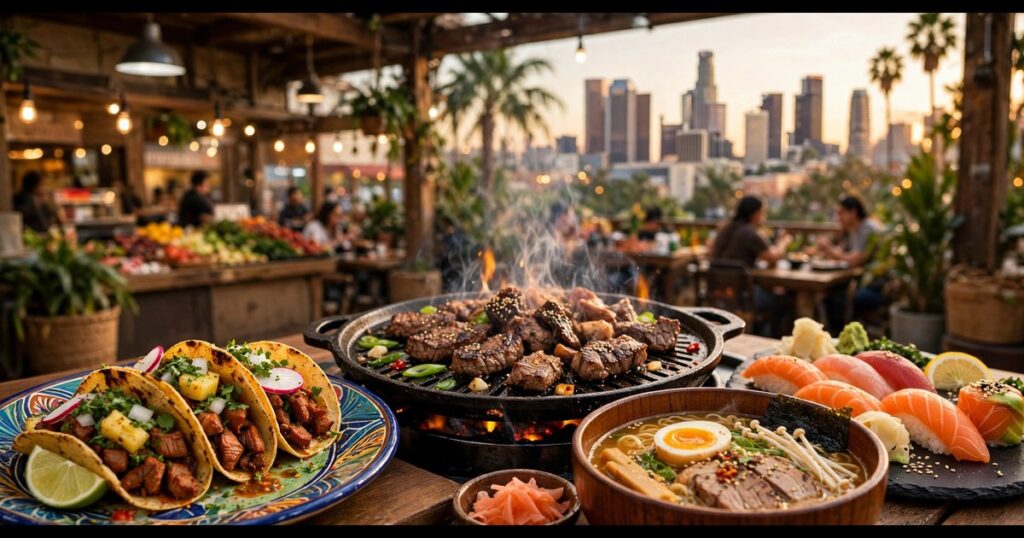
Los Angeles eats like it dreams: big, restless, and endlessly varied. In a single day you can start with a breakfast burrito from a truck in East LA, eat hand-pulled noodles in the San Gabriel Valley at lunch, and finish with a tasting menu in Beverly Hills — and every one of those meals can be the best thing you eat all year. No other American city packs this many food cultures into one sprawl: Mexican, Korean, Japanese, Thai, Chinese, Armenian, Persian, Filipino, Salvadoran, Ethiopian, and more, all cooking at full strength. Whether you are here for a weekend or a week, this guide will help you find the best restaurants in Los Angeles without wasting a single meal.
Los Angeles is a driving city, and its food scene is spread across distinct neighborhoods, each with its own flavor: tacos and Oaxacan food in East LA and Boyle Heights, Korean BBQ in Koreatown, sushi and ramen in Little Tokyo, creative cooking in Silver Lake and the Arts District, and beachside dining in Santa Monica and Venice. This guide covers all of them, plus what to order, what it costs, and how to plan a great eating day. It is part of our Food Guides series — pair it with our guides to where to eat in Nashville and where to eat in Houston if you are planning a food-focused road trip.
Quick Answer: The best restaurants in Los Angeles include n/naka and Providence for fine dining, Bestia and Guelaguetza for special occasions, Sonoratown and Guisados for tacos, Park’s BBQ for Korean BBQ, Sushi Gen for omakase, and Grand Central Market for sampling many vendors in one stop. Budget $15–$25 per person for casual meals and $150–$300 for fine dining.
What Is Los Angeles Known for Food-Wise?
Los Angeles is known first for its tacos. The city is home to the best Mexican food in the United States outside of Mexico itself, and the range is staggering: al pastor shaved off the trompo at Leo’s Tacos, mesquite-grilled carne asada at Sonoratown, birria at Teddy’s Red Tacos, Oaxacan moles at Guelaguetza, and late-night tacos from trucks like Avenue 26. Tacos are not a snack here — they are a way of life, and locals argue about them the way other cities argue about sports teams.
Beyond tacos, LA’s other great strength is its immigrant cooking, served without apology or translation. Koreatown has some of the best Korean food outside Seoul, from sizzling BBQ at Park’s BBQ to bubbling soon tofu at Sun Nong Dan. Little Tokyo is the heart of Japanese food in America, with ramen shops, hand-roll bars, and omakase counters. Thai Town, the only officially designated Thai Town in the country, serves fiery, funky dishes you will not find anywhere else. And the San Gabriel Valley, east of downtown, is one of the great Chinese food destinations in the world, with dim sum, Sichuan hot pot, hand-pulled noodles, and Taiwanese breakfasts. Add the city’s famous food trucks, its farmers markets, and a fine-dining scene with more Michelin stars than almost any other American city, and you have a food town with no equal.
Where Should First-Time Visitors Eat in Los Angeles?
If you only have one day in Los Angeles, start downtown at Grand Central Market, where you can taste the whole city in one room: eggslut breakfast sandwiches, tacos from Tacos Tumbras a Tomas, pupusas, and fresh juices. For lunch, head to Koreatown for Korean BBQ — Park’s BBQ or Quarters — where the tabletop grills and banchan make the meal an event. In the evening, book a table at Bestia in the Arts District, the industrial-chic Italian restaurant that has been one of the city’s hardest reservations for a decade.
On your second day, explore the east side. Start with breakfast at Sqirl in Silver Lake or a bagel at Courage Bagels, then spend the afternoon in East LA and Boyle Heights eating tacos: Sonoratown for carne asada, Guisados for braised-meat tacos, and a mariscos truck like Mariscos Jalisco for shrimp tacos. Finish the day with dinner in Little Tokyo — ramen at Daikokuya or sushi at Sushi Gen — and a walk through the neighborhood’s shops and plazas.
What Are the Best Restaurants in Los Angeles by Neighborhood?
Los Angeles rewards visitors who explore by neighborhood. Each district has its own rhythm, its own cuisine, and its own price range. Here is how they compare.
| Neighborhood | What to eat | Price range |
|---|---|---|
| Silver Lake / Echo Park | Creative cafes, tacos, modern American | $–$$$ |
| Koreatown | Korean BBQ, tofu soup, late-night eats | $–$$$ |
| Little Tokyo | Sushi, ramen, Japanese cafes | $–$$$$ |
| Arts District | Fine dining, Italian, coffee roasters | $$–$$$$ |
| West Hollywood / Beverly Hills | Fine dining, sushi, celebrity spots | $$$–$$$$ |
| Santa Monica / Venice | Seafood, California cuisine, beach cafes | $$–$$$$ |
| Hollywood | Thai, Armenian, classic diners | $–$$$ |
| East LA / Boyle Heights | Tacos, Oaxacan, mariscos, panaderias | $–$$ |
| San Gabriel Valley | Chinese, dim sum, Taiwanese, noodles | $–$$ |
| Downtown | Food halls, Grand Central Market, fine dining | $–$$$$ |
Silver Lake and Echo Park
Silver Lake is LA’s creative heart, and its restaurants match the neighborhood: inventive, casual, and very good. Sqirl is the area’s best-known breakfast spot, famous for its sorrel pesto rice bowl and ricotta toast. Alimento, a tiny Italian wine bar on Silver Lake Boulevard, serves handmade pasta and natural wine in a warm, candlelit room. For tacos, head to Echo Park, where Guisados serves slow-braised meat tacos — the cochinita pibil and the chile-braised beef are the ones to order. Courage Bagels, a Montreal-style bagel shop with lines out the door, is the neighborhood’s weekend ritual.
Koreatown
Koreatown is the beating heart of Korean food in America, and it never really sleeps. Park’s BBQ is the classic Korean BBQ experience: prime cuts grilled at your table, a dozen banchan, and a lively, smoky room. Quarters, its sister restaurant, is a little more modern and a little more affordable. For something different, Sun Nong Dan serves bubbling soon tofu stews and galbi jjim, the braised short ribs that have a cult following. Late at night, Koreatown’s restaurants stay open when the rest of the city has gone to bed — it is the best neighborhood in LA for a 2 a.m. meal.
Little Tokyo
Little Tokyo has been the center of Japanese life in Los Angeles for more than a century, and its food is the best in the country. Sushi Gen, the no-frills sushi bar on East 2nd Street, is the neighborhood’s institution — arrive early, because the line forms fast and the fish is extraordinary. Daikokuya, the ramen shop, is famous for its rich tonkotsu broth and its long waits, which are worth it. For omakase, the neighborhood’s counters are among the finest in America. Between meals, the Japanese Village Plaza is a lovely place to wander, with mochi shops, bakeries, and tea houses.
Arts District
The Arts District is where LA’s industrial past meets its fine-dining future. Bestia, the sprawling Italian restaurant in a converted warehouse, is the neighborhood’s anchor — handmade pastas, wood-fired pizzas, and a bone marrow dish that has become legendary. Bavel, from the same team, serves Middle Eastern-inspired food in a gorgeous, plant-filled room. The neighborhood is also home to some of the city’s best coffee roasters and bakeries, making it a great place to start a morning before the galleries open.
West Hollywood and Beverly Hills
West Hollywood and Beverly Hills are where LA dresses up. This is the home of the city’s most famous fine-dining rooms: n/naka, the modern kaiseki restaurant that serves one of the most celebrated tasting menus in America, and Providence, the temple of sustainable seafood. The area also has excellent sushi counters, classic steakhouses, and the see-and-be-seen restaurants of the Sunset Strip. Prices run higher here than anywhere else in the city, so this is the neighborhood for a special occasion.
Santa Monica and Venice
Santa Monica and Venice are LA’s beachside dining rooms, and the food tastes like the ocean air. Gjusta, the bakery and deli in Venice, is the neighborhood’s all-day anchor — order the smoked fish plate or a sandwich and eat it on the patio. Felix, also in Venice, serves some of the best handmade pasta in the city. In Santa Monica, the seafood is the draw: oysters, whole grilled fish, and California cuisine with a view of the Pacific. The farmers markets here are among the best in the country, and many of the city’s top chefs shop them on Wednesday and Saturday mornings.
Hollywood
Hollywood is more than the Walk of Fame. Thai Town, on the neighborhood’s east edge, is the only officially designated Thai Town in America, and its restaurants serve dishes you will not find anywhere else: Jitlada, the legendary Southern Thai restaurant, is famous for its fiery curries and its jungle curry, while Sapp Coffee Shop serves boat noodles and jade noodles to a devoted crowd. The neighborhood also has excellent Armenian and Persian food — Carousel, in East Hollywood, is the classic spot for Armenian kebabs and meze, and Raffi’s Place is beloved for its Persian stews and rice. Musso & Frank Grill, the century-old Hollywood steakhouse, is a living piece of film history.
East LA and Boyle Heights
East LA and Boyle Heights are the soul of Mexican food in Los Angeles. Sonoratown, in downtown-adjacent Boyle Heights, serves mesquite-grilled carne asada tacos that many Angelenos consider the best in the city. Guelaguetza, the Oaxacan restaurant in Koreatown-adjacent Mid-Wilshire, is the place for mole — seven varieties, served with chicken or enchiladas, plus tlayudas and mezcal. The mariscos trucks, like Mariscos Jalisco, serve shrimp tacos and ceviche that rival anything in Baja. And the panaderias — the Mexican bakeries — are worth a morning visit for pan dulce and coffee.
San Gabriel Valley
The San Gabriel Valley, east of downtown, is one of the great Chinese food destinations in the world. Din Tai Fung, in Arcadia, is the famous soup dumpling chain — the xiao long bao are delicate, precise, and worth the wait. Chengdu Taste, in Alhambra, serves fiery Sichuan dishes like mapo tofu and Chongqing chicken. For hand-pulled noodles, the valley’s noodle shops are the place to go, and for Taiwanese breakfast, the early-morning spots serve soy milk, scallion pancakes, and dan bing. If you care about Chinese food, plan a full day here — it is a destination in itself.
Which Los Angeles Restaurants Are Best for Each Occasion?
Not every great restaurant is great for every situation. Here is a quick guide to matching the meal to the moment.
- Best for a special occasion: n/naka (Palms) — modern kaiseki tasting menu, $$$$; book weeks ahead.
- Best classic fine dining: Providence (Hollywood) — sustainable seafood, $$$$; and Melisse (Santa Monica) — elegant California-French, $$$$.
- Best creative tasting menu: Bestia (Arts District) — industrial-chic Italian, $$$; and Kato (Arts District) — Taiwanese-inspired tasting menu, $$$.
- Best tacos: Sonoratown (Downtown) — mesquite carne asada, $; and Guisados (Echo Park) — slow-braised tacos, $.
- Best Korean BBQ: Park’s BBQ (Koreatown) — prime cuts, tabletop grills, $$$; and Quarters (Koreatown) — modern, $$.
- Best sushi and omakase: Sushi Gen (Little Tokyo) — classic sushi bar, $$–$$$; and Sugarfish (multiple locations) — reliable, excellent omakase-style sets, $$.
- Best ramen: Daikokuya (Little Tokyo) — rich tonkotsu, $; and Tsujita (Sawtelle) — tsukemen dipping ramen, $$.
- Best breakfast: Sqirl (Silver Lake) — sorrel pesto rice bowl, $$; and Courage Bagels (Echo Park) — Montreal-style bagels, $.
- Best for a group with different tastes: Grand Central Market (Downtown) — dozens of vendors, $–$$; and Smorgasburg LA (Arts District, Sundays) — food market with everything.
- Best for a date night: Bavel (Arts District) — Middle Eastern-inspired, $$$; and Felix (Venice) — handmade pasta, $$$.
- Best for a food crawl: Koreatown at night — BBQ, tofu soup, and late-night spots on foot.
- Best for a day trip: San Gabriel Valley — a full day of Chinese food, $–$$.
- Best food truck: Kogi — the Korean-Mexican fusion truck that started the modern food truck movement, $; and Leo’s Tacos — al pastor from the truck, $.
What Is Los Angeles’ Signature Dish?
If Los Angeles has a signature dish, it is the taco — specifically the al pastor taco, shaved off a spinning trompo, topped with onion, cilantro, and pineapple, and eaten standing on a sidewalk at midnight. Leo’s Tacos, the truck with locations across the city, is the most famous place to try it, but the best al pastor is a matter of fierce local debate, and every neighborhood has its champion.
The other contender is the French dip sandwich, invented in downtown Los Angeles more than a century ago. Philippe the Original, near Union Station, claims the invention, and its French dip — roast beef or pork dipped in jus, served with a pickled egg — is still one of the city’s great cheap eats. The French dip is LA’s original contribution to American food, and Philippe’s sawdust-floored dining room is a piece of living history.
Where Is the Best Breakfast and Brunch in Los Angeles?
Los Angeles takes breakfast seriously, and the city’s best mornings start early. Sqirl, in Silver Lake, is the place to start: the sorrel pesto rice bowl, topped with a jammy egg, is one of the most photographed breakfasts in America, and the ricotta toast with jam is its perfect partner. The line is long on weekends, so arrive early or come on a weekday.
Courage Bagels, in Echo Park, is the other breakfast institution. Its Montreal-style bagels — boiled in honey water, baked in a wood-fired oven — are chewy, slightly sweet, and unlike any bagel you have had before. Order one with smoked salmon and cream cheese, and eat it on the sidewalk. For a more classic diner breakfast, the city’s old-school coffee shops and diners serve pancakes, huevos rancheros, and breakfast burritos at honest prices.
For a more relaxed brunch, the patios of Silver Lake and Los Feliz are the place to be. Kismet, in Los Feliz, serves a Mediterranean-inspired brunch with flatbreads and shakshuka, and the neighborhood’s cafes are perfect for a slow morning with coffee and pastries.
What Are the Best Food Halls and Markets in Los Angeles?
Los Angeles’ food halls are the best way to taste the city in a single visit, and the best option for groups. Grand Central Market, downtown, is the biggest and best known: a century-old market hall filled with stalls serving tacos, eggslut breakfast sandwiches, pupusas, ramen, and fresh juices, with long communal tables and a lively atmosphere.
Smorgasburg LA, the Sunday food market in the Arts District, is the place to go on a weekend. Dozens of vendors serve everything from Filipino barbecue to vegan ice cream, and the market is a great way to try many small plates in one visit. The Original Farmers Market at The Grove, open since 1934, is another classic: a sprawling market with stalls, restaurants, and shops, and a lovely place to spend an afternoon.
Where Can I Find the Best Mexican and International Food in Los Angeles?
Los Angeles’ Mexican food scene is the deepest in the United States, running the full range from street tacos to Oaxacan fine dining. For the classic experience, head to East LA and Boyle Heights, where taquerias and family-run restaurants serve tacos, tamales, and pozole at honest prices. The al pastor taco, shaved off the trompo at Leo’s Tacos, is the dish to order first — a Los Angeles institution, and the best versions come from trucks and small counters where the meat is cooked to order.
For a more regional take on Mexican food, Guelaguetza is the place for Oaxacan cooking: seven moles, tlayudas, and mezcal, served in a colorful, festive dining room. Mariscos Jalisco, the food truck, serves some of the best shrimp tacos in the city, and the mariscos stands along the coast are worth a detour. For a modern, upscale take, the city’s Mexican restaurants in Silver Lake and Echo Park serve inventive dishes with natural wine and mezcal cocktails.
Beyond Mexican food, Los Angeles’ international scene is unmatched. Sushi Gen, in Little Tokyo, is widely considered the best sushi bar in the city, with fresh fish and a no-nonsense dining room. Park’s BBQ, in Koreatown, is the classic Korean BBQ experience. Jitlada, in Thai Town, serves Southern Thai dishes so fiery that the menu warns you twice. Din Tai Fung, in Arcadia, is the famous soup dumpling restaurant, and the San Gabriel Valley’s noodle shops and Sichuan restaurants are among the best in the world. The city’s Armenian restaurants in East Hollywood, Persian restaurants on Westwood Boulevard, and Filipino spots in Historic Filipinotown round out a food scene with no equal in America.
Is Los Angeles Good for Vegetarian and Vegan Food?
Yes. Los Angeles is one of the best cities in America for plant-based eating. Crossroads Kitchen, on Melrose, is the city’s best-known vegan fine-dining restaurant, serving a fully plant-based menu in a stylish, elegant room, with dishes like artichoke oysters and tagliatelle that convert even committed carnivores.
Gracias Madre, in West Hollywood, serves organic, plant-based Mexican food — tacos, enchiladas, and cashew cheese — in a beautiful, plant-filled space. Cafe Gratitude, with locations across the city, is the classic LA vegan cafe, serving bowls, smoothies, and raw dishes. The food halls — Grand Central Market, Smorgasburg LA, and the Original Farmers Market — are also great for vegetarians, because everyone in a group can order from a different stall. Los Angeles is an easy city to eat very well in without meat.
Where to Eat in Los Angeles on a Budget?
Los Angeles is a friendly city for budget eating, especially outside West Hollywood and Beverly Hills. The best value is the taco truck: at Leo’s Tacos, Sonoratown, or Guisados, a satisfying meal runs $8 to $15 per person, and you can try several tacos for the price of one sit-down entree. Food trucks across the city are another great budget option — most plates run $10 to $16.
East LA and Boyle Heights are the neighborhoods to choose when you want to eat well and cheaply. Taquerias, panaderias, and family-run counters line the streets, and most meals run $8 to $15 per person. Grand Central Market, downtown, is the classic LA budget meal: a huge plate of food from one of the stalls, for well under $20. Philippe the Original serves a filling French dip sandwich with a side for around $12 to $15.
How Much Does a Meal Cost in Los Angeles?
Los Angeles is more expensive than most American cities, but the range is enormous. A taco truck meal — a few tacos and a drink — typically costs $8 to $15 per person. A mid-range sit-down dinner runs $40 to $70 per person, with an entree in the $25 to $45 range. Fine dining is a different world: expect $150 to $300 per person at the city’s top restaurants, more with a tasting menu or a bottle of wine.
| Meal type | Typical cost per person | Example |
|---|---|---|
| Taco truck / street food | $8–$15 | Leo’s Tacos, Sonoratown, Guisados |
| Food hall / market | $12–$20 | Grand Central Market, Smorgasburg LA |
| Casual counter service | $15–$25 | Daikokuya, Sqirl, Courage Bagels |
| Neighborhood sit-down | $40–$70 | Bestia, Bavel, Felix |
| Upscale dinner | $75–$150 | Providence, Melisse, République |
| Fine dining | $150–$300+ | n/naka, Providence, Melisse |
| Breakfast / brunch | $15–$30 | Sqirl, Courage Bagels, Kismet |
Taxes and tips add to every bill. California sales tax applies to restaurant meals, and a standard tip is 18 to 20 percent. A few restaurants add a service charge, so check the bottom of the menu before you order.
What Mistakes Should Visitors Avoid When Eating in Los Angeles?
The most common mistake is staying only in Hollywood or West Hollywood. The famous neighborhoods have good restaurants, but the most interesting food in Los Angeles is in the neighborhoods tourists skip: Koreatown, East LA, Boyle Heights, Little Tokyo, and the San Gabriel Valley. If you never leave the tourist strip, you will miss the tacos, the Korean BBQ, and the Chinese food that make the city special. Rent a car or use rideshares — Los Angeles is a driving city, and the distances are real.
The second mistake is not booking ahead. n/naka, Providence, Bestia, and Bavel all fill up weeks in advance, and a walk-in on a Friday night is likely to be turned away. Book at least a few days ahead for the popular spots, and a month or more ahead for a Saturday night at the top tasting-menu rooms. For the casual places — the taco trucks, the food halls, the ramen shops — no booking is needed, but expect a line.
The third mistake is underestimating the traffic. Los Angeles is famous for it, and a 10-mile drive can take an hour at rush hour. Plan your meals by neighborhood, not by restaurant: pick one area, eat there, and stay there for the afternoon. Trying to cross the city for dinner after lunch on the other side is a recipe for a ruined reservation.
Frequently Asked Questions About Eating in Los Angeles
Where should first-time visitors eat in Los Angeles?
Start downtown: breakfast at Grand Central Market, lunch at Park’s BBQ in Koreatown, dinner at Bestia in the Arts District. On day two, explore the east side — Sonoratown and Guisados for tacos, Daikokuya or Sushi Gen in Little Tokyo for dinner.
What are the best restaurants in Los Angeles for fine dining?
The best restaurants in Los Angeles for fine dining are n/naka in Palms, Providence in Hollywood, and Melisse in Santa Monica. n/naka serves a modern kaiseki tasting menu, Providence focuses on sustainable seafood, and Melisse offers elegant California-French cooking. Book ahead — all three fill up weeks in advance.
What is Los Angeles known for food-wise?
Los Angeles is known for tacos, Korean BBQ, sushi and omakase, ramen, Thai food, and Chinese food in the San Gabriel Valley. The al pastor taco and the French dip sandwich are the city’s signature dishes.
Is Los Angeles expensive to eat in?
Los Angeles can be expensive, but the range is enormous. A taco truck meal costs $8–$15 per person, a mid-range dinner $40–$70, and fine dining $150–$300 or more. Food halls, food trucks, and taquerias are the best value.
Where can I eat late at night in Los Angeles?
Koreatown is the best neighborhood in Los Angeles for late-night eating, with restaurants open until 2 a.m. or later. Taco trucks like Leo’s Tacos also stay open late, and the city’s late-night ramen shops are a classic post-midnight stop. Check hours before you go.
What neighborhoods are best for food in Los Angeles?
Koreatown is best for Korean food and late-night eats, East LA and Boyle Heights for tacos and Oaxacan food, Little Tokyo for sushi and ramen, the Arts District for fine dining, Silver Lake for creative cafes, and the San Gabriel Valley for Chinese food.
Is Los Angeles good for vegetarian and vegan food?
Yes. Crossroads Kitchen on Melrose is the city’s best-known vegan fine-dining restaurant, Gracias Madre serves plant-based Mexican food in West Hollywood, and Cafe Gratitude is the classic LA vegan cafe. The food halls have vegetarian-friendly stalls too.
Los Angeles rewards eaters who wander. Pick a neighborhood, drive it, and let the smell of al pastor guide you.
If you run a restaurant, food brand, or local business and would like to be featured in a GiggleGrubs guide, check our Work With Us page to learn more.
I’m Lila Spoonbelle, your host on this flavorful ride through food, fun, and fearless puns. Let’s turn every bite into a burst of laughter!