
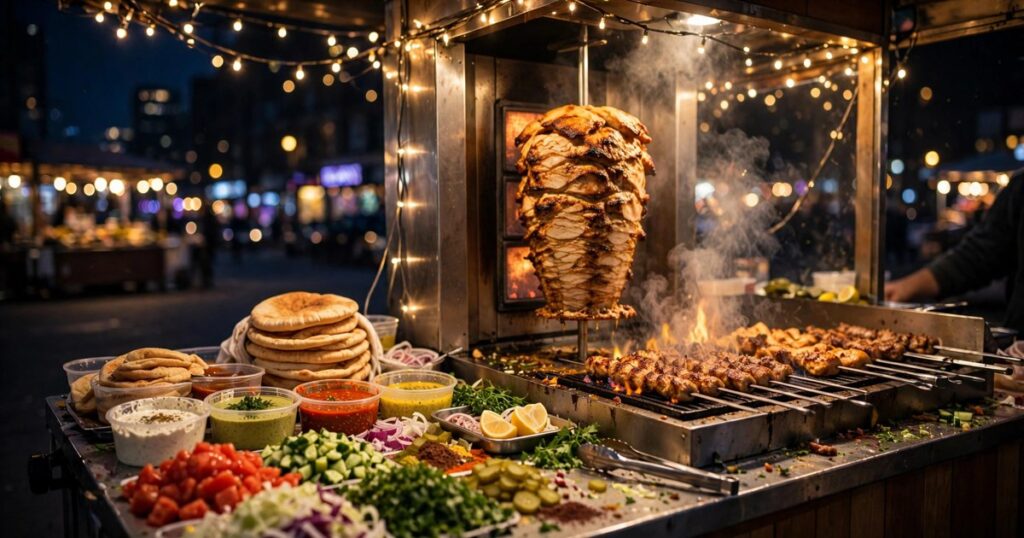
It is 1:30 in the morning, you are properly hungry, and every restaurant you can think of has already closed. For halal eaters it can feel even harder, because the places still open do not always serve halal meat. The good news is that some of the best late-night food in America is halal, and once you know where to look, a proper meal at 2am is easier to find than you might think. This guide is part of our Food Guides series, and it covers what counts as late, where the food actually is, what to order, what it costs, and how to stay safe.
If you are new to the halal scene in the biggest late-night city of all, start with our guide to the best halal restaurants in NYC — many of the spots on that list keep their grills hot long after midnight. The rest of this guide works anywhere in the country, and it will help you build a shortlist of reliable halal restaurants open late enough to count on, whether you are coming home from a night shift or just craving shawarma at an unreasonable hour.
Quick Answer: The best halal restaurants open late are usually halal food carts and trucks, 24-hour diners, and shawarma shops in busy neighborhoods, most serving until 2am to 4am. In New York, the halal carts around Midtown run nearly all night. Always confirm hours and halal status before you go.
What Counts as “Open Late” for a Halal Restaurant?
In this guide, “open late” means a restaurant still serving a full menu at or after 10pm. The second tier is the midnight crowd — places serving until midnight or 1am, which covers most late dinners and the end of a long shift. The third tier is real night-owl territory: spots open until 2am, 3am, or 4am, and the rare 24-hour places that never close. The kind of place you want changes with the hour: at 10:30pm a sit-down halal restaurant is still realistic, at 1am your best bet is a cart or a shawarma shop, and at 3am you are looking at 24-hour diners and delivery apps. Check the hours for tonight specifically, not the hours you remember from last month.
Where Can I Find Halal Restaurants Open Late Near Me?
Start with a map search that includes the hour: type “halal restaurants open late” into Google Maps or Apple Maps and use the “Open now” filter, or search “halal food open now” after midnight and let the apps do the filtering. Maps results show closing times right on the listing, which lets you eliminate the 10pm closers in seconds. Next, look for the places the apps do not surface well. Halal carts and food trucks are the backbone of the late-night halal scene, and many have thin or nonexistent Google listings. If you are in a new city, ask at the nearest mosque, halal grocery, or hookah lounge — the people who work the night shift in any Muslim neighborhood know exactly which cart is still serving at 2am. Finally, save what you find: favorite the spot in your maps app and note the real closing time — not the time the listing claims, but the time the grill actually goes off.
Why Are Food Trucks and Halal Carts the Kings of Late Night?
Halal carts and food trucks dominate late-night halal eating for a simple economic reason — low overhead, a small menu, and a location they can move to wherever the hungry people are. That is why the most famous late-night halal food in America is not served in a restaurant at all, but from a stainless-steel cart on a Manhattan street corner. The classic example is the halal cart scene around 53rd Street and 6th Avenue in Midtown Manhattan, where the carts associated with The Halal Guys built a reputation that spread far beyond New York. Carts stay open deep into the night because their customers do: taxi drivers, hospital staff, night-shift workers, and everyone coming out of the bars and clubs. The trade-off is comfort — nowhere to sit and no shelter if it rains — but a hot plate of chicken over rice eaten standing up beats a closed restaurant every time.
What Are the Best Late-Night Halal Dishes to Order?
Not every dish survives the late-night test. The best late-night halal food is cooked fast, holds its heat, travels well, and satisfies a real hunger without requiring a knife and fork and a table. Chicken or lamb over rice is the undefeated champion: a complete meal in one container, the rice soaks up the sauces, and it is just as good eaten on a park bench as at a table. Biryani is the third great late-night order, with one caveat: it needs to be fresh. A biryani that has sat in a tray since dinner will be dry at 1am, but a place that cooks biryani in batches through the night serves something wonderful — ask when the last batch came out.
| Dish | Why it works late | Watch out for | Typical price |
|---|---|---|---|
| Chicken / lamb over rice | Complete meal, holds heat, eats anywhere | Sauce can make rice soggy if it sits too long | $10–$14 |
| Shawarma wrap | Fast, portable, no cutlery needed | Gets soggy after 15–20 minutes | $9–$13 |
| Biryani | Hearty, fragrant, deeply satisfying | Can be dry if it has sat for hours | $12–$17 |
| Mixed grill / kebabs | Cooked to order, high protein | Longer wait at busy carts | $14–$20 |
| Falafel wrap | Light, vegetarian, quick | Loses crunch fast — eat it now | $8–$11 |
| Lentil soup & bread | Warm, gentle on the stomach | Not every late-night spot serves it | $7–$10 |
Which Cities Have the Best Late-Night Halal Scenes?
Some American cities are genuinely good for late-night halal food, and some are a desert after 10pm.
New York City
New York is the capital of late-night halal eating. The halal carts of Midtown Manhattan — most famously the stretch around 53rd and 6th — serve until 3am or 4am on weekends, and The Halal Guys’ brick-and-mortar locations keep long hours too. For the full deep dive, see our guide to late-night halal food in NYC, with 12 spots open past midnight.
Chicago
Chicago’s late-night halal scene centers on Devon Avenue, the city’s great South Asian and Middle Eastern corridor, where restaurants and sweet shops keep long hours, especially on weekends. In winter the carts thin out, so the brick-and-mortar spots become the reliable option — call ahead in cold months.
Houston
Houston has one of the largest and most diverse Muslim populations in the US, and its halal scene reflects that: Pakistani, Indian, Middle Eastern, and East African restaurants spread across the city, many open until midnight or later on weekends. The late-night spots are spread out, so pick a neighborhood and search within it rather than crossing the whole city at 1am.
Dearborn and Detroit
Dearborn, Michigan has the highest concentration of Arab Americans in the country, and its main drag, Warren Avenue, is lined with Middle Eastern restaurants, bakeries, and shawarma shops — several of which keep late hours, particularly on weekends and during Ramadan. In Dearborn the food is superb and the prices are reasonable, and the bakeries alone are worth a late-night visit: fresh pita and manakish at midnight is a real thing here.
Los Angeles
Los Angeles has a strong halal scene but a spread-out one, which makes late-night eating a neighborhood-by-neighborhood hunt. The San Gabriel Valley has halal Chinese and Middle Eastern restaurants, the Westside has halal Persian and Mediterranean spots, and the areas around UCLA and USC have shawarma shops that serve students late.
| City | Where to look late | Typical late hours | Best bet after 1am |
|---|---|---|---|
| New York City | Midtown carts, Jackson Heights, Atlantic Ave | Until 3–4am | Halal carts, chicken over rice |
| Chicago | Devon Avenue, downtown, university areas | Until 12–2am | Shawarma shops, carts in summer |
| Houston | Hillcroft / Harwin corridors | Until 12–1am | Pakistani & Middle Eastern restaurants |
| Dearborn / Detroit | Warren Avenue, downtown Detroit | Until 12–2am | Shawarma, bakeries, manakish |
| Los Angeles | San Gabriel Valley, Westside, UCLA/USC | Until 12–1am | Halal food trucks, shawarma shops |
Outside these five cities, the pattern still holds: look for the neighborhood with the biggest Muslim community, the university, or the hospital district, and you will usually find at least one place still serving.
How Do I Verify a Place Is Really Halal at 2 AM?
The hard part of eating halal late at night is not finding food — it is trusting it. At 2am you cannot call a certifying body, so use the checks that work in the middle of the night. First, look for the signs: a halal certificate on the wall, a “100% halal” or “zabiha halal” statement on the menu, or a named certifier. Second, ask a direct question. “Is all of your meat halal?” is a yes-or-no question, and a real halal kitchen answers it instantly and without hedging. Be wary of vague answers: “most of it is halal” or “I think so” means you should order the falafel instead, or walk away. Third, use your phone: even at 2am you can check the restaurant’s Google listing, recent reviews, and its own website in about a minute. Look for reviews that mention halal specifically, and be suspicious of a place whose own website never uses the word at all. For the full verification checklist, see our halal food delivery guide.
Can I Get Halal Food Delivered Late at Night?
Yes — and for many people, delivery is the most practical late-night halal option of all. After midnight, Uber Eats, DoorDash, and Grubhub all still operate in major cities, and halal restaurants that are open late are usually listed. Search “halal” plus your dish — “halal shawarma,” “halal biryani” — and filter by “open now” to see what is actually cooking. The trade-offs are time and money. Late-night delivery takes longer — 45 to 75 minutes is normal after midnight, because fewer drivers are on the road — and fees run higher, with delivery fees, service fees, and tips often adding $8 to $12 to the order. Order early in your hunger window, keep the order simple, and choose dishes that travel well, like biryani, curries, and wraps. Many halal restaurants also offer their own direct delivery or takeout, often cheaper than the apps because the restaurant avoids the commission — call them directly and you can ask the halal question to a real person at the same time.
How Much Does Late-Night Halal Food Cost?
Late-night halal food is some of the best-value eating in any city, and the prices barely change after midnight. A cart plate of chicken or lamb over rice typically runs $10 to $14, a shawarma wrap $9 to $13, and a biryani $12 to $17. A sit-down restaurant will cost more — $15 to $25 per person for a main dish, plus drinks — but you are paying for a table, service, and a full menu. What does change at night is the extras. Delivery fees and tips climb after midnight, so a $12 cart plate ordered through an app can easily become a $24 order by the time it reaches your door. If you are feeding a group, ordering family-style is the best value: a large tray of chicken over rice, a few wraps, and a couple of sides will feed four people for $40 to $60, which beats four separate delivery orders by a wide margin.
Is It Safe to Eat Out Late at Night?
Eating out late is safe when you treat it like any other late-night outing: pick busy places, stay aware, and keep it simple. The safest late-night halal spots are the busy ones — a cart with a line of customers at 1am is self-policing, because there are witnesses everywhere and the vendor wants to stay in business. A deserted street with a single open shop is a different proposition, and it is worth the extra ten-minute drive to the busy spot instead. Stick to well-lit main streets rather than cutting through side streets or empty lots, and let someone know where you are going if you are heading out alone late. Food safety matters too: a busy cart is also a place where the food is turning over fast, which means the tray you are eating from was cooked recently. Look for steam rising off the food, watch whether the grill is actually cooking, and skip anything that has been sitting lukewarm.
What About Ramadan and Suhoor?
Ramadan transforms the late-night halal food scene. During the holy month, the whole rhythm of eating shifts: the fast breaks at iftar around sunset, and then the city eats again — late. Restaurants that normally close at 10pm extend their hours until 2am, 3am, or even 4am to serve the suhoor crowd, the pre-dawn meal before the next day’s fast begins. Suhoor itself is a particular kind of meal: it needs to be filling, hydrating, and slow-burning, because it has to last until sunset the next day. The best suhoor orders are the hearty ones — biryani, kebabs with rice, lentil soup with bread, eggs and paratha from a Pakistani restaurant, or manakish and labneh from a Middle Eastern bakery. Save the very spicy and very salty dishes for iftar; at 3am, your stomach will thank you for something gentler.
What Mistakes Should I Avoid When Eating Halal Late at Night?
The most common late-night mistake is assuming the hours are right. A Google listing that says “open until 2am” may be out of date, a cart may have packed up early because of rain, and a restaurant may have stopped seating at 1:30am even though the listing says 2am. The second mistake is not verifying halal status, which matters more at night than during the day because your options are fewer and the pressure to just eat is higher. A non-halal place that is open at 2am is not a solution for a halal eater; it is a trap. The third mistake is ordering badly: do not order a feast at 3am, do not order food that will be a mess in the car, do not skip the water, and do not forget cash for the carts.
Frequently Asked Questions
What are the best halal restaurants open late near me?
The best halal restaurants open late are usually halal food carts, 24-hour diners, and shawarma shops in busy neighborhoods. In New York, the Midtown carts around 53rd and 6th serve until 3am or later.
Are halal food trucks open late at night?
Yes — food trucks and carts are the most reliable late-night halal option in most big cities. They stay open late because their costs are low and their customers are out late: night-shift workers, taxi drivers, students, and people coming home from a night out.
How can I check if a restaurant is halal before I order?
Look for a halal certificate on the wall or a “100% halal” or “zabiha halal” statement on the menu or website. Ask the staff directly: “Is all of your meat halal?” and “Who supplies your meat?” A genuine halal kitchen answers both without hesitation. If the answers are vague, order the falafel or go elsewhere.
What time do halal restaurants usually close?
Most halal restaurants close between 9pm and 11pm, which is why late-night eating takes some planning. The places that stay open later — until midnight, 2am, or 4am — are usually carts, trucks, shawarma shops, and restaurants in busy nightlife or university neighborhoods.
Is halal food delivery available after midnight?
Yes, in most major cities. Uber Eats, DoorDash, and Grubhub all carry halal restaurants that are open late, and you can filter by “open now” to see what is actually cooking. Expect delivery to take 45 to 75 minutes after midnight and to cost more, with fees and tips often adding $8 to $12 to the order.
How much should I expect to pay for late-night halal food?
A cart plate of chicken or lamb over rice costs $10 to $14, a shawarma wrap $9 to $13, and a biryani $12 to $17. A sit-down restaurant meal runs $15 to $25 per person. Prices are generally the same as daytime, but delivery fees and tips are higher after midnight, and some carts are cash-only, so bring cash.
Where is the best late-night halal food in the US?
New York City has the best late-night halal scene in the country, thanks to the Midtown halal carts and the deep bench of restaurants in Queens and Brooklyn.
However late your hunger strikes, the night has an answer. Keep a shortlist of verified spots, check the hours before you leave, ask the halal question every time you try somewhere new, and bring cash for the carts.

I’m Lila Spoonbelle, your host on this flavorful ride through food, fun, and fearless puns. Let’s turn every bite into a burst of laughter!