
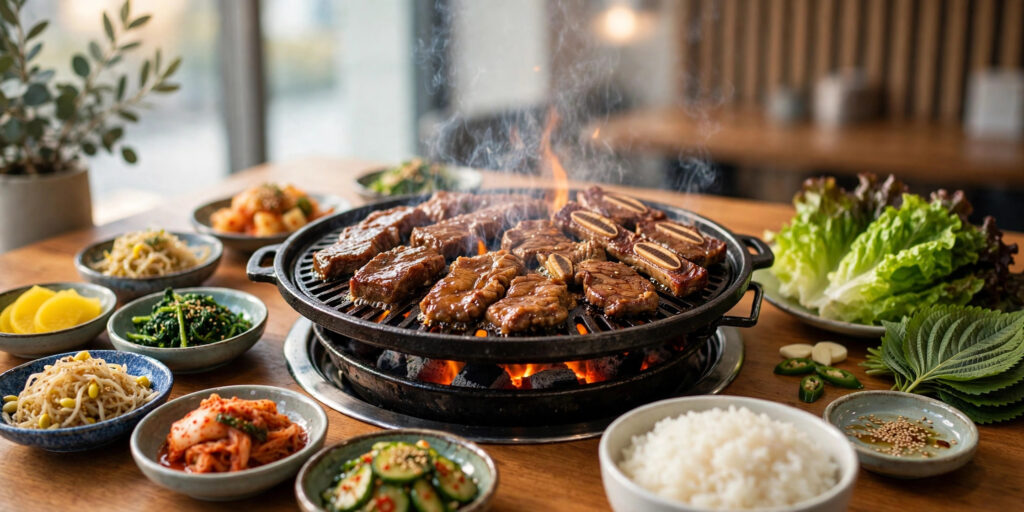
Korean BBQ is one of the most joyful ways to eat in America. There is no quiet, formal service and no single plate arriving from a hidden kitchen: the grill sits in the middle of the table, glowing with charcoal or humming with gas, and you cook your own dinner — thin slices of marinated beef bulgogi curling at the edges, galbi short ribs caramelising over the heat, mushrooms and onions sizzling in the corners, and a dozen small banchan dishes crowded around the edges waiting to be picked at. The smoke rises, the meat hisses, someone flips a piece too early and someone else steals it off the grill, and the whole table eats together, at the same speed, from the same fire. It is dinner as an event, and it is why Korean BBQ restaurants in the United States are packed on Friday nights from Los Angeles to New York.
For Muslim diners, Korean BBQ comes with a question that never quite goes away. The cuisine is built on meat, and the most famous cut in the whole tradition is samgyeopsal — pork belly, thick, fatty and grilled until the edges are crisp. Pork is not a side note in Korean BBQ: it is the dish many regulars order first, it shares the grill with everything else, and its marinades, its dipping sauces and its cooking fats sit next to the beef on the same menu. A plate of bulgogi can be perfect in every way and still be off the table if the beef was never slaughtered halal, or if it was grilled on a surface that just cooked pork belly, or if the marinade contains alcohol. That is why the halal Korean BBQ restaurant matters so much: it is the only place where you can sit down at the grill, cook your own meat and eat everything that arrives — from the galbi to the japchae to the kimchi — without a single question left unanswered.
The good news is that halal Korean BBQ in America is a real, growing scene, even if it is thinner than the halal scenes for Middle Eastern or South Asian food. Fully halal Korean BBQ kitchens are thriving from New York to Chicago to Los Angeles, run by Muslim owners and by Korean owners who built their kitchens around halal sourcing from the start. Some of them are full table-grill experiences with all-you-can-eat menus; others are fried-chicken and BBQ-plate spots where the grill is in the kitchen rather than on the table, but the meat is halal and the food is the real thing. This guide explains exactly what makes a Korean BBQ restaurant halal, which cuts are usually safe to order, which ones to avoid, how to verify a halal claim before you sit down, and what a night at the grill should cost. It finishes with ten verified Korean BBQ restaurants across the US, from Astoria’s first all-you-can-eat halal grill to a hand-slaughtered, HFSAA-certified kitchen outside Chicago. Every restaurant entry below uses verified information only — where a price or detail could not be confirmed, we say so honestly, and where the halal status is only partial, the meat is only partly halal, or the restaurant also serves pork or alcohol, we say that too. If you want to compare with a neighbouring halal cuisine, our halal Turkish food guide covers the other great grill tradition of the Muslim world, and our halal Lebanese food guide covers the charcoal grill table.
Quick answer: The best halal Korean BBQ in the US includes Prime No 7 in Astoria, New York, Seoul Bites in Lombard, Illinois, and Seoul Halal Restaurant in Los Angeles. Look for halal kitchens with zabiha meat, no pork and no alcohol — and at partially halal spots, ask for the halal menu and confirm the cut before you order.
What Is Halal Korean BBQ?
Halal Korean BBQ is Korean BBQ in which every part of the meal follows Islamic dietary rules. The name describes the same experience as regular Korean BBQ — thinly sliced meat grilled at the table, wrapped in lettuce leaves with rice, garlic, chilli paste and fermented side dishes — with one difference that runs through the whole kitchen: the meat is zabiha halal, there is no pork anywhere on the menu or on the grill, and no alcohol is used in the cooking or served at the table.
The grill is the heart of it. In a Korean BBQ restaurant, the grill is built into the table. You order raw, marinated meat by the plate — bulgogi, galbi, brisket, chicken — and a server brings it to your table with tongs and scissors. You lay the slices on the hot grill, watch them cook in a minute or two, and eat them straight off the heat, usually wrapped in a lettuce leaf with rice and ssamjang, the savoury dipping paste. The grill is also the thing that makes the halal question harder than at an ordinary restaurant, because a shared grill is a shared cooking surface: if pork belly was cooked on that grill an hour ago, traces of it can reach your beef. A fully halal Korean BBQ restaurant solves this by never bringing pork into the building at all, so the grill is halal from the first table of the day to the last.
All-you-can-eat is the classic format. Most Korean BBQ restaurants in the US run on AYCE — all-you-can-eat — pricing: one price per person, usually split between a cheaper lunch and a more expensive dinner, and you keep ordering plates of meat until the table is full. Some restaurants also offer an a la carte menu, where you order individual plates at individual prices. Both formats work for a halal diner; what matters is not the pricing model but the sourcing behind it, and this guide flags the price and the halal status of every restaurant separately.
The meal is bigger than the meat. A Korean BBQ dinner arrives with banchan — the small side dishes that fill the table before the meat even arrives — plus rice, lettuce leaves for wrapping, garlic, chillies, and sauces. The banchan, the rice and the lettuce are almost always safe; the questions are the meat, the marinades and the kimchi. A fully halal Korean BBQ restaurant lets you eat the whole spread without asking; a partially halal one means you choose dish by dish, and this guide tells you how to do that.
Halal Korean BBQ is not a fusion invention. Korea has a small but real Muslim community, and halal Korean restaurants have served it for years, from the halal restaurants around Itaewon in Seoul to the certified kitchens of the United States. The food in this guide is not a watered-down version of Korean BBQ: the bulgogi is marinated the same way, the galbi is cut the same way, the kimchi is fermented the same way, and the grill is the same grill. The only thing that changes is the sourcing — and that is exactly what makes it possible for a Muslim diner to sit down at the table and eat like everyone else.
Is Korean BBQ Halal?
Korean BBQ is halal only when the restaurant makes it halal. The cuisine itself is not halal by default, and it is not haram by default either — it is a way of cooking, and whether a given restaurant is halal depends entirely on what it buys, what it cooks with, and what shares its grill. The short answer is that most Korean BBQ restaurants in America are not halal, a growing number are fully halal, and a useful middle group is partially halal: some of the meat is halal, some of it is not, and the diner has to choose carefully.
Zabiha meat is the foundation. Zabiha means the animal was slaughtered in the Islamic way: a swift cut to the throat by a Muslim slaughterman, with the name of Allah pronounced, and the blood fully drained. The beef, the chicken and the lamb at a halal Korean BBQ restaurant should all be zabiha. This is the single most important question to ask, because Korean BBQ is meat first: the bulgogi, the galbi, the brisket, the dak-galbi and the fried chicken are all meat, and a restaurant that buys halal chicken but regular beef is not a halal restaurant — it is a restaurant with one halal dish. Two restaurants in this guide — Seoul Bites in Lombard, Illinois, and Prime No 7 in Astoria, New York — are fully halal, and their entries explain what that means in practice.
No pork, ever — and in Korean BBQ this takes real checking. Pork is the most popular meat in Korean BBQ. Samgyeopsal (pork belly) is the dish most regulars order first, and it sits on the same menu as the beef, cooked on the same grill, cut with the same scissors and flipped with the same tongs. A restaurant can serve 100% halal beef and still not be a halal restaurant if pork belly is grilled on the next table over and the same tools are used for both. Several restaurants in this guide fall into the middle category: the chicken or the beef is halal, but pork is on the menu and alcohol is served. That is a real distinction, and this guide labels it every time.
No alcohol in the food or the drink. Alcohol shows up in Korean BBQ in three places: the bar (soju and makgeolli are the classic Korean BBQ drinks), the marinades (some bulgogi and galbi marinades contain rice wine, mirin or soju), and the sauces (some gochujang and dipping sauces contain alcohol). A restaurant can serve 100% halal meat and still not be fully halal if it pours rice wine into the marinade or serves soju at the next table. Prime No 7 in Astoria serves no alcohol at all — mocktails only — and Seoul Bites in Lombard serves no alcohol either. Other restaurants in this guide serve alcohol, and their entries say so.
The grill itself is the quiet risk. In a table-grill restaurant, the grill is a shared surface, and halal meat can pick up haram traces from a grill that just cooked pork belly, from tongs used for both meats, or from scissors that cut both. Fully halal kitchens avoid the problem entirely by never bringing pork into the building. At a partially halal restaurant with a mixed menu, it is worth asking whether the grill is changed between meats, whether separate tongs are used, and whether the halal meat is cooked first. A good kitchen will answer plainly; a vague answer is itself an answer.
Fully halal vs halal-friendly is a spectrum, not a single label. At one end sits the fully halal restaurant: every meat is zabiha, no pork, no alcohol served or cooked with, often with a certificate on the wall. In the middle sits the halal-menu restaurant: a separate zabihah menu exists, but the regular menu serves pork and the bar serves alcohol. At the other end sits the chicken-only or wings-only spot: one protein is halal, the rest is not, and the diner orders from that one protein only. All of these kinds appear in this guide, and each entry says exactly which one it is. Inventing a fully-halal claim for a restaurant that serves pork would be false, and hiding a good halal-menu restaurant because it has a bar would be unhelpful. The honest label is the useful one. For more of the same honest labelling across other cuisines, browse our Food Guides hub.
What Korean BBQ Meats Are Halal?
Most of the famous Korean BBQ cuts are halal by nature — they are beef, chicken or lamb, and whether you can eat them depends on the sourcing, not the cut. The exceptions are the pork cuts, which are never halal, and the marinades, which can quietly contain alcohol. Here are the cuts and dishes you will meet at the table, grouped the way they arrive.
Beef: bulgogi, galbi and brisket
Bulgogi. The most famous Korean BBQ dish, and the one most first-timers order first: thinly sliced beef — usually ribeye or sirloin — marinated in a sweet-savoury mix of soy sauce, sugar, sesame oil, garlic, Asian pear and black pepper, then grilled quickly until the edges caramelise. The marinade is the question: a traditional bulgogi marinade sometimes contains rice wine or mirin. At a fully halal restaurant the marinade is made without alcohol, and at a partially halal restaurant it is worth one question before you order. Prime No 7 in Astoria marinates its spicy beef bulgogi for 48 hours, and Seoul Bites in Lombard serves bulgogi at $29 — both halal, both worth ordering. Bulgogi is also the most versatile cut in the cuisine: it appears in bibimbap, in japchae, on loaded fries, and wrapped in lettuce, so once you have confirmed a restaurant’s bulgogi is halal, you have confirmed half its menu.
Galbi (beef short ribs). The second classic: cross-cut beef short ribs, marinated in a soy, garlic and sesame marinade similar to bulgogi’s, then grilled until the meat is charred at the edges and tender in the middle. Galbi is usually cut in the LA style — thin, across the bone, so it cooks in minutes on a hot grill — and it is the richest beef on the table, with marbling that renders over the heat. The same marinade question applies: ask whether the marinade contains alcohol. At a fully halal restaurant, galbi is the dish to order when you want the full Korean BBQ experience in a single plate.
Brisket and chadol (beef brisket plate). Chadol is thinly sliced beef brisket plate, lightly marinated or unmarinated, grilled in seconds and dipped in sesame oil with salt and pepper. It is the simplest beef on the table — no sweet marinade, no long soak, just beef and heat — and for that reason it is one of the easiest cuts to verify: if the beef itself is halal, the dish is halal. It is also the cut that regulars order when they want to taste the beef rather than the marinade, and it cooks faster than anything else on the grill, so order it early while the grill is at its hottest.
Chicken: dak-galbi and Korean fried chicken
Dak-galbi (spicy stir-fried chicken). Dak-galbi is chicken marinated in a spicy gochujang-based sauce, then grilled or stir-fried at the table with cabbage, sweet potato, rice cakes and perilla leaves. It is the chicken answer to bulgogi: spicy rather than sweet, and cooked in the sauce rather than grilled dry. The chicken must be zabiha halal, and the gochujang in the sauce must be alcohol-free — some gochujang contains alcohol, so this is a dish where the question matters twice, once for the meat and once for the sauce. Several restaurants in this guide serve halal chicken as their confirmed protein: BibimGRILL in Dublin, California, has its chicken certified halal, and Mr. Dak in Flushing, New York, is a halal-chicken specialist.
Korean fried chicken. The BBQ-adjacent classic: chicken double-fried until the coating shatters, then tossed in a sauce — soy garlic, sweet and spicy, honey garlic, or the fiery tiger sauce. It is not a table grill, but it is the dish most Americans meet first when they meet Korean food, and several restaurants in this guide are fried-chicken specialists rather than table grills. The chicken must be halal, and the batter and the sauce must be checked — some batters contain alcohol, and some sauces are made with rice wine. Seoul Bites in Lombard serves Korean fried chicken wings in sweet and spicy and honey pineapple flavours at $16, Blossom Bites & Eatery in Culver City serves soy garlic and sweet and spicy fried chicken, and SeoulSpot Eatery in Tustin lists halal wings on its menu. Order the fried chicken when the table does not have a grill, and order it as a side when it does.
Lamb, seafood and the noodles
Bulgogi lamb. Lamb marinated the bulgogi way — soy, sesame, garlic, pear — and grilled the same way. It is rare in Korean BBQ: most restaurants do not offer it at all, because lamb is not a traditional Korean BBQ meat. Prime No 7 in Astoria is the exception in this guide, and it is one of the reasons the restaurant is worth a visit: bulgogi lamb is a halal-friendly cut that most Korean BBQ menus never offer, and here it is on the all-you-can-eat menu. The same sourcing rule applies — the lamb must be zabiha halal — and Prime No 7 is fully halal, so it is.
Japchae. Glass noodles made from sweet potato starch, stir-fried with vegetables, sesame oil and your choice of beef, chicken or mushrooms. Japchae is the noodle dish of Korean BBQ, and it arrives at the table as a side or as a main. The noodles themselves are safe everywhere — sweet potato starch, soy sauce, sesame oil and vegetables — and the question is the meat mixed into them. At a halal restaurant, order the beef or chicken japchae freely; at a mixed restaurant, order the mushroom version or confirm the meat. Seoul Bites in Lombard and Ssam Korean Bistro in Brooklyn both serve japchae, and Ssam’s beef bulgogi japchae is one of its signature plates.
Tteokbokki. Chewy rice cakes simmered in a spicy gochujang sauce, often with fish cakes, boiled egg and scallions. Tteokbokki is the street-food classic of Korea, and it appears on several menus in this guide — cheese tteokbokki at Ssam Korean Bistro in Brooklyn, and tteokbokki at Seoul Bites in Lombard and Modoo Chicken and Noodle Bar in Bayside. The rice cakes are safe; the questions are the gochujang (some contains alcohol) and the fish cakes (some contain pork or non-halal additives). Ask about both, and order the cheese version when it is on the menu — it is the richest, and the cheese is usually the safest addition.
The watch-outs: kimchi, gochujang, samgyeopsal and alcohol
Kimchi. The fermented cabbage that sits at the centre of every Korean table — and the dish that most needs a warning in bold. Kimchi is made by fermenting napa cabbage with chilli, garlic, ginger and salt, and the traditional recipe uses fish sauce and fermented shrimp paste (saeujeot) in the seasoning. Fish sauce and shrimp paste are halal, so a kimchi made with them is halal. But some kimchi recipes also use pork stock, oyster sauce made with non-halal ingredients, or a seasoning paste that contains alcohol, and some restaurant kimchi is bought in from suppliers whose recipes are not visible. At a fully halal restaurant the kimchi is halal — the kitchen has checked its recipe. At a mixed restaurant, ask what is in the kimchi before you eat it, and if the staff cannot answer, eat the other banchan and leave the kimchi.
Gochujang. The red chilli paste that flavours half the Korean menu — dak-galbi, tteokbokki, bibimbap, ssamjang and the dipping sauces. Gochujang is made from fermented soybeans, glutinous rice, chilli and salt, and most gochujang is halal. But some brands and some restaurant-made batches contain alcohol as a preservative or as part of the fermentation, and a gochujang that contains alcohol is not halal even when everything else in the dish is. This is a question worth asking at every restaurant in this guide that is not fully halal, and the answer tells you a lot about how careful the kitchen is: a kitchen that knows its gochujang brand and can name it is a kitchen that has thought about this.
Samgyeopsal (pork belly). The classic Korean BBQ cut that Muslims must skip, every time, without exception. Samgyeopsal is thick-cut pork belly, grilled until the fat renders and the edges crisp, and it is the most-ordered dish at most Korean BBQ restaurants in America. It is also the cut that shares the grill with everything else, which is why the grill question matters so much at a mixed restaurant. If samgyeopsal is on the menu, the restaurant is not fully halal — and your beef, your chicken and your vegetables were probably cooked on the same grill. That does not mean you cannot eat there: several restaurants in this guide serve pork alongside halal chicken or halal beef, and their entries explain exactly how to order safely. It does mean you should never assume, and you should always ask.
Soju and makgeolli. The two classic Korean BBQ drinks, and both are alcoholic. Soju is a clear distilled spirit, usually around 20% alcohol, served in small glasses alongside the grill; makgeolli is a milky, lightly sparkling rice wine. Both are haram, and both are served at most Korean BBQ restaurants in the United States. At a fully halal restaurant neither is served — Prime No 7 in Astoria serves mocktails instead, and Seoul Bites in Lombard serves no alcohol at all. At a mixed restaurant, order a soft drink, a barley tea or a fruit soju alternative like a mango or lychee lemonade — Ssam Korean Bistro in Brooklyn serves mango and lychee lemonades, and they are the right order at a table where others are drinking soju.
| Dish or cut | Usually halal? | Watch out for |
|---|---|---|
| Bulgogi (marinated beef) | Yes, if the beef is zabiha halal | Marinade may contain rice wine or mirin — ask |
| Galbi (beef short ribs) | Yes, if the beef is zabiha halal | Same marinade question as bulgogi |
| Brisket / chadol | Yes, if the beef is zabiha halal | Usually unmarinated — the easiest cut to verify |
| Dak-galbi (spicy chicken) | Yes, if the chicken is zabiha halal | Gochujang in the sauce may contain alcohol — ask |
| Korean fried chicken | Yes, if the chicken is zabiha halal | Batter and sauce may contain alcohol — ask |
| Bulgogi lamb | Yes, if the lamb is zabiha halal | Rare on menus — confirm the lamb specifically |
| Japchae (glass noodles) | Yes — noodles and vegetables are safe | The meat mixed in must be halal; mushroom version is safest at mixed restaurants |
| Kimchi | Usually yes | Some recipes use pork stock or alcohol in the seasoning paste — ask what is in it |
| Gochujang (chilli paste) | Usually yes | Some brands contain alcohol as a preservative — ask which brand the kitchen uses |
| Tteokbokki (rice cakes) | Usually yes | Fish cakes may contain pork; gochujang may contain alcohol — ask |
| Banchan (side dishes) | Usually yes | Check the kimchi and any meat-based banchan; most vegetable banchan are safe |
| Samgyeopsal (pork belly) | Never | Pork — skip it, and ask whether it shares your grill |
| Soju / makgeolli | Never | Alcohol — order a mocktail, lemonade or barley tea instead |
| Seafood (scallops, shrimp, fish) | Yes — seafood is halal | Check the marinade and whether it is grilled on a shared grill with pork |
What Should You Avoid at a Korean BBQ Restaurant?
The avoid list at a Korean BBQ restaurant is short, and it is worth memorising before you sit down, because the menu is long and the grill moves fast. The things to avoid fall into three groups: the meats that are never halal, the ingredients that are sometimes hidden, and the ordering mistakes that cost you the meal.
Skip the pork, all of it. Samgyeopsal (pork belly) is the famous one, but it is not the only pork on a Korean BBQ menu. Pork jowl, pork neck, pork ribs, and pork sausages all appear at some restaurants, and pork is also the meat in many Korean stews, dumplings and fried-rice dishes that sit alongside the BBQ menu. If a dish has pork in the name, skip it; if a dish has pork in the description, skip it; and if a dish is described as “pork” in any form — including spam, which appears in some Korean fried rice — skip that too. One of the restaurants considered for this guide, Rokstar Chicken in Douglaston, was dropped from the list for exactly this reason: its fried rice contains spam and its dumplings contain pork, so only the chicken is halal there.
Skip the alcohol in the food, not just in the glass. The drinks are the obvious part — soju, makgeolli, beer and cocktails are all haram — but the hidden part is the cooking. Rice wine in a bulgogi marinade, mirin in a dipping sauce, alcohol in a gochujang batch, wine in a stew: none of these are visible from the name of the dish, and all of them matter. The rule is simple: if the restaurant is fully halal, the kitchen has already removed them. If it is not fully halal, ask about the marinade and the gochujang before you order, and order the unmarinated cuts — chadol brisket, plain chicken — when you cannot get a clear answer.
Skip the shared grill problem. At a mixed restaurant, the grill is the risk, not the menu. If pork belly was grilled on your table’s grill before your beef arrived, or if the same tongs flipped both, your halal meat has touched a haram surface. Ask for a fresh grill, a fresh set of tongs and scissors, and for your meat to be cooked first — before any pork goes on. A good restaurant will do this without a fuss. If the restaurant will not change the grill, order the kitchen-cooked dishes instead: the japchae, the bibimbap, the fried chicken and the stews are cooked in the kitchen, on pans and in fryers that are easier to keep separate than a table grill.
Skip the dishes you cannot verify. This is the hardest rule, because it means leaving food on the table. But a dish whose meat you cannot confirm, whose marinade you cannot check, or whose kimchi recipe the staff cannot explain is a dish to skip — and there is always another dish on a Korean BBQ menu. Order the vegetables, the rice, the mushroom japchae and the egg dishes while you decide, and remember that a restaurant that cannot answer a simple question about its own food is telling you something. For a fuller version of the same rule applied to another cuisine, see our halal Moroccan food guide.
Skip the cross-contamination in the fryer. Fried chicken and fried dumplings share fryers at many restaurants, and a fryer that cooks pork dumplings alongside halal chicken is a shared-oil problem. This is the reason Pelicana Chicken in Koreatown was dropped from this guide: the halal chicken there is cooked alongside non-halal chicken, and the staff acknowledged the cross-contamination. Ask whether the halal chicken is fried in its own oil, and if the answer is no, order a grilled dish instead.
How Do You Verify a Korean BBQ Place Is Really Halal?
The halal claim is easy to print and hard to fake for long, but there are reliable signs that separate a genuinely halal kitchen from a restaurant that is borrowing the word. Here is what to look for, in order of reliability — and the five questions to ask at the table.
A certificate on the wall or on the website. The strongest signal is a halal certificate from a recognised certifier, displayed in the restaurant or stated on its own site. Seoul Bites in Lombard, Illinois, is HFSAA certified and hand-slaughtered — the certificate names the certifier, the slaughter method and the scope, and that is exactly what a strong claim looks like. A named certifier or supplier beats a bare “halal” sign every time, and a certificate that names the meats it covers beats a certificate that does not.
A menu that names the halal items. At a partially halal restaurant, the halal claim should be specific: a separate zabihah menu, a halal section on the menu, or a note on each dish. I Can Barbecue Korean Grill in Irvine has a separate zabihah menu — reviewers report 9 of 12 beef options halal and the chicken halal — and the diner must specifically ask for it, because the regular menu serves pork. A restaurant that can show you the halal menu is a restaurant that has thought about this; a restaurant that says “everything is halal” while pork sits on the menu is a restaurant that has not.
A listing on a halal directory, backed by reviewers. Zabihah, HalalSpy and community halal guides list restaurants that the community has actually eaten at. A listing plus recent reviews from Muslim diners saying the food is halal is a good sign. A listing alone, with no reviews and no other evidence, is a weak one — which is why this guide always names its source for each restaurant. Seoul Halal Restaurant in Los Angeles, for example, is listed in HalalSpy’s LA guide with halal-certified beef and chicken, no pork on the menu and separate cooking equipment — but its street address could not be independently verified, so this guide says that plainly rather than printing an address it cannot stand behind.
Staff who answer the five questions without blinking. This is the final test, and it happens at the table. A restaurant that is genuinely halal has answered these questions a thousand times, and the answer comes out fast and specific. Hesitation is information.
- “Is all the meat halal?” Not “is this dish halal” — all of it. You want to know whether the beef, the chicken and the lamb are all zabiha halal, or whether only some of them are. This question matters more at Korean BBQ restaurants than at most others, because one restaurant in this guide — BibimGRILL in Dublin, California — has its chicken certified halal without a verified claim for the beef. If the answer is “the chicken is halal but the beef isn’t,” you now know exactly what you can and cannot eat.
- “Is the meat zabiha, and who certifies it?” Zabiha means slaughtered the Islamic way. A certificate from a recognised certifier is the strongest answer; a supplier’s assurance is the next best. If the restaurant cannot name its supplier or its certifier, treat the claim with caution.
- “Do you serve pork, and does it share the grill?” This catches the two things that make a restaurant halal-friendly rather than fully halal. A menu with samgyeopsal changes what the “halal” label means, even if every beef cut is certified — and a shared grill can carry pork traces into a halal dish. I Can Barbecue in Irvine, for example, serves pork on its regular menu alongside its halal menu. Good to know before you sit down.
- “Is alcohol used in the marinades or the gochujang?” Rice wine in a bulgogi marinade, alcohol in a gochujang batch, mirin in a dipping sauce — these are easy to miss and worth one question. Most fully halal kitchens do not cook with alcohol at all, but the ones that do should say so.
- “Is the kimchi halal, and what is in it?” Kimchi can contain pork stock or alcohol in the seasoning paste. One question covers it, and the answer tells you whether you can eat the banchan freely or need to pick around the kimchi.
If the staff answer clearly and confidently, eat happily. If they dodge, shrug, or say “I think so,” order the mushroom japchae, the vegetable banchan and the rice — those are safe regardless — and decide whether to come back. A restaurant that is proud of its halal sourcing will tell you about it before you ask; several of the restaurants in this guide put it on their own websites.
One warning: a “halal” tag on a delivery app or a review site is the weakest evidence of all. Those tags are often added by the platform, not the restaurant, and they are sometimes wrong. Use them as a lead, never as proof — and check before you go. The bb.q Chicken location in Park Slope, Brooklyn, is the cautionary tale here: a halal certificate was displayed, but a phone confirmation found that location is not halal, so it was dropped from this guide entirely.
The 10 Best Halal Korean BBQ Restaurants in the US (2026)
Every restaurant below was verified in November 2026 from its own website, a halal directory, or multiple review sources. Each entry states its halal status honestly — fully halal, partially halal with a separate halal menu, halal chicken only, or BBQ-adjacent rather than a table grill — because a wrong halal claim is worse than no recommendation at all. Prices are given only where they were found in search, and every price is flagged “check before you go.” Where a price could not be verified, the table says so. Hours change; confirm them before you travel.
| # | Restaurant | City | Halal status | Price note |
|---|---|---|---|---|
| 1 | Prime No 7 | Astoria, NY | Fully halal; no alcohol served | AYCE lunch from $29.95, dinner $49.99 — check before you go |
| 2 | I Can Barbecue Korean Grill | Irvine, CA | Partially halal — separate zabihah menu; pork and alcohol on regular menu | Older prices ~$17 lunch / ~$25–27 dinner — check before you go |
| 3 | Ssam Korean Bistro | Brooklyn, NY | Halal meat | Not verified — check before you go |
| 4 | Seoul Bites | Lombard, IL | Fully halal, HFSAA certified, hand-slaughtered; no alcohol | Bulgogi $29, wings $16, loaded bulgogi fries $15 — check before you go |
| 5 | Seoul Halal Restaurant | Los Angeles, CA (Koreatown) | Halal-certified beef and chicken; no pork on menu | Not verified — check before you go |
| 6 | Blossom Bites & Eatery | Culver City, CA | All food halal per reviewers; BBQ-adjacent, not a table grill | Not verified — check before you go |
| 7 | BibimGRILL | Dublin, CA | Chicken certified halal; beef status not verified | Not verified — check before you go |
| 8 | Mr. Dak | Flushing, NY | Halal chicken; fried-chicken specialist, not a table grill | Korean fried chicken over rice $17.45 (DoorDash) — check before you go |
| 9 | Modoo Chicken and Noodle Bar | Bayside, NY | Halal menu, prepared separately by a Muslim chef | Not verified — check before you go |
| 10 | SeoulSpot Eatery | Tustin, CA | Halal wings on the menu; wings/BBQ-adjacent, not a table grill | 10 halal wings $18.95 — check before you go |
1. Prime No 7 — Astoria, NY
Address: 34-19 Steinway St, Astoria, NY 11101. Phone: (718) 350-8665. Halal status: FULLY HALAL, no alcohol served (mocktails only). Prices (per Queens Gazette): lunch AYCE from $29.95, dinner AYCE $49.99 per person, vegetarian $24.99 — all flagged “check before you go.” Hours (per FSR Magazine): Mon–Thu 12 PM–11 PM, Fri–Sun 12 PM–2 AM — note that another source gives Sun–Thu to midnight and Fri–Sat to 1 AM, so hours vary by source; check before you go. Reservations via Resy. A Mahwah, NJ location also exists.
Prime No 7 is the most fully halal Korean BBQ restaurant on this list, and the most ambitious: a 130-seat all-you-can-eat Korean BBQ and sushi restaurant with table grills and proper ventilation, a DJ booth on weekends, and the distinction of being Astoria’s first Korean BBQ restaurant when it opened on September 12, 2026. Everything on the menu is halal and no alcohol is served — mocktails only — so you can order freely from the grill, the sushi and the sides without a single question. The dishes to order are the marinated chicken, the spicy beef bulgogi with its 48-hour marinade, the spicy top blade, the bulgogi lamb — a cut that is rare in Korean BBQ anywhere — the butter garlic scallops and the assorted mushrooms. The bulgogi lamb alone is worth the trip: lamb is not a traditional Korean BBQ meat, and finding it marinated the bulgogi way, on a fully halal all-you-can-eat menu, is unusual anywhere in the country. Book through Resy, especially on weekends, when the DJ booth is running and the 130 seats fill up. One warning about prices: one aggregator listed the all-you-can-eat menu at $100 per person — do not use that figure. This guide uses the Queens Gazette figures (lunch from $29.95, dinner $49.99), and even those should be confirmed before you go, because the restaurant is new and prices may move.
2. I Can Barbecue Korean Grill — Irvine, CA
Address: 5781 Alton Pkwy, Irvine, CA 92618. Phone: (949) 502-5768. Halal status: PARTIALLY HALAL — a separate zabihah menu exists; reviewers report 9 of 12 beef options halal and the chicken halal, but the regular menu serves pork and alcohol is served, so diners MUST specifically ask for the halal menu. Hours (per Zabihah): Mon–Thu 11 AM–10 PM, Fri–Sat 11 AM–11 PM, Sun 11 AM–10 PM. Prices (older reviews): around $17 for lunch and $25–27 for dinner — flagged “check before you go” as older prices. A second location exists in Tustin, at 2961 El Camino Real, Tustin, CA 92782, with the same concept; a Ramadan platter with beef and lamb kebabs was noted in 2026 coverage, and a Monday to Thursday lunch discount of 30% was mentioned in social coverage — flag that discount as reported, not verified, and check before you go.
I Can Barbecue is the classic all-you-can-eat, grill-your-own Korean BBQ restaurant — and the most important entry in this guide to read carefully, because it is the one where the halal experience depends entirely on what you ask for. The restaurant runs a separate zabihah menu alongside its regular menu: reviewers report that 9 of the 12 beef options are halal and the chicken is halal, but the regular menu serves pork and the bar serves alcohol, so a diner who sits down and orders from the regular menu will not be eating halal. Ask for the halal menu by name when you arrive, confirm which beef options are halal that day, and confirm that your grill is fresh before the meat goes on. Do that, and you get the full AYCE grill-your-own experience — the sizzle, the smoke, the lettuce wraps — at one of the most affordable price points in this guide. The Tustin location follows the same concept, and its Ramadan platter with beef and lamb kebabs, noted in 2026 coverage, shows a kitchen that is thinking about its Muslim diners rather than just tolerating them. Confirm the older review prices before you go, and confirm the lunch discount at the Tustin location before you count on it.
3. Ssam Korean Bistro — Brooklyn, NY
Address: 170 Smith St, Brooklyn, NY 11201. Phone: not listed — check before visiting. Halal status: HALAL MEAT — the menu was updated to halal meat, inspired by the restaurant’s Muslim staff. Prices: not verified — check before you go.
Ssam Korean Bistro is the neighbourhood one: a Korean bistro on Smith Street in Brooklyn whose menu was updated to halal meat, inspired by the Muslim staff in its own kitchen — a halal change that came from inside the restaurant rather than from a marketing decision. The dishes to order are the beef bulgogi, the spicy chicken BBQ, the beef bulgogi japchae, the bibimbap, the kimchi fried rice, the cheeseling wings, the cheese tteokbokki, and the mango and lychee lemonades. That last item matters more than it looks: a restaurant that serves mango and lychee lemonades alongside its BBQ is a restaurant where a Muslim diner can sit at the table, order a proper drink, and not feel like the odd one out while others drink soju. The beef bulgogi japchae is the signature plate — the two great Korean BBQ dishes, bulgogi and japchae, in a single order — and the cheese tteokbokki is the dish to order when you want the street-food side of the cuisine. No phone number could be verified for this restaurant, so check the number and the hours before you visit, and confirm the halal status with staff on the day — a menu updated to halal meat is a strong sign, and a direct confirmation makes it certain.
4. Seoul Bites — Lombard, IL
Address: 533 E Roosevelt Rd, Lombard, IL 60148. Phone: (630) 596-2715. Halal status: FULLY HALAL, HFSAA certified, hand-slaughtered, NO alcohol. Hours: Tue–Sun 1–10 PM, Friday from 2 PM, closed Monday. Prices: bulgogi $29, Korean fried chicken wings sweet and spicy and honey pineapple $16, loaded bulgogi fries $15 — all flagged “check before you go.”
Seoul Bites is the strongest halal credential in this guide, and the restaurant to recommend first to anyone who wants a certificate rather than a promise: it is fully halal, HFSAA certified, hand-slaughtered, and it serves no alcohol at all. HFSAA certification means a named certifier has checked the sourcing, the slaughter and the scope — and hand-slaughtered means the animals were slaughtered by hand in the Islamic way, which is the standard many Muslim diners ask for specifically. The menu runs across the whole Korean BBQ table: the kalbi and the bulgogi at $29, the Korean fried chicken wings in sweet and spicy and honey pineapple flavours at $16, the loaded bulgogi fries at $15, the dolsot bibimbap, the buldak, the japchae, the cheese tteokbokki, the shrimp tempura and the seafood pancake. The loaded bulgogi fries are the dish to order when you want the cuisine in a single plate — bulgogi, cheese, fries and sauce, built for sharing — and the dolsot bibimbap, served in a hot stone bowl, is the dish that arrives still sizzling at the table. Note the hours before you travel: the restaurant opens at 1 PM, opens at 2 PM on Fridays, and is closed on Mondays. Confirm the prices before you go. For more of the Chicago area’s halal scene, see our halal food guide to Chicago.
5. Seoul Halal Restaurant — Koreatown, Los Angeles, CA
Address: Koreatown, Los Angeles, CA — the street address was NOT independently verified, so confirm the address before you visit. Halal status: HALAL-CERTIFIED beef and chicken Korean BBQ, no pork on the menu, separate cooking equipment, per HalalSpy’s LA guide. Phone, hours and prices: not verified — check before you go.
Seoul Halal Restaurant is the Koreatown one — and the entry in this guide that requires the most honesty about what could and could not be verified. HalalSpy’s LA guide lists it as a halal-certified Korean BBQ restaurant with halal-certified beef and chicken, no pork on the menu and separate cooking equipment, which is exactly the combination a Muslim diner wants to hear: certified meat, no pork in the building, and a kitchen that keeps its equipment separate. That is a strong halal claim, and it earns the restaurant its place here. But no street address could be independently verified, so this guide does not print one — and you should not rely on an address from an aggregator or a review site without confirming it first. Call ahead, confirm the address, confirm the hours, and confirm the halal certification on the day. If the address checks out, this is the most convenient halal Korean BBQ in Koreatown itself — the neighbourhood where Korean BBQ in America was born — and eating a halal-certified galbi in the middle of Koreatown is an experience worth the phone call. Prices could not be verified — check before you go.
6. Blossom Bites & Eatery — Culver City, CA
Address: 9626 Venice Blvd, Culver City, CA 90232. Phone: (424) 666-7172. Halal status: ALL FOOD HALAL per multiple reviewers. Note: this is Korean fried chicken and BBQ-style plates, not a table grill — labelled honestly as BBQ-adjacent. Prices: not verified, but reviewers describe the portions as generous and the prices as slightly pricey — check before you go.
Blossom Bites & Eatery is the owner-driven one: a Culver City kitchen run by Asim, serving Korean fried chicken and BBQ-style plates with ingredients imported from Korea, and described by multiple reviewers as all food halal. The dishes to order are the Korean fried chicken in soy garlic and sweet and spicy flavours, and the beef bulgogi — the two pillars of the menu, served as plates rather than grilled at your table. The portions are generous and the prices run slightly high, which is the trade for ingredients imported from Korea and a kitchen that cooks everything halal. Be clear about what this restaurant is and is not: it is not a table grill, so you will not be cooking your own meat over charcoal here. What you will get is the same flavours — the soy garlic glaze, the sweet and spicy coating, the marinated bulgogi — cooked in the kitchen and served as a proper plate. For a first visit, order the soy garlic fried chicken and the beef bulgogi together, and you will have eaten the two dishes that define the restaurant. Confirm the prices before you go.
7. BibimGRILL — Dublin, CA
Address: 3742 Fallon Rd, Dublin, CA 94568. Phone: (925) 248-2281. Halal status: CHICKEN CERTIFIED HALAL (per TikTok and reviews, November 2026); fast-casual BBQ bowls. Hours: 11 AM–9 PM daily. Prices: not verified — check before you go. Note: the beef halal status has not been verified — the chicken is the confirmed halal protein, and readers should ask about the beef.
BibimGRILL is the fast-casual one: a BBQ-bowl restaurant in Dublin, California, where the Korean BBQ experience is rebuilt as a bowl — bulgogi beef or halal chicken over a japchae noodle base or purple rice, ordered at the counter and eaten in minutes rather than over a two-hour grill session. The chicken is certified halal, according to TikTok and reviews from November 2026, and it is the protein to order: the halal chicken bowl, with the japchae noodle base, is the dish the restaurant is built around. The beef is the question — its halal status has not been verified, so do not order the bulgogi beef bowl until you have asked the staff about it, and if the answer is not clear, order the chicken. This is the sharpest partial-halal case in this guide after I Can Barbecue: one protein confirmed, one protein unconfirmed, and the difference between them is the difference between a halal meal and a guess. The hours are simple and generous — 11 AM to 9 PM every day — which makes it the easiest restaurant on this list to visit on a weekday lunch. Confirm the prices before you go, and ask about the beef before you order it.
8. Mr. Dak — Flushing, NY
Address: 194-15 Northern Blvd, Flushing, NY 11358. Halal status: HALAL CHICKEN — staff confirm verbally, and one review says around 98% of the menu is halal. Note: this is a fried-chicken specialist, not a table grill — labelled honestly. Prices: Korean fried chicken over rice $17.45 (DoorDash) — flagged “check before you go” as a delivery-app price.
Mr. Dak is the fried-chicken specialist of this list: a Flushing kitchen built around Korean fried chicken over rice, with the staff confirming the chicken is halal verbally and one review putting the halal share of the menu at around 98%. The flavours are the draw — soy garlic, spicy red, honey garlic and the tiger chicken — served over rice, with ramen and rice cakes on the side. The soy garlic is the classic first order: sweet, savoury and garlicky, with the double-fried coating that stays crisp under the sauce. The spicy red is the one to order when you want heat, and the honey garlic is the one to order when you do not. Be clear about what this restaurant is: it is not a table grill, and you will not be cooking anything yourself. What you will get is the best version of the fried-chicken half of Korean food, in a neighbourhood — Flushing — that is one of the great food destinations in New York. The chicken is halal; the rest of the menu is described as around 98% halal, so ask about any dish that is not chicken before you order it. Confirm the delivery-app price before you go, as in-restaurant prices may be lower. If your travels take you to the Midwest, our halal food guide to Chicago covers another great halal city.
9. Modoo Chicken and Noodle Bar — Bayside, NY
Address: 216-17 Northern Blvd, Bayside, NY 11361. Phone: (347) 836-8382. Halal status: HALAL MENU prepared separately by a Muslim chef; halal-certified chicken and beef per the owner’s answer — but a non-halal menu also exists, so order from the halal menu. Hours: closes 10 PM. Prices: not verified — check before you go. Note: the halal ramen can take around 30 minutes; the restaurant is usually packed, and reservations are advised.
Modoo Chicken and Noodle Bar is the chef-driven one: a Bayside restaurant where the halal menu is prepared separately by a Muslim chef, with halal-certified chicken and beef according to the owner’s own answer — and a non-halal menu that also exists, so the order matters as much as the restaurant. Say “halal menu” when you sit down, and order from it: the spicy beef bulgogi, the chicken katsu, the spicy beef ramen, the tteokbokki and the kimchi pancake are the dishes to ask for. The spicy beef ramen is the signature — a rich, spicy noodle soup that can take around 30 minutes to prepare on the halal menu, so order it first and eat the kimchi pancake while you wait. The restaurant is usually packed, so book ahead, and note that it closes at 10 PM, which makes it an early-dinner spot rather than a late-night one. The separate preparation by a Muslim chef is the strongest part of this entry: it means the halal food is cooked by someone who understands the standard from the inside, not by a kitchen following a checklist. Confirm the prices before you go, and confirm the halal menu by name when you arrive — the two menus are the whole story here.
10. SeoulSpot Eatery — Tustin, CA
Address: 2455 Park Ave, Tustin, CA 92782. Phone: (714) 673-6331. Halal status: HALAL WINGS on the menu. Note: this is a Korean fried chicken and wings spot — labelled honestly as wings and BBQ-adjacent, not a table grill. Prices: 10 halal wings $18.95 — flagged “check before you go.”
SeoulSpot Eatery is the wings one: a Tustin Korean fried chicken spot with halal wings on the menu — 10 halal wings for $18.95 — and the simplest, most direct entry in this guide. There is no table grill here, no all-you-can-eat menu, and no long list of dishes to work through: there are wings, they are halal, and they are the order. Tustin is also home to the second location of I Can Barbecue, which makes the city a useful two-stop trip — the wings at SeoulSpot for a quick lunch, and the full grill-your-own experience at I Can Barbecue for dinner, with the halal menu requested by name. Order the wings, ask about the flavours on the day, and confirm the price before you go. It is the smallest entry in this guide, and it earns its place for exactly that reason: sometimes the right halal Korean BBQ recommendation is not a two-hour grill session but a plate of wings you can trust.
How Much Does Halal Korean BBQ Cost in the US?
Korean BBQ is one of the more expensive cuisines in America, because the format is built on premium cuts of meat, a grill at every table, and a dozen side dishes that arrive before you order anything. A filling lunch costs about the same as a sit-down meal at a mid-range restaurant, and a proper all-you-can-eat dinner for two — with the grill going all evening and plates of bulgogi and galbi coming one after another — is a special-occasion price, not a weeknight one. The table below is built from prices actually found in search for the restaurants in this guide; every figure is flagged “check before you go,” because menus change, delivery-app prices run higher than in-restaurant prices, and all-you-can-eat prices move with the season.
| Cost type | Typical range per person | Verified example |
|---|---|---|
| AYCE lunch | About $17–$30 | Prime No 7 (Astoria): lunch AYCE from $29.95 (Queens Gazette) — check before you go; I Can Barbecue (Irvine): ~$17 lunch in older reviews — check before you go |
| AYCE dinner | About $25–$50 | Prime No 7 (Astoria): dinner AYCE $49.99 per person (Queens Gazette) — check before you go; I Can Barbecue (Irvine): ~$25–27 dinner in older reviews — check before you go |
| Vegetarian AYCE | About $25 | Prime No 7 (Astoria): vegetarian $24.99 (Queens Gazette) — check before you go |
| A la carte mains (bulgogi, galbi, chicken) | About $16–$29 | Seoul Bites (Lombard): bulgogi $29, Korean fried chicken wings $16, loaded bulgogi fries $15 — check before you go |
| Fried chicken plates and wings | About $17–$19 | Mr. Dak (Flushing): Korean fried chicken over rice $17.45 (DoorDash) — check before you go; SeoulSpot Eatery (Tustin): 10 halal wings $18.95 — check before you go |
| Sides and extras (fries, japchae, tteokbokki) | About $15 | Seoul Bites (Lombard): loaded bulgogi fries $15 — check before you go |
Budget lunch ($17–$30 per person): an all-you-can-eat lunch at I Can Barbecue in Irvine at the older review price of around $17, or a fried-chicken plate at Mr. Dak in Flushing at $17.45, or a plate of wings at SeoulSpot Eatery in Tustin at $18.95. This is the everyday Korean BBQ lunch, and at those prices it is one of the best-value proper meals in America — a full grill session, or a full plate of fried chicken, for the price of a fast-food combo for two.
Mid-range dinner ($25–$35 per person): an all-you-can-eat dinner at I Can Barbecue at the older review price of $25–27, or a bulgogi and a round of wings at Seoul Bites in Lombard — bulgogi at $29, wings at $16, loaded bulgogi fries at $15, shared between two. This is the standard sit-down order, and it is where the cuisine shows its full range: the grill, the fried chicken, the noodles and the banchan in a single meal.
Special occasion ($50 per person): the all-you-can-eat dinner at Prime No 7 in Astoria at $49.99 per person, with the 48-hour-marinated spicy bulgogi, the bulgogi lamb and the butter garlic scallops on the table, and the DJ booth running on the weekend. This is an evening, not a weeknight dinner, and it should be booked in advance through Resy. For more budget-friendly halal eating ideas, browse the rest of our Food Guides.
Money-saving tips: go at lunch — the all-you-can-eat lunch price is almost always much lower than dinner for the same meat, and the lunch grill is the same grill. Share the banchan and the sides: they arrive free with the meal, and a table that orders two mains and shares the sides eats as well as a table that orders four. Order the fried chicken or the wings as a starter rather than a main — they are cheaper than a second plate of bulgogi and they fill the table. And check the restaurant’s own social media before you go: I Can Barbecue’s Tustin location was reported to offer a Monday to Thursday lunch discount of 30%, and discounts like that are the difference between a $50 dinner and a $35 one — but confirm them before you count on them, because social-media offers change without notice.
One warning about prices: the $100-per-person all-you-can-eat figure that one aggregator listed for Prime No 7 in Astoria is not used in this guide, and you should not use it either. The Queens Gazette figures — lunch from $29.95, dinner $49.99 — are the ones this guide stands behind, and even those should be confirmed before you go. Aggregator prices are often scraped, outdated or simply wrong, and a Korean BBQ price that looks twice as high as every other restaurant on the list usually is.
What Is Banchan and What Comes With Korean BBQ?
Banchan is the reason a Korean BBQ table looks full before the meat even arrives. The word means “side dishes,” and it describes the small plates — usually between six and twelve of them — that a Korean restaurant brings to your table free with the meal, refilled as often as you ask. They are not appetisers and they are not garnish: they are part of the meal, eaten alongside the meat, wrapped into the lettuce with it, and picked at between grill rounds while the next plate cooks.
Kimchi is the centre of the banchan table. The fermented napa cabbage — spicy, sour, garlicky and deeply savoury — is the banchan that every Korean table has, and the one that most needs the halal check described earlier in this guide: fish sauce and shrimp paste are halal, but some recipes use pork stock or alcohol in the seasoning paste, so ask what is in it at any restaurant that is not fully halal. A good kimchi is fermented for days or weeks, and it tastes of time as much as of chilli — sour first, then spicy, then savoury, with a crunch that holds up against the richness of the grilled meat.
The other banchan are mostly vegetables, and mostly safe. A typical banchan spread includes kongnamul (seasoned bean sprouts), sigeumchi namul (seasoned spinach), gamja jorim (braised potatoes in soy sauce), oi muchim (spicy cucumber salad), danmuji (pickled yellow radish), myeolchi bokkeum (stir-fried anchovies with peanuts), and steamed egg (gyeran-jjim), which arrives bubbling in a hot stone bowl. The vegetable banchan — the bean sprouts, the spinach, the potatoes, the cucumber, the radish — are safe almost everywhere: they are vegetables, soy sauce, sesame oil and garlic. The anchovies are safe too, and the steamed egg is one of the best dishes on the table. The ones to check are the meat-based banchan and the kimchi, and at a fully halal restaurant you can eat the whole spread without asking.
What else comes with the meal: steamed white rice, always, in a small metal bowl that you refill as you go; ssam — lettuce leaves, perilla leaves and sometimes cabbage leaves — for wrapping the meat; sliced garlic, sliced green chillies and sometimes sliced jalapeños, to tuck into the wrap; ssamjang, the thick savoury paste made from doenjang (fermented soybean paste) and gochujang, for spreading inside the wrap; sesame oil with salt and pepper, for dipping the unmarinated cuts like chadol brisket; and a soup, usually a light doenjang jjigae (soybean paste stew) or a kimchi jjigae, served at the end of the meal to settle the grill. The rice and the lettuce are safe everywhere; the ssamjang needs the same gochujang question as the sauces — some gochujang contains alcohol — and the soup needs a check on its stock at a mixed restaurant.
Banchan is refillable, and you should ask for refills. This is the part first-timers miss: the banchan are free, and the restaurant expects you to ask for more. If the kimchi runs out, ask for more kimchi. If the bean sprouts are gone, ask for more bean sprouts. The refills are part of the price of the meal, and a table that eats its banchan properly — a little of each, with every piece of meat — eats a better meal than a table that leaves them untouched. The same applies to the lettuce and the rice: ask for more, and the server will bring them.
How Do You Eat Korean BBQ (Ssam, Grilling, Etiquette)?
Eating Korean BBQ is a skill, and it is a skill you learn in one meal — but the first meal goes better if someone explains the order of operations before the meat arrives. Here is the whole process, in the order it happens at the table.
Start with the banchan and the rice. When you sit down, the banchan arrive first, then the rice, then the lettuce, the garlic, the chillies and the sauces. Eat a little banchan while the grill heats up — it is there to wake up your appetite, not to fill you up — and set the table the way you like it: the ssamjang near your hand, the sesame oil near the grill, the lettuce within reach.
Grill in small batches, and do not crowd the grill. Lay four or five slices of meat on the hot grill at a time, not the whole plate. Thin cuts like bulgogi and chadol cook in a minute or two; thicker cuts like galbi take longer, and the server will usually cut them with scissors on the grill when they are ready. Crowding the grill drops its temperature, steams the meat instead of searing it, and leaves you with grey beef instead of caramelised beef. Cook a little, eat a little, cook a little more — the meal is designed to move at that pace.
Make a ssam — a wrap — for every piece. This is the heart of Korean BBQ, and it is the step that turns grilled meat into a complete bite. Take a lettuce leaf (or a perilla leaf, if the restaurant serves them) in your palm. Add a piece of grilled meat, a spoonful of rice, a dab of ssamjang, a slice of garlic, a piece of chilli, and a little kimchi. Fold the leaf up, tuck the edges in, and eat the whole wrap in one bite. The wrap should be small — one bite, not two — and it should have a little of everything: the richness of the meat, the freshness of the lettuce, the heat of the chilli, the salt of the ssamjang, and the sourness of the kimchi. If your wrap is falling apart, you put too much in it; make the next one smaller.
Let the oldest person at the table eat first. Korean dining etiquette puts respect for elders at the centre of the meal: the oldest person is served first, and younger diners wait until the elder has picked up their chopsticks before they start eating. At a BBQ table this means the first piece off the grill goes to the oldest person at the table, and the grill cook — usually the person sitting nearest the grill, or the most experienced diner — serves others before serving themselves. It is a small gesture, and it is noticed.
Pour drinks with two hands, and receive with two hands. When you pour a drink for someone older than you, hold the bottle with two hands, or with one hand supporting the elbow of the other. When someone pours for you, hold your glass with two hands. This applies to soft drinks and tea as much as to alcohol — and at a halal table, where the drinks are mocktails, lemonades and barley tea, the rule is the same and the gesture is just as warm.
Do not stick your chopsticks upright in the rice. This is the one rule that matters most to get right, because it is the one that looks like a mistake rather than a choice: chopsticks stuck upright in a bowl of rice resemble the incense sticks burned at a funeral, and it is considered bad luck. Lay your chopsticks flat on the chopstick rest, or across the top of your bowl, when you are not using them.
Leave a little, or finish it all — both are fine. In Korean dining, finishing everything on your plate is a compliment to the cook, and leaving a little is also acceptable — it signals that you were served generously. What matters is that you eat with the table: the meal is shared, the grill is shared, and the pace is shared. A Korean BBQ dinner is not a race to finish your own plate; it is a slow, smoky hour in which the table cooks together, eats together, and talks between grill rounds. That is the whole point of the restaurant — and the reason a halal Korean BBQ restaurant, where the whole table can eat freely, is worth finding.
Can You Do Halal Korean BBQ at Home?
Yes — and a home Korean BBQ is one of the easiest and most rewarding meals to cook halal, because you control the sourcing, the grill and the marinades completely. There is no shared grill to worry about, no pork on the next table, and no marinade you cannot read. All you need is a grill, halal meat, and the four sauces that make the cuisine work.
Buy halal meat from a halal butcher, and ask for the right cuts. The cuts to ask for are ribeye or sirloin sliced thin for bulgogi, cross-cut short ribs for galbi (ask the butcher to cut them LA style — thin, across the bone), and brisket plate sliced thin for chadol. Ask the butcher to slice the meat as thin as possible — around 3 millimetres — and if they cannot slice it thin enough, freeze the meat for an hour and slice it yourself with a sharp knife: partially frozen meat slices far more thinly than fresh meat. The chicken should be zabiha halal, boneless and skinless, sliced thin for dak-galbi. If your butcher does not carry lamb, ask — bulgogi lamb is worth trying at home, and a halal butcher can usually order it.
Make the bulgogi marinade without alcohol. The classic marinade is soy sauce, sugar, sesame oil, garlic, grated Asian pear, black pepper and a little sesame seed. The pear is the secret: its enzymes tenderise the meat, and its sweetness balances the soy sauce. If you cannot find Asian pear, use a regular pear or a grated apple — the result is close enough. The only thing to leave out is the rice wine or mirin that some recipes include: the marinade works perfectly without it, and leaving it out is what makes the dish halal. Marinate the beef for at least 30 minutes and ideally overnight — Prime No 7 in Astoria marinates its spicy bulgogi for 48 hours, and the difference between a 30-minute marinade and an overnight one is the difference between a good bulgogi and a great one.
Make a halal gochujang sauce. Buy a gochujang that lists no alcohol in its ingredients — most major brands are alcohol-free, but check the label, because some are not. Mix it with soy sauce, sesame oil, garlic, a little honey or sugar, and rice vinegar for the dak-galbi marinade, and mix it with doenjang (fermented soybean paste) for ssamjang, the wrapping paste. If you cannot find doenjang, use a mild miso as a substitute — the flavour is close, and the paste is the right consistency for spreading inside a lettuce leaf.
Make the kimchi, or buy it from a halal source. Homemade kimchi is a weekend project — napa cabbage, salt, chilli flakes, garlic, ginger, fish sauce and a little sugar, fermented for three to five days — and it is the most rewarding part of a home Korean BBQ, because a kimchi you made yourself is a kimchi you know is halal. If you buy kimchi, read the ingredients: look for fish sauce and shrimp paste, and avoid any jar that lists pork stock, oyster sauce with unknown sourcing, or alcohol. Several halal grocers and Korean grocers now stock halal-certified kimchi, and a jar from a halal source is worth the search.
Set the table the way the restaurant does. You need a grill — a portable tabletop gas grill, an electric grill, or a charcoal grill on the patio all work, and a cast-iron grill pan on the stove works in a small kitchen. You need lettuce leaves and perilla leaves, steamed rice, sliced garlic, sliced chillies, ssamjang, sesame oil with salt and pepper, and the banchan: at minimum, kimchi, seasoned bean sprouts and seasoned spinach, all of which take ten minutes to make. Cook in small batches, wrap in lettuce, and eat as you go — the same rhythm as the restaurant, at your own table, with meat you know is halal. The cost is a fraction of the restaurant price: a home Korean BBQ for four costs about what one person pays for an all-you-can-eat dinner, and the leftovers — the marinated meat, the kimchi, the rice — make the next day’s lunch.
Where Can You Find Halal Korean BBQ Near You?
Halal Korean BBQ is still a thin scene — ten restaurants across the whole country in this guide, and only two of them fully halal — so finding one near you takes a little more work than finding a halal Middle Eastern or South Asian restaurant. Here is how to search, city by city, and what to do when the nearest restaurant is a three-hour drive away.
Start with the halal directories. Zabihah and HalalSpy are the two directories that list halal Korean restaurants with the most detail, and both let you search by city. Zabihah’s listings include hours, phone numbers and reviewer comments on the halal status; HalalSpy’s LA guide is the source for the Seoul Halal Restaurant entry in this guide. Search both for your city, and read the reviewer comments before you trust the listing — a directory entry with three recent reviews from Muslim diners is worth more than a directory entry with none. Our halal Turkish food guide uses the same directories, and the same rules apply there.
Search the way Muslim diners search. The search terms that work are “halal Korean BBQ” plus your city, “zabiha Korean BBQ” plus your city, and “halal bulgogi” plus your city. The word “zabiha” matters: a restaurant that describes its own meat as zabiha is a restaurant that has thought about the slaughter standard, and its listing will use the word. The word “halal” alone is weaker, because delivery apps and review sites add it to listings that the restaurant never claimed. Try the same search on TikTok and Instagram: the halal food community posts short videos from halal Korean restaurants — BibimGRILL’s halal chicken certification, for example, was confirmed through TikTok and reviews in November 2026 — and a video of a restaurant’s halal sign is stronger evidence than a text listing.
Ask the local Muslim community. The fastest way to find a halal Korean BBQ restaurant in your city is to ask the people who already eat halal there: the local mosque’s WhatsApp group, the Muslim student association, the halal butcher, and the owner of the halal Middle Eastern restaurant down the road. Halal diners share restaurant tips the way other diners share recipes, and a recommendation from a Muslim diner who has eaten at the restaurant is the best evidence you can get — better than a directory, better than a review site, and better than a certificate on the wall. If your city has no halal Korean BBQ restaurant, ask the halal butcher whether any Korean restaurant buys halal meat from them: that is how several of the restaurants in this guide were found.
Use this guide’s map as a starting point. The ten restaurants in this guide cover three states — New York, California and Illinois — with clusters in New York City (Astoria, Brooklyn, Flushing, Bayside), Southern California (Irvine, Tustin, Culver City, Dublin, Los Angeles) and Chicago (Lombard). If you live in one of those clusters, you have a choice: the fully halal grill at Prime No 7 in Astoria, the HFSAA-certified kitchen at Seoul Bites in Lombard, or the halal-menu grill at I Can Barbecue in Irvine. If you live elsewhere, the directories and the community are your best route — and if you find a halal Korean BBQ restaurant this guide missed, tell us about it, because the scene is growing and this guide should grow with it.
When there is nothing near you, cook it at home. A home Korean BBQ needs a halal butcher, a grill and an afternoon — and it is the right answer for every city where the nearest halal Korean BBQ restaurant is a plane ride away. The section above explains how, and the cost is lower, the meat is certain, and the table is yours. A home grill session is also the best way to introduce friends to the cuisine: the cooking is the entertainment, and the meal is the conversation.
What Should You Order First at a Halal Korean BBQ Restaurant?
If it is your first time at a halal Korean BBQ restaurant, do not order a single main course and stop. Korean BBQ is designed to be shared, and the best first visit follows a simple pattern that works at almost every restaurant in this guide — at the fully halal grill in Astoria, at the HFSAA-certified kitchen in Lombard, and at the halal-menu grill in Irvine alike.
Start with the bulgogi. Order a plate of bulgogi first — the marinated beef, grilled quickly, wrapped in lettuce with rice and ssamjang. This is the foundation of the meal and the fastest way to judge the kitchen: if the bulgogi is properly marinated, caramelised at the edges and tender in the middle, everything else will be good. At Prime No 7 in Astoria, order the spicy beef bulgogi with its 48-hour marinade; at Seoul Bites in Lombard, the bulgogi at $29; at I Can Barbecue in Irvine, the bulgogi from the halal menu. One plate of bulgogi between two people, with the banchan already on the table, is a generous start.
Add a second meat for the table. Galbi if the restaurant serves it — the short ribs are the richest beef on the table, and they show you what the grill can do with a thicker cut. Dak-galbi if you want spice — the chicken, the gochujang sauce, the cabbage and the rice cakes in a single sizzling plate. Or the Korean fried chicken, ordered as a side: the soy garlic at Blossom Bites in Culver City, the sweet and spicy wings at Seoul Bites in Lombard, or the tiger chicken at Mr. Dak in Flushing. Two meats, one from the grill and one from the fryer, give you the full range of the cuisine in a single meal.
Order a noodle dish to share. A japchae, or a bibimbap in a hot stone bowl, ordered for the table, gives you the noodle and rice side of the cuisine in the same meal. The japchae is the lighter choice — glass noodles, vegetables and a little meat, eaten alongside the grill. The dolsot bibimbap is the richer one — rice, vegetables, meat and egg in a stone bowl that keeps sizzling at the table, with a crisp layer of rice at the bottom that is the best bite in the whole meal. Order one of the two, not both, and share it.
Finish with the soup and a sweet drink. A doenjang jjigae or a kimchi jjigae, served at the end of the meal, settles the grill and the richness — and a mango or lychee lemonade, like the ones at Ssam Korean Bistro in Brooklyn, is the right finish at a table where others are drinking soju. It is a short, sweet ending, and it is the course most first-timers remember.
A note on ordering for a group: Korean BBQ restaurants expect sharing, and most will happily bring extra banchan, extra lettuce and extra rice without being asked. For a table of four at an all-you-can-eat restaurant, two plates of bulgogi, one plate of galbi, one plate of dak-galbi and a japchae to share will feed everyone well, with the banchan doing the rest of the work. Check before you go whether the restaurant takes reservations — the small dining rooms on this list fill up on Friday and Saturday evenings, and the wait can be long. Prime No 7 in Astoria takes reservations through Resy; Modoo in Bayside advises them; and the rest are worth a phone call before a weekend visit.
Frequently Asked Questions About Halal Korean BBQ
Is Korean BBQ halal?
Korean BBQ is halal only when the restaurant makes it halal. The cuisine itself is a way of cooking — meat grilled at the table — and whether a given restaurant is halal depends on its sourcing: the meat must be zabiha halal, there must be no pork on the menu or on the grill, and no alcohol in the marinades, the sauces or the drinks. Most Korean BBQ restaurants in America are not halal, a growing number are fully halal, and a useful middle group is partially halal, with a separate halal menu or one confirmed halal protein. This guide verifies each restaurant instead of assuming.
What is the best halal Korean BBQ restaurant in the US?
For a fully halal table-grill experience, Prime No 7 in Astoria, New York, is the strongest choice: fully halal, no alcohol served, all-you-can-eat with table grills, and a menu that includes the rare bulgogi lamb. For the strongest halal credential, Seoul Bites in Lombard, Illinois, is HFSAA certified and hand-slaughtered, with no alcohol served. For the classic all-you-can-eat grill at the lowest price, I Can Barbecue in Irvine, California, has a separate zabihah menu — but you must ask for it by name, because the regular menu serves pork. In Los Angeles, Seoul Halal Restaurant in Koreatown is halal-certified with no pork on the menu, though its street address could not be independently verified, so confirm it before you visit.
Is bulgogi halal?
Bulgogi is halal when the beef is zabiha halal and the marinade contains no alcohol. The marinade is the question: a traditional bulgogi marinade sometimes contains rice wine or mirin, so ask whether the restaurant’s marinade is alcohol-free. At a fully halal restaurant — Prime No 7 in Astoria, Seoul Bites in Lombard — the marinade is made without alcohol, and the bulgogi is halal without a question. At a mixed restaurant, ask about the marinade before you order, and order an unmarinated cut like chadol brisket if you cannot get a clear answer.
Can Muslims eat kimchi?
Yes, usually — but check the recipe. Kimchi is made by fermenting napa cabbage with chilli, garlic, ginger and salt, and the traditional seasoning uses fish sauce and fermented shrimp paste, both of which are halal. Some kimchi recipes also use pork stock or alcohol in the seasoning paste, and some restaurant kimchi is bought in from suppliers whose recipes are not visible. At a fully halal restaurant the kimchi is halal. At a mixed restaurant, ask what is in the kimchi before you eat it, and if the staff cannot answer, eat the other banchan and leave the kimchi.
What is samgyeopsal, and why can’t Muslims eat it?
Samgyeopsal is pork belly — thick-cut, fatty, grilled until the edges are crisp — and it is the most-ordered dish at most Korean BBQ restaurants in America. Muslims cannot eat it because pork is haram, and that is the whole answer. The reason it matters beyond the dish itself is the grill: samgyeopsal shares the grill, the tongs and the scissors with everything else, so at a restaurant that serves it, your halal meat may have touched a haram surface. Ask for a fresh grill and fresh tongs, or order the kitchen-cooked dishes instead.
How much does halal Korean BBQ cost?
An all-you-can-eat lunch costs about $17–$30 per person, and an all-you-can-eat dinner costs about $25–$50 — Prime No 7 in Astoria charges from $29.95 for lunch and $49.99 for dinner, per the Queens Gazette, while I Can Barbecue in Irvine was around $17 for lunch and $25–$27 for dinner in older reviews. A la carte mains run about $16–$29: bulgogi is $29 at Seoul Bites in Lombard, Korean fried chicken over rice is $17.45 at Mr. Dak in Flushing, and 10 halal wings are $18.95 at SeoulSpot Eatery in Tustin. Every price in this guide is flagged “check before you go,” because menus change and delivery-app prices run higher than in-restaurant prices.
Is soju halal?
No. Soju is a clear distilled spirit, usually around 20% alcohol, and it is haram. Makgeolli, the milky rice wine served alongside Korean BBQ, is also alcoholic and also haram. At a fully halal restaurant neither is served — Prime No 7 in Astoria serves mocktails instead, and Seoul Bites in Lombard serves no alcohol at all. At a mixed restaurant, order a soft drink, a barley tea, or a fruit lemonade: Ssam Korean Bistro in Brooklyn serves mango and lychee lemonades, and they are the right order at a table where others are drinking soju.
Korean BBQ rewards the curious diner. The bulgogi is an education in itself, the galbi is honest and generous, and the halal scene in America — thin as it is — is strong enough that you can eat the real thing: meat grilled at your own table, wrapped in lettuce with rice and ssamjang, kimchi on the side and banchan crowded around the edges — without compromising on your faith. Start with the restaurants in this guide, ask the five questions, and let the table do the rest. For more halal eating across the country, explore the rest of our Food Guides — and if you find a halal Korean BBQ restaurant we missed, tell us about it.
Restaurant brand? Get featured — Work With Us.

I’m Lila Spoonbelle, your host on this flavorful ride through food, fun, and fearless puns. Let’s turn every bite into a burst of laughter!