
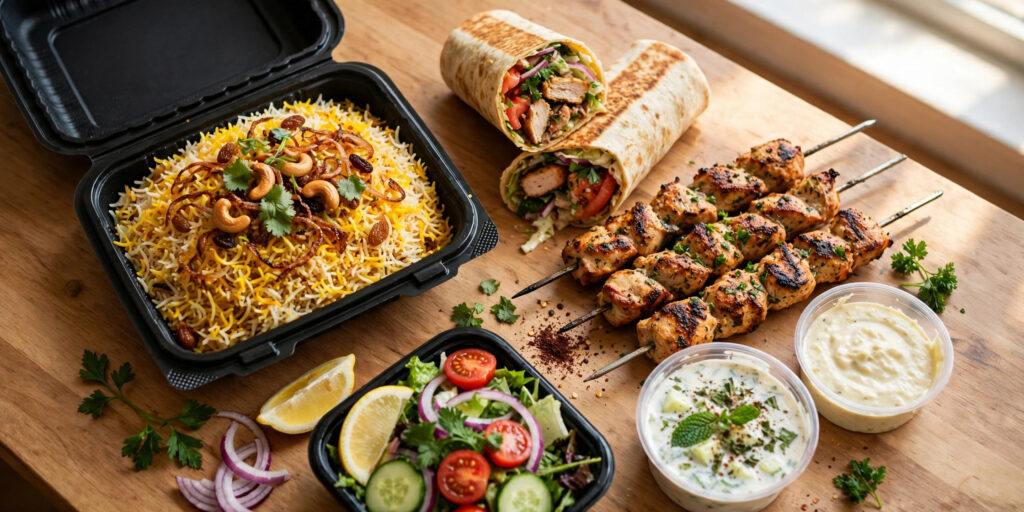
Ordering halal food used to mean driving across town to the one restaurant you trusted. Today, a halal biryani, shawarma wrap, or kebab platter can arrive at your door in under an hour — if you know where to look and how to check that what you are eating is genuinely halal. Delivery apps have made halal food far more accessible, but they have also made it easier to order from a place that is not as halal as its menu claims.
This guide covers how to order halal food delivery anywhere in the US: which apps have the best halal options, how to verify a restaurant is really halal before you pay, what delivery costs, which dishes travel best, and what to do when an order goes wrong. If you are still finding your go-to spots, start with our guide to the best halal food near you.
Quick Answer: To order halal food delivery, search Uber Eats, DoorDash, or Grubhub using the word “halal” plus your dish or cuisine, then verify the restaurant by checking its own website or calling to confirm zabiha halal certification. Delivery usually takes 30–60 minutes and costs $3–$6 plus tip; biryani, kebabs, shawarma wraps, and curries travel best.
How Do I Order Halal Food Delivery Near Me?
Ordering halal delivery is a three-step habit: search, verify, then order. First, open your delivery app and search “halal” along with the dish or cuisine you want — “halal biryani,” “halal shawarma,” or “halal burgers” all work better than a bare “halal” search, which can surface anything from a grocery store to a restaurant that happens to mention the word once. Most major apps now index menu text, so a restaurant that labels its chicken “halal” will show up even if it does not advertise itself as a halal restaurant.
Second, verify before you pay. Tap into the restaurant’s profile, look for a halal statement, then cross-check it against the restaurant’s own website or Google listing. A genuine halal restaurant usually says so proudly — “100% halal,” “zabiha halal,” or a named certifier such as IFANCA or HMC. If the app listing is silent on halal but the restaurant’s own site makes the claim, you are usually safe. If neither says anything, a 30-second phone call settles it: ask “Is all your meat halal?” and “Who supplies your meat?” A real halal kitchen answers both without hesitation.
Third, order with delivery in mind. Dishes with sauces travel well; crispy fried items do not. Add a note if you need something specific — “no pork on the grill, please” or “halal chicken only” — because delivery notes do reach the kitchen on most apps. And save the restaurants that pass your check: favoriting them turns a 10-minute verification job into a two-tap reorder next time.
Which Delivery Apps Have the Best Halal Options?
There is no single best app for halal delivery — it depends on your city. Uber Eats, DoorDash, and Grubhub all carry halal restaurants in major metros, and each has a dietary filter that can narrow results. Uber Eats has the widest restaurant coverage overall, DoorDash tends to be strongest in suburbs and smaller cities, and Grubhub is competitive in the Northeast. Smaller halal-focused apps exist in some cities, and local restaurant-direct delivery — ordering from the restaurant’s own website — often costs less because the restaurant avoids the 20–30% commission apps charge.
Here is how the main options compare for halal eaters:
| App / option | Halal search & filters | Coverage | Best for |
|---|---|---|---|
| Uber Eats | Search “halal”; dietary filter in many cities | Widest US coverage | Biggest restaurant choice in metros |
| DoorDash | Search “halal”; dietary filters by market | Strong in suburbs & smaller cities | Finding halal outside big cities |
| Grubhub | Search “halal”; cuisine filters | Strongest in Northeast | NYC, Boston, Philadelphia orders |
| Restaurant’s own site | Full halal info on their own menu | Single restaurant only | Lowest fees, most reliable halal info |
| Halal-focused apps | Every listing is halal by design | Select US cities only | Zero verification work |
The practical move is to keep two apps installed. When one has no halal options nearby, the other often does — restaurant coverage varies street by street, and a place listed on DoorDash may not be on Uber Eats at all. Also check whether the restaurant delivers directly: many halal restaurants offer free delivery over a minimum order on their own site, and the food arrives hotter because the order goes straight to their kitchen instead of through an app queue.
How Can I Tell If a Restaurant on a Delivery App Is Really Halal?
This is the question that matters most, because delivery apps do not verify halal claims. A restaurant can type “halal” into its own menu description and the app will show it. So treat the app as a discovery tool, not a guarantee, and run a quick check before ordering from a new place.
Start with the signals that cost nothing. A halal certificate on the restaurant’s website or Google photos is the strongest sign — look for the name of a certifying body, not just the word “halal” in a logo. Reviews help too: search the restaurant’s reviews for “halal” and read what Muslim customers say. If several reviewers mention that the place is certified or that the staff confirmed it, that is meaningful. If reviewers say the opposite — “they serve pork too” or “the chicken isn’t halal” — believe them.
Then ask the direct questions. Call and ask: Is all the meat halal, or only some dishes? Is the chicken zabiha halal? Do you cook halal meat separately from non-halal items? A restaurant that is fully halal will answer quickly and specifically, often naming its supplier. A restaurant that is partially halal — halal chicken but non-halal beef, for example — should say so clearly; many do, and that is fine as long as you order the halal items only. The red flag is vagueness: “I think so,” “probably,” or a long pause before an answer.
Watch for the common traps. “Halal-style” and “halal-friendly” are not the same as halal — they usually mean the restaurant serves some halal dishes or Middle Eastern food, not that its meat is certified. A Mediterranean restaurant is not automatically halal, and a restaurant with “halal” in its name can still serve alcohol or cook pork on the same grill. When in doubt, order vegetarian or seafood dishes, which are halal by default, and save the meat dishes for a place you have verified.
What Is the Difference Between Halal and Zabiha Halal?
All zabiha halal meat is halal, but not all meat labelled halal is zabiha — and the distinction matters to many Muslim eaters. Zabiha is the specific Islamic method of slaughter: the animal is slaughtered by a Muslim with a blessing, with the blood drained. Some restaurants use the word “halal” loosely to mean “no pork and no alcohol,” while sourcing ordinary meat. For many customers that is enough; for others, only zabiha counts.
When you see “zabiha halal” on a menu, the restaurant is making a stronger claim, and it is worth asking which certifier or supplier backs it. Common certifiers in the US include IFANCA, the Islamic Food and Nutrition Council of America, and HMC, the Halal Monitoring Committee. A restaurant that names its certifier is almost always the real thing. If you follow the zabiha standard strictly, add “zabiha” to your delivery-app search — “zabiha halal biryani” filters out the loose users of the word — and confirm on the phone the first time you order from a new place.
How Much Does Halal Food Delivery Cost?
Halal delivery costs about the same as any other delivery — the food itself is not inherently more expensive, and the fees are set by the app, not the restaurant. What you pay is the menu price plus a delivery fee, a service fee, tax, and a tip. Menu prices on apps are often $1–$3 higher per dish than in the restaurant, because the restaurant passes part of the app’s commission to you.
| Cost item | Typical range | Notes |
|---|---|---|
| Delivery fee | $0–$6 | Free with app subscriptions or promos |
| Service fee | 10–15% of subtotal | Charged by the app, not the restaurant |
| Tip | 15–20% | Goes to the driver |
| Small-order fee | $2–$3 | Applies below the minimum, usually $10–$12 |
| Typical halal meal | $15–$25 per person | Biryani, kebab platter, or shawarma + drink |
You can cut the bill in several ways. App subscriptions such as Uber One or DashPass wipe out delivery fees and cut service fees, and they pay for themselves if you order more than twice a month. Ordering directly from the restaurant’s own website avoids the app’s markup entirely — many halal restaurants offer 10–15% off first online orders. Family platters and combo deals are also the best value in halal delivery: a $35–$45 mixed grill or biryani family pack often feeds three or four people, working out to $10–$12 per person, while individual plates run $15–$20 each.
What Are the Best Halal Dishes to Order for Delivery?
Not every dish survives a 30-minute ride in a delivery bag. The winners are dishes with sauce, moisture, and sturdy textures — they arrive hot and often taste better after the flavors have had time to settle. The losers are anything that needs to be crispy, because steam inside a closed container kills crunch fast.
These travel best:
- Chicken or lamb biryani — rice dishes hold heat beautifully, and the steam keeps the meat moist. Order raita on the side so it stays cool.
- Kebab platters and mixed grills — grilled meats reheat well, and the rice, salad, and bread travel separately.
- Shawarma wraps — ask for the sauce on the side if the drive is long, so the wrap does not go soggy.
- Curries and karahi — saucy dishes are almost impossible to ruin in transit, and they reheat perfectly the next day.
- Falafel and hummus platters — falafel loses some crunch, but the platter format keeps everything separate and fresh.
- Mandi and kabsa — large-format rice dishes made for sharing, and generous portions for the price.
Order with caution: fries and samosas (they steam and soften), naan (ask for it wrapped separately), and anything with melted cheese on top. If you do order them, open the container as soon as it arrives to let the steam out, and a two-minute blast in a hot oven or air fryer brings fries and samosas most of the way back.
Can I Get Halal Food Delivered Late at Night?
Yes, but your options narrow after 10pm. Most halal restaurants close by 10 or 11pm, and delivery apps stop listing them once the kitchen closes. The places that stay open late tend to be in big cities — New York, Chicago, Houston, and Dearborn all have halal spots serving until 2am or later on weekends, usually carts, kebab shops, and 24-hour diners.
For late-night orders, search the app with “open now” filters and sort by delivery time, not rating — a place open at 1am with a 45-minute estimate is better than a closed five-star spot. Keep a short list of late-night halal places saved in your app, because at midnight you do not want to be verifying a new restaurant. If you regularly eat late, our guide to halal brunch spots in NYC also covers several restaurants that run long hours. And if nothing halal is open, a grocery delivery of eggs, bread, and cheese is a better fallback than a non-halal meat order you will regret.
How Do I Avoid Cross-Contamination When Ordering Halal Delivery?
Cross-contamination is the quiet worry in halal delivery: halal meat cooked on the same grill as pork, or fried in the same oil as non-halal items. Fully halal restaurants do not have this problem at all, which is the simplest reason to prefer them. But when you order from a mixed restaurant — one that serves halal chicken alongside other meats — a few steps reduce the risk.
First, order the dishes that are least exposed: grilled items cooked to order are safer than fried items that share a fryer. Second, use the delivery note to state your requirement plainly — “halal chicken only, cooked separately if possible” — because the note is visible to the kitchen. Third, prefer restaurants that keep their halal supply separate and say so; many mixed restaurants now advertise “halal chicken cooked separately” as a selling point. Finally, remember that food-delivery drivers carry multiple orders in one bag, so if you order alcohol-free and pork-free, the risk is about the kitchen, not the courier — sealed containers and separate bags handle the delivery leg.
What Should I Do If My Halal Order Arrives Wrong?
It happens: the wrong dish, a missing item, or a sinking feeling that the meat is not what you ordered. Act fast, because delivery apps have short refund windows. Photograph the food and the receipt, then report the problem in the app within the hour — missing items and wrong orders are almost always refunded or re-delivered without argument.
If the problem is halal rather than logistical — you suspect the meat is not halal, or the restaurant served pork by mistake — do not eat it. Contact the restaurant directly as well as the app, explain exactly what happened, and keep the order number. A serious restaurant will investigate and often refund and re-make the order. Then leave an honest review naming the issue: it protects the next Muslim customer who orders from the same place. If the restaurant lied about being halal, report the listing to the app too — delivery platforms do remove misleading listings when customers flag them.
How Can I Find Halal Delivery in a New City?
Arriving in a city you do not know is the hardest halal-delivery moment: no saved favorites, no trusted spots, and you are hungry now. Use this order of operations. First, search your delivery apps for “halal” plus the city or neighborhood — “halal food Houston” beats a generic “halal” search because it surfaces the restaurants the app associates with that area. Second, check the Zabihah directory online, which lists halal restaurants by city with user reviews — it is the oldest halal restaurant database and still the most complete. Third, search Google Maps for “halal restaurants near me” and filter by “open now,” then check whether those restaurants are on a delivery app.
Local shortcuts help. Mosques and Islamic centers usually know the best nearby halal spots, and many have a list on their website or noticeboard. University Muslim student associations post recommendations too. And once you find one good restaurant, ask them — halal restaurant owners know their local scene, and a quick “who else nearby is halal?” often gives you three more places in one answer. For city-specific guides before you travel, browse our Food Guides hub, which covers halal eating city by city.
Tips for Ordering Halal Takeout Like a Pro
- Save your verified spots. Favorite every halal restaurant you have checked — the list becomes your personal halal delivery menu.
- Order direct when you can. The restaurant’s own website is usually cheaper, and the halal information is more reliable than an app listing.
- Batch your orders. Ordering for the family or the week in one delivery saves fees and keeps per-person costs near $10–$12.
- Check the clock. Ordering at 6pm on a Friday means a 60–90 minute wait; order at 5pm or 8pm and it is usually half that.
- Keep sauces separate. Ask for raita, chutney, and garlic sauce on the side — they stay fresh, and soggy food stays crisp.
- Reheat properly. Biryani and curries reheat beautifully in a covered pan with a splash of water; the microwave dries them out.
- Tip your driver. Halal restaurants cluster in certain neighborhoods, and good tips keep drivers accepting orders from your area.
Frequently Asked Questions About Halal Food Delivery
Is halal food delivery more expensive than regular delivery?
No. Delivery fees and service charges are set by the app and are the same whatever you order. Halal dishes are priced like any other restaurant food — a biryani or kebab plate usually costs $15–$25 per person delivered, which is in line with other cuisines.
Which app is best for halal food delivery?
It depends on your city. Uber Eats has the widest coverage, DoorDash is often stronger in suburbs and smaller cities, and Grubhub leads in parts of the Northeast. Keep two apps installed, and always check whether the restaurant delivers directly from its own website, which is often cheaper.
How do I know if a restaurant on DoorDash or Uber Eats is really halal?
Check the restaurant’s own website or Google listing for a halal certificate, read reviews from Muslim customers, and call to confirm when ordering from a new place. Delivery apps do not verify halal claims, so the app listing alone is not proof.
Can I order halal food on Uber Eats?
Yes. Search “halal” plus your dish or cuisine — “halal biryani” or “halal shawarma” — and use the dietary filter where it is available in your city. Always verify the restaurant’s halal status on its own website or by phone before your first order.
What halal food delivers best?
Biryani, kebab platters, curries, karahi, and shawarma wraps travel best because their sauces and moisture protect them in transit. Fried foods like fries and samosas lose their crunch quickly — ask for sauces on the side and open containers immediately on arrival.
Is “halal-friendly” the same as halal?
No. “Halal-friendly” usually means the restaurant serves some halal dishes or Middle Eastern food, not that all its meat is certified halal. Ask which dishes are halal and who supplies the meat before you order.
Can I get halal delivery at midnight?
In big cities, yes — New York, Chicago, Houston, and Dearborn have halal spots open until 2am or later, especially on weekends. In smaller cities your options are thin after 10pm, so keep a short list of late-night halal places saved in your delivery app.
Halal delivery is only getting easier: more restaurants are certifying, more apps are adding dietary filters, and more cities are gaining halal options every year. Build your list of verified spots, order direct when you can, and the next time hunger strikes you will have a halal meal at your door in under an hour — no drive across town required. For more city-by-city halal eating guides, explore our Food Guides hub.
I’m Lila Spoonbelle, your host on this flavorful ride through food, fun, and fearless puns. Let’s turn every bite into a burst of laughter!