
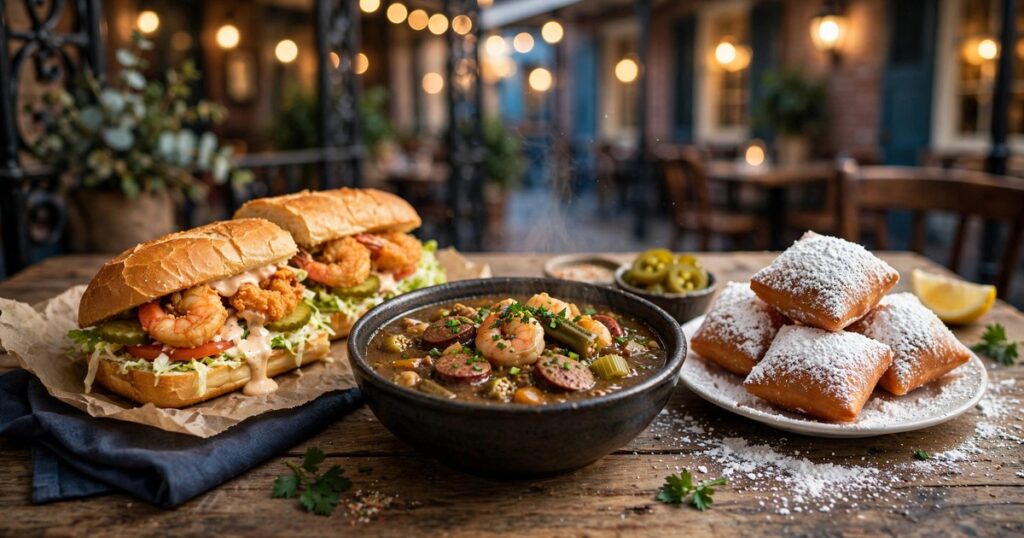
New Orleans is one of the few American cities where you could eat well for a week straight and still leave with a list of regrets. The food here doesn’t come from one tradition — it’s Creole and Cajun, French and Spanish and West African and Italian, all folded together over three hundred years. In the French Quarter you’ll pass century-old dining rooms, hole-in-the-wall po’boy counters, and beignet lines that never quite disappear. Here’s how to eat your way through it without wasting a single meal.
Quick Answer: The best places to eat in New Orleans span classic and modern: Commander’s Palace and Arnaud’s for grand Creole dining, Dooky Chase’s for historic Creole soul food, Café du Monde for beignets, Central Grocery for muffulettas, Willie Mae’s Scotch House for fried chicken, Drago’s for charbroiled oysters, Mother’s and Parkway Bakery & Tavern for po’boys, and Brennan’s for bananas Foster. Expect a mix of white-tablecloth institutions and casual counters — both are essential.
Before you plan a single reservation, browse our Food Guides hub for more city-by-city eating guides built the same way: neighborhood by neighborhood, with the tourist traps filtered out.
What is the difference between Creole and Cajun food?
This is the question every first-timer asks, and locals love explaining it — so get it straight before you order. Creole cooking is the food of the city: New Orleans’ French, Spanish, Caribbean, and West African communities cooking with butter, cream, tomatoes, and a proper roux. Think shrimp remoulade, oysters Rockefeller, and rich sauces. Cajun cooking comes from the Acadian settlers of southwest Louisiana — country food, rustic and porky, one-pot dishes like jambalaya and crawfish étouffée built for feeding a crowd.
The shorthand locals use: Creole is city food, Cajun is country food. Most great New Orleans restaurants lean Creole, and you’ll see both labels on menus across town. You don’t need to memorize the difference — but knowing it will make ordering a lot more fun. And if you’re curious how another Southern food city compares, check our guide to where to eat in Nashville for a totally different flavor of the South.
Where should first-time visitors eat in the French Quarter?
The Quarter is where most visitors land, and honestly, it’s where some of the city’s best meals still happen — if you know where to go.
Which classic restaurants are worth the hype?
- Antoine’s — Open since 1840, this is the granddaddy of Creole dining rooms. Oysters Rockefeller were invented here. It’s old-school in the best way: jacket-preferred, multi-course, and genuinely excellent.
- Galatoire’s — The Friday-lunch institution where the dining room buzzes like a party. Classic French-Creole dishes, a no-reservations downstairs tradition, and some of the best people-watching in the city.
- Arnaud’s — Another century-old Creole palace on Bourbon Street, famous for shrimp Arnaud and a dazzling Creole dining room. The French 75 cocktail bar upstairs is worth a stop on its own.
- Mr. B’s Bistro — Brennan family Creole in a slightly more relaxed package. The barbecue shrimp (which is neither barbecued nor, technically, shrimp in the usual sense — just order it) is legendary.
- Acme Oyster House — The line out front looks intimidating, but it moves fast. Raw and chargrilled oysters, po’boys, and cold beer in a loud, happy room. A Quarter rite of passage.
Where can I get a great casual meal in the Quarter?
Not every Quarter meal needs a reservation. Coop’s Place is the local-favorite dive on Decatur — rabbit and sausage jambalaya, fried chicken, and a bar crowd that actually lives here. Café Beignet on Royal Street is the calmer alternative when the Café du Monde line wraps the block. And Dat Dog on Frenchmen Street does gloriously over-the-top hot dogs and sausages when you need something fast between sets.
What are the best classic Creole restaurants in New Orleans?
Beyond the Quarter, the city’s grand Creole dining rooms are the reason New Orleans punches so far above its weight as a food city.
- Commander’s Palace — In the Garden District, this turquoise-and-white landmark is arguably America’s most famous restaurant. Turtle soup, bread pudding soufflé, and a jazz brunch that’s been a tradition for generations. Book ahead — it’s popular for a reason.
- Dooky Chase’s — Leah Chase’s legendary Tremé restaurant fed civil rights leaders when nowhere else would, and the Creole menu (gumbo, fried chicken, stuffed shrimp) remains deeply soulful. It’s history you can taste.
- Brennan’s — On Royal Street, the birthplace of bananas Foster, which they still flambé tableside. Breakfast here — eggs Hussarde, grillades — is one of the city’s great mornings.
- Herbsaint — Donald Link’s Warehouse District bistro takes Creole-French cooking in a modern direction: the lamb neck, the gumbo, and a short rib that people cross town for.
- Emeril’s — Yes, that Emeril. The Warehouse District flagship still serves refined Creole with the famous “bam” energy dialed into genuine fine dining.
- Restaurant R’evolution — In the Royal Sonesta, a polished, contemporary take on Creole classics — think refined gumbo and modern Louisiana tasting menus.
Where can I find the best po’boy in New Orleans?
The po’boy is New Orleans’ signature sandwich — crusty French bread, dressed (mayo, lettuce, tomato, pickles) or not, stuffed with anything from fried shrimp to roast beef debris. Here’s where the debate gets serious:
- Parkway Bakery & Tavern — In Mid-City, the roast beef po’boy here is the stuff of legend: gravy-soaked, messy, perfect. The James Brown “surf and turf” po’boy (fried shrimp and roast beef) is the insider order.
- Mother’s — The Poydras Street institution famous for the Ferdi Special — baked ham, roast beef, debris, and gravy. The line is part of the experience.
- Domilise’s — A tiny Uptown sandwich shop where the fried shrimp po’boy, dressed, is close to sandwich perfection. Cash-friendly, no-frills, beloved.
- Casamento’s — On Magazine Street, famous for the oyster loaf — a whole loaf of bread stuffed with fried oysters. Closed in summer (oyster off-season), which tells you how seriously they take it.
What makes a po’boy great?
Three things: the bread (Leidenheimer or similar French bread with a crackly crust and airy crumb), the fry (hot, crisp, seasoned), and the dress. A po’boy should be a little messy. If you’re eating one neatly, something’s wrong.
Where can I get beignets besides Café du Monde?
Café du Monde in the French Market is the icon — open 24 hours (except Christmas), powdered sugar everywhere, café au lait. You should go at least once, ideally at an odd hour when the line is short.
But locals have opinions. Morning Call — the longtime Metairie favorite that opened a City Park location — serves beignets many residents prefer, with a calmer setting under the oaks. Café Beignet on Royal and Bourbon offers a pleasant sit-down alternative with live music some mornings. The truth? They’re all good. The beignet itself barely varies; the experience around it is what you’re choosing.
What is the best food in the Garden District and Uptown?
The Garden District and Uptown are where many of the city’s destination restaurants live, away from the Quarter crowds.
- Commander’s Palace — Worth repeating: the Garden District’s crown jewel. See above — just go.
- Jacques-Imo’s — Uptown funk in restaurant form: eclectic Creole with Caribbean touches, alligator cheesecake (yes, really), and a famously fun dining room. No reservations for small parties — get there early.
- Coquette — On Magazine Street, a refined but relaxed spot for contemporary Louisiana cooking with serious wine chops.
- Shaya — Alon Shaya’s modern Israeli restaurant on Magazine, which won national awards and proves New Orleans’ food scene goes far beyond Creole.
- n7 — A tiny French-Japanese hideaway on Montegut in the Bywater-adjacent area, intimate and inventive — the kind of place locals take out-of-towners to show off.
- Turkey and the Wolf — In the Lower Garden District, the sandwich shop that won national “best new restaurant” buzz with playful, brilliant sandwiches (the fried bologna is famous). Casual, counter-service, essential.
Where do locals eat in New Orleans?
Ask a local where they actually eat on a Tuesday, and the grand dining rooms rarely come up first. Here’s the real rotation:
- Willie Mae’s Scotch House — In Tremé, the fried chicken here is regularly called the best in America. Crispy, juicy, served with red beans and rice. It’s a pilgrimage.
- Mosquito Supper Club — A tiny, reservation-only Cajun supper club experience that’s become one of the hardest tables in town. Intimate, seasonal, unforgettable.
- Compère Lapin — Nina Compton’s Warehouse District restaurant blending Caribbean and Louisiana flavors — goat curry, conch croquettes, and one of the city’s best bars.
- Central Grocery — The French Quarter Italian grocery that invented the muffuletta: a whole round loaf layered with salami, ham, and olive salad. Get it to go and eat it on a bench by the river.
- Drago’s — Technically in Metairie (and now with a Hilton Riverside location), but the charbroiled oysters — buttery, garlicky, bubbling — are worth the trip wherever you find them.
- Dat Dog — Already mentioned, but locals genuinely eat here. Frenchmen Street after a show, loaded fries, done.
Which New Orleans neighborhoods are best for food?
Each neighborhood eats differently. Use this as your planning map:
| Neighborhood | Vibe | Best for | Price level |
|---|---|---|---|
| French Quarter | Historic, touristy, buzzing | Classic Creole dining rooms, beignets, oysters | $$–$$$ |
| Garden District / Uptown | Leafy, residential, grand | Commander’s Palace, Jacques-Imo’s, Magazine St. cafés | $$–$$$ |
| Tremé | Historic Black neighborhood, soulful | Dooky Chase’s, Willie Mae’s fried chicken | $–$$ |
| Marigny / Bywater | Artsier, bohemian, local | Frenchmen St. late-night, n7, Turkey and the Wolf | $–$$ |
| Warehouse District | Modern, gallery-like | Herbsaint, Compère Lapin, Emeril’s | $$–$$$ |
| Mid-City | Neighborhoody, unpretentious | Parkway po’boys, Morning Call beignets at City Park | $–$$ |
Traveling for food is the whole point of a trip like this — and if dietary needs shape your planning, our note on halal food in Atlanta shows how we cover food cities with specific dining requirements in mind.
How much does a meal cost in New Orleans?
New Orleans is refreshingly affordable for a major American food city. Roughly:
- $ (under $15/person): beignets and café au lait, a muffuletta to split, most po’boys, Dat Dog, slice-and-go spots.
- $$ ($15–$40/person): Coop’s Place, Casamento’s, Domilise’s, Willie Mae’s, Acme Oyster House, most lunch menus — including the famous lunch deals at grand restaurants.
- $$$ ($40+/person): Commander’s Palace, Antoine’s, Galatoire’s, Brennan’s dinner, tasting menus at R’evolution and Compère Lapin.
Pro tip: many of the grand Creole dining rooms offer lunch menus or prix fixe deals that are dramatically cheaper than dinner. Commander’s Palace’s jazz brunch and multi-course lunches are the classic example — same kitchen, friendlier bill.
What are the best late-night food spots?
New Orleans runs late, and the food follows.
- Café du Monde — Open 24 hours. A 2 AM beignet run is a rite of passage.
- Coop’s Place — Kitchen open late on Decatur; jambalaya at midnight hits different.
- Dat Dog (Frenchmen St.) — Built for the post-show crowd.
- Clover Grill — The Bourbon Street diner under the iconic sign, flipping burgers around the clock since the 1930s.
- Killer Poboys — The Erin Rose bar’s back-room po’boy operation (Frenchmen/Dauphine area), serving creative po’boys late into the night.
What foods must I try before leaving New Orleans?
If your trip is short, prioritize these — they’re the dishes that define the city:
- Gumbo — The dark-roux stew (seafood or chicken-and-sausage) that is Louisiana in a bowl. Try it at Dooky Chase’s or Herbsaint.
- Jambalaya — The one-pot rice dish; Coop’s Place does a standout version.
- Po’boy — Fried shrimp or roast beef debris, dressed. Parkway or Domilise’s.
- Beignets — Pillowy fried dough under a snowdrift of powdered sugar. Café du Monde or Morning Call.
- Crawfish étouffée — Crawfish smothered in a rich roux-based sauce over rice. Peak season is spring, but good versions run year-round.
- Muffuletta — The Italian-French Quarter sandwich from Central Grocery. Get the whole; eat half now, half later.
- Red beans & rice — Traditionally a Monday dish (laundry day, historically). Creamy, smoky, perfect.
- Charbroiled oysters — Drago’s signature: oysters grilled with butter, garlic, and Parmesan until bubbling.
- Bananas Foster — Invented at Brennan’s: bananas flambéed tableside with rum and brown sugar over vanilla ice cream.
- Pralines — The creamy pecan candies sold all over the Quarter. Grab a fresh box to take home.
- Shrimp remoulade — Cold boiled shrimp in a tangy Creole remoulade — the classic starter at Galatoire’s and Arnaud’s.
Frequently asked questions
How many days do I need to eat well in New Orleans?
Three full days is the sweet spot: one for the French Quarter classics, one for Uptown/Garden District and Tremé, and one for wandering — po’boys, markets, and whatever you stumble into. Food-focused travelers often wish they’d booked four.
Do I need reservations at New Orleans restaurants?
For the grand Creole dining rooms (Commander’s Palace, Antoine’s, Brennan’s, Dooky Chase’s), yes — book days or weeks ahead, especially for weekend brunch. For po’boy shops, beignet stands, and casual spots, just show up.
What is the best month to visit New Orleans for food?
Spring (March–May) is ideal: crawfish season, pleasant weather, and festival season. Fall (October–November) is the runner-up. Summer is hot and quiet — but restaurant deals are at their best.
Is the French Quarter food just a tourist trap?
Some of it is, but the Quarter also holds genuinely great institutions — Antoine’s, Galatoire’s, Arnaud’s, Central Grocery, and Acme are the real thing. The trick is choosing the century-old places over the generic “Cajun” spots with barkers outside.
Can I eat well in New Orleans on a budget?
Absolutely — it’s one of America’s best budget food cities. Po’boys, beignets, red beans and rice, and muffulettas keep you under $15 a meal, and many fine-dining rooms offer lunch prix fixe menus at a fraction of dinner prices.
Where should I stay to be near the best food?
The French Quarter puts the classics at your doorstep; the Garden District/Uptown area keeps you near Commander’s Palace and Magazine Street; the Marigny puts you by Frenchmen Street’s music and late-night eats. Any of the three works — the streetcar connects them all.
New Orleans rewards the curious eater — the person who tries the oyster loaf, orders the bread pudding soufflé, and says yes to the second beignet run. Start with the classics on this list, then follow your nose: some of the best meals in the city are the ones you didn’t plan. For more city eating guides in this series, head back to our Food Guides hub and keep exploring.

I’m Lila Spoonbelle, your host on this flavorful ride through food, fun, and fearless puns. Let’s turn every bite into a burst of laughter!