
We still remember the first time we landed in Japan as Muslim travelers: the excitement of the neon, the temples, the trains that run like clockwork — and then, about three hours in, the stomach-check. Where do we eat? Can we eat this? Is that ramen broth pork? Japan is not a country with a centuries-old halal food culture, and a decade ago, eating halal here took real detective work. The good news is that everything has changed. Japan’s halal dining scene has quietly exploded — halal ramen counters, certified yakiniku restaurants, Muslim-friendly convenience-store staples, prayer rooms in malls and airports — and the country is now one of the most exciting food destinations on earth for Muslim travelers who plan ahead.
This is the parent guide: the big-picture map of eating halal across Japan. For the capital specifically, we have a dedicated deep dive — our halal food in Tokyo city chapter walks you street by street through Asakusa, Shinjuku, Akihabara and beyond. And if your East Asia trip keeps going west, pair this with our halal food in Seoul guide for the Korean side of the journey. More Travel Guides like this one live in our food-travel hub.
Quick Answer: Eating halal in Japan in 2026 is entirely doable with a plan. Tokyo leads with dozens of halal ramen, yakiniku, and curry spots; Osaka and Kyoto follow with solid clusters. Use halal-finder apps, learn a few Japanese phrases, read konbini labels carefully, and you will eat extremely well across the country.
How Hard Is It to Eat Halal in Japan?
Honest answer: harder than in Malaysia or Dubai, far easier than it was five years ago, and much more rewarding than most travelers expect. Japan is a non-Muslim-majority country where pork (tonkatsu, gyoza, ramen broth) and alcohol (mirin, sake in cooking) are woven deep into everyday cuisine. You cannot just walk into a random izakaya and assume anything. But the Muslim-traveler infrastructure has grown fast — Japan has been actively courting Muslim tourists since the 2010s, halal certification bodies operate nationwide, and the big cities now have real, walkable halal food neighborhoods rather than one lonely restaurant.
The trick is front-loading the effort. Spend an hour with this guide before you fly: save a halal-finder app, bookmark the city sections below, download a translation app with an offline Japanese pack, and learn the two kanji that matter most — 豚 (buta, pig/pork) and 酒 (sake, alcohol). Do that, and Japan goes from “stressful” to “one of the best food trips of your life.”
Where Can I Find Halal Food in Tokyo?
Tokyo is Japan’s halal capital, full stop. If you eat well anywhere in Japan, it will be here. The city has the densest concentration of halal and Muslim-friendly restaurants in the country, spread across several traveler-friendly clusters.
Asakusa — the halal ramen heartland
The old-town district around Senso-ji temple is Tokyo’s most famous halal dining cluster. Halal ramen counters in Asakusa serve rich, certified broths — chicken-based shoyu, spicy miso, even vegetarian tantanmen-style bowls — to queues of Muslim tourists and curious locals alike. The area also has halal curry houses, Turkish kebab counters, and souvenir shops that stock halal snacks. Arrive before noon for ramen; the popular counters sell out or queue up fast.
Shinjuku and Okubo — the Muslim quarter
Okubo, one stop from Shinjuku, is Tokyo’s de facto Muslim neighborhood — halal butchers, Islamic goods shops, and South Asian and Middle Eastern restaurants run by long-settled Muslim families. This is where you come for a proper desi dinner: biryani, karahi, kebabs, naan fresh off the tandoor. Shinjuku itself adds halal-certified Japanese restaurants and hotel-adjacent Muslim-friendly dining, useful if you are based near the station.
Akihabara, Ueno, and Shibuya
Akihabara has halal ramen and curry spots catering to the tourist stream; Ueno’s multicultural back streets hide affordable halal eateries near the museums and park; Shibuya has scattered Muslim-friendly restaurants and is handy for a mid-shopping lunch. For the full street-by-street breakdown — station exits, walking routes, and area-by-area picks — read our halal food in Tokyo city chapter, which we keep as the dedicated deep dive so this parent guide stays conflict-free.
What About Halal Food in Osaka?
Osaka is Japan’s kitchen — the city that takes food personally — and its halal scene punches above its weight. The clusters are smaller than Tokyo’s but well-organized around the tourist trail.
Dotonbori and Namba
The neon heart of Osaka has halal ramen counters and Muslim-friendly restaurants tucked among the takoyaki stands. Takoyaki itself (octopus balls) is often cooked in shared oil or with pork-based dashi, so default to certified halal spots rather than street stalls unless you can verify ingredients. The Shinsaibashi shopping arcade nearby adds halal curry and kebab options.
Shin-Osaka and Umeda
The business and transit districts hold a handful of halal-certified Japanese restaurants — convenient for a sit-down dinner near your hotel. Osaka’s halal yakiniku options also cluster here and in Namba; several operate with certification and English menus.
Day-trip note: Kobe, 30 minutes by train, is worth the ride for certified halal Kobe beef restaurants — one of the great bucket-list meals for a Muslim traveler in Japan. Book ahead; the certified counters are small.
Can I Eat Halal in Kyoto, Nagoya, and Hokkaido?
Yes — with thinner coverage the farther you get from the big two, so plan a little more and lean on apps.
Kyoto
The old capital moves at a gentler pace, and so does its halal scene. Halal and Muslim-friendly restaurants cluster near Kyoto Station, Gion, and the Arashiyama area — think halal ramen, udon counters, and Japanese set-meal (teishoku) restaurants with Muslim-friendly menus. Kyoto’s famous kaiseki and temple cuisine (shojin ryori, Buddhist vegetarian) is naturally pork- and alcohol-light, but confirm dashi (fish stock is fine for most, but some broths use pork) and sake-based seasonings. A vegetarian shojin lunch at a temple restaurant is one of the most memorable halal-adjacent meals in Japan.
Nagoya
Often skipped by first-timers, Nagoya has a small but real halal scene around Nagoya Station and the Sakae district — halal curry houses, kebab counters, and a few Muslim-friendly Japanese restaurants. Its local specialties (miso katsu, hitsumabushi eel) are pork-heavy by default, so eat them only at certified spots or skip and save your appetite for Osaka.
Hokkaido (Sapporo)
Japan’s northern island is a food paradise — soup curry, fresh seafood, dairy — and Sapporo has a growing handful of halal and Muslim-friendly restaurants, plus seafood-heavy dishes that are easy to navigate. The famous Sapporo miso ramen is typically pork-broth based, so seek out halal ramen counters specifically. Summer lavender-season and winter snow-festival crowds mean booking restaurants ahead in peak weeks.
Where Do I Find Halal Ramen in Japan?
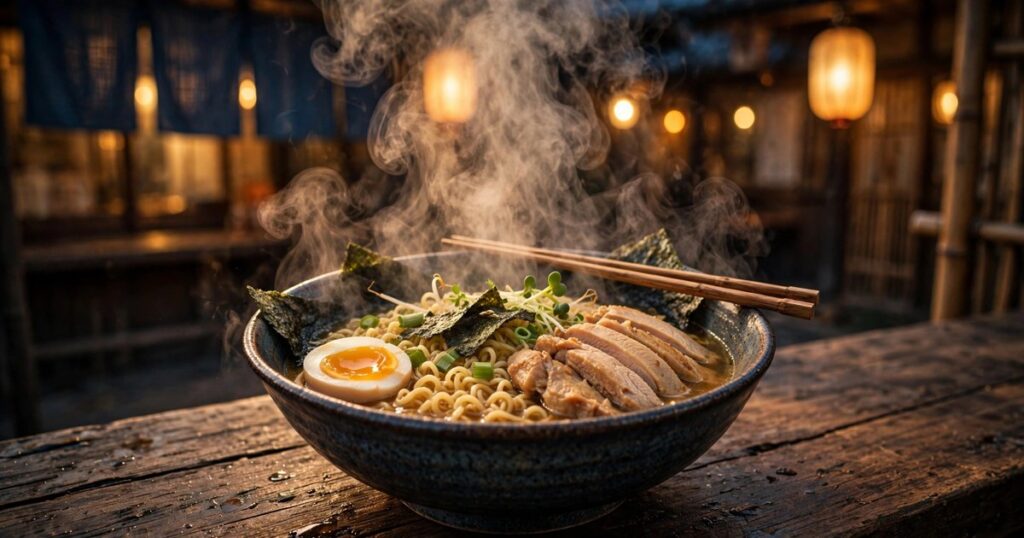
Halal ramen is the dish that proves how far Japan has come. A proper bowl — springy noodles, deep savory broth, jammy egg, nori, menma — with zero pork and zero alcohol in the tare or broth. Here is how to hunt it down.
- Tokyo (Asakusa cluster): the highest density in the country. Halal ramen counters here specialize in chicken-based shoyu and spicy miso broths, with certification displayed and English menus standard. Go at lunch to dodge the dinner queues.
- Tokyo (elsewhere): halal ramen counters also operate in Akihabara, Shibuya, and near Tokyo Skytree — useful when your sightseeing takes you out of Asakusa.
- Osaka: halal ramen shops in Dotonbori and Namba serve chicken and seafood broths; check certification on the door or the shop’s website before queuing.
- Kyoto and beyond: thinner — one or two certified counters per city is typical. Search your halal-finder app the night before and screenshot the map pin, because English signage can be sparse.
What to ask anywhere: is the broth 100% pork-free and alcohol-free (豚肉もお酒も使っていませんか — “butaniku mo osake mo tsukatte imasen ka?”)? Most halal ramen shops will answer with a proud yes and point at the certificate on the wall.
Can I Try Halal Yakiniku and Wagyu in Japan?
Yes — and you absolutely should. Yakiniku (Japanese BBQ, grilling bite-size meat at your table) is one of Japan’s great dining rituals, and halal-certified yakiniku restaurants now operate in Tokyo, Osaka, and Kobe. The format is perfect for Muslim diners: you see exactly what you are grilling, the meat is certified, and the sauces can be confirmed alcohol-free.
The crown jewel is certified halal Kobe beef or halal wagyu. A handful of restaurants in Kobe and Tokyo serve certified-halal wagyu yakiniku or teppanyaki — marbled, buttery, unforgettable. It is not cheap (expect premium pricing), and the certified counters are small, so reserve days ahead. For a mid-range alternative, halal-certified domestic beef yakiniku in Tokyo’s Shinjuku/Okubo area and Osaka’s Namba district delivers 80% of the joy at half the price.
Etiquette at the grill: most yakiniku restaurants provide tongs for raw meat and separate chopsticks for eating — use them as intended. Sauces (tare) sometimes contain alcohol; ask for a confirmation or request salt-and-lemon seasoning instead, which is standard and delicious.
How Do I Read Labels at Japanese Konbini?
Japan’s konbini (7-Eleven, FamilyMart, Lawson) are legendary — open 24 hours, genuinely good food — and they are a Muslim traveler’s secret weapon once you learn to read them. Japanese law requires allergen labeling, and the ingredient lists, while in Japanese, follow patterns you can decode.
- Learn the danger kanji: 豚 (buta — pig/pork), 豚肉 (butaniku — pork meat), ゼラチン (zerachin — gelatin), 酒 (sake — alcohol), みりん (mirin — sweet cooking wine), ラード (raado — lard).
- Generally safe bets: plain onigiri with umeboshi (pickled plum), kombu (kelp), or grilled salmon fillings; plain bread and melon pan; plain milk, yogurt, and fruit juices; fresh fruit cups; hard-boiled eggs.
- Check carefully: onigiri with meat fillings, sandwiches with ham or sausage, instant noodles and cup ramen (flavor oils and powders often contain pork extract), chocolate and candy (gelatin and alcohol fillings), sauces and dressings (mirin hides everywhere).
- Camera translation: point your phone’s translation app at the ingredient panel. Download the Japanese offline pack before you fly — konbini basements and rural stations do not always have signal.
- The allergen shortcut: the boxed allergen section lists items like wheat, egg, milk, and pork-adjacent ingredients in a standardized format — faster to scan than the full ingredient paragraph once you know the layout.
Konbini also sell “Muslim-friendly” marked products in tourist areas — look for crescent-mark stickers or English “pork-free / alcohol-free” labels, which chains have been rolling out in major cities.
What Does Halal Certification in Japan Actually Look Like?
Japan has no single government halal authority; instead, several private certification bodies audit restaurants, food manufacturers, and hotels. What matters for you as a traveler is recognition, not the organizational chart.
- Look for certificates on the wall: legitimate halal restaurants display their certification prominently — often in English and Arabic, with an expiry date. A framed certificate beats a menu sticker.
- “Muslim-friendly” vs “halal-certified”: “Muslim-friendly” usually means no pork and no alcohol in the food, but without formal certification of the supply chain. Many excellent restaurants use this label honestly. Decide your own comfort level: strict travelers stick to certified; most travelers mix both.
- Check expiry dates: certifications lapse. If a certificate looks five years old, a quick check of the restaurant’s website or a halal-finder app listing (which usually notes certification status) takes thirty seconds.
- Hotel breakfasts: an increasing number of city hotels offer halal or Muslim-friendly breakfast options — ask when booking, not at check-in.
- Cross-check with apps: no single source is perfect, so triangulate: the certificate on the wall, the app listing, and recent reviews from Muslim travelers.
Which Apps and Tools Help Muslim Travelers in Japan?
Your phone is your halal compass in Japan. Set these up before departure, not at Narita.
- Halal-finder apps: download one or two Muslim-traveler restaurant finders (the popular ones cover Tokyo, Osaka, and Kyoto well, with user reviews and prayer-space pins). Save offline maps of the areas you will visit.
- Translation with camera mode: a translation app with Japanese camera translation and an offline language pack is non-negotiable — for menus, labels, and signs. Practice on a Japanese snack label at home first.
- Google Maps lists: build a saved list per city (“Tokyo halal”, “Osaka halal”) as you research; star the restaurants from this guide’s city sections so dinner decisions take ten seconds, not forty minutes.
- Train apps: Japan’s trains are the circulatory system of your trip — a transit app with English station names keeps you moving between food clusters efficiently.
- Qibla and prayer-time apps: your usual prayer app works fine; just confirm it is set to Japan’s calculation method and your current city as you move.
What Japanese Phrases Do I Need for Halal Dining?
English works at halal-certified restaurants in tourist areas. Everywhere else, these phrases — shown on your phone if pronunciation fails — open doors. Politeness matters enormously in Japan; lead with a smile and a sumimasen (excuse me).
| English | Japanese (romaji) | Japanese script |
|---|---|---|
| Excuse me (to get attention) | Sumimasen | すみません |
| I am Muslim. I don’t eat pork. | Watashi wa Musurimu desu. Butaniku wa tabemasen. | 私はムスリムです。豚肉は食べません。 |
| Does this contain pork? | Kore wa butaniku ga haitte imasu ka? | これは豚肉が入っていますか? |
| Does this contain alcohol? | Kore wa arukōru / osake ga haitte imasu ka? | これはアルコール/お酒が入っていますか? |
| Is the broth pork-free and alcohol-free? | Butaniku mo osake mo tsukatte imasen ka? | 豚肉もお酒も使っていませんか? |
| Vegetable only, please. | Yasai dake onegai shimasu. | 野菜だけお願いします。 |
| Thank you (for the meal, after eating) | Gochisōsama deshita | ごちそうさまでした |
| Where is the prayer room? | Oinori no heya wa doko desu ka? | お祈りの部屋はどこですか? |
Where Can I Pray in Japan?
Japan’s prayer infrastructure is small but growing, and knowing the anchors in each city removes the day’s biggest logistical worry.
- Tokyo Camii (Yoyogi-Uenohara): Japan’s largest and most beautiful mosque — Ottoman-style architecture, five daily prayers, Friday congregation, and a halal market and cultural center attached. Worth visiting as a sight in its own right; time it for Dhuhr and eat in nearby Shinjuku after.
- Asakusa and Otsuka mosques: smaller prayer spaces near the halal food clusters — practical for combining prayer and lunch in one stop.
- Osaka and Kyoto: both cities have mosques and Islamic centers serving their Muslim communities; check prayer times and Friday schedules on their websites before visiting.
- Malls and department stores: major shopping complexes in Tokyo and Osaka increasingly provide multi-faith prayer rooms — ask at the information desk (use the phrase above).
- Airports: Narita, Haneda, and Kansai airports all offer prayer rooms, well-signed in English. Haneda also has halal dining options for a last proper meal before flying.
- Hotels: many mid-range and upscale hotels can lend a prayer mat and indicate the qibla — ask at check-in, ideally when booking.
What Food Etiquette Should I Know in Japan?
Japan’s dining etiquette is part of the pleasure — and getting it right earns you warm smiles everywhere.
- Say itadakimasu before eating (“I humbly receive”) and gochisōsama deshita after — everyone does, and joining in is respectful, not presumptuous.
- Never stick chopsticks upright in rice — it resembles funeral incense offerings. Lay them on the chopstick rest.
- Don’t pass food chopstick-to-chopstick — also a funeral-rite echo. Place it on a plate instead.
- Slurping noodles is polite — it cools the noodles and signals enjoyment. Your halal ramen deserves loud appreciation.
- No tipping. Tipping can confuse or offend; excellent service is the default, already priced in.
- Pay at the counter or machine: many ramen and casual restaurants use ticket machines — buy your meal ticket at the entrance, hand it to staff, sit down. Cash was king for years; IC cards (Suica/Pasmo) now work at most machines.
- Shared dishes: at yakiniku and izakaya-style meals, use the provided serving chopsticks or tongs for shared plates, and your own chopsticks only for your food.
How Do Japan’s Halal-Friendly Cities Compare?
Use this to decide where to spend your days — every city is visitable, but they are not interchangeable for a halal food trip.
| City | Best For | What to Know |
|---|---|---|
| Tokyo | First-timers; widest choice (ramen, yakiniku, wagyu, desi food) | Densest halal clusters (Asakusa, Okubo/Shinjuku); Tokyo Camii; plan 4+ days here |
| Osaka | Food lovers; street-food energy; Kobe beef day trip | Dotonbori/Namba clusters; certified halal Kobe beef 30 min away; 2–3 days ideal |
| Kyoto | Culture, temples, refined dining; shojin (Buddhist vegetarian) meals | Thinner halal coverage — research restaurants nightly; pairs perfectly with Osaka |
| Nagoya | Transit stopovers; miso-katsu region (eat at certified spots only) | Small scene near Nagoya Station/Sakae; fine for a night, not a food base |
| Sapporo (Hokkaido) | Seafood, soup curry, winter/summer scenery | Growing Muslim-friendly options; ramen is pork-broth by default — seek halal counters |
What Does a 7-Day Halal Food Itinerary in Japan Look Like?
Seven days, three cities, zero skipped meals. This balances Tokyo’s depth with the Kansai classics and keeps travel days food-productive.
- Day 1 — Tokyo (Asakusa): land, drop bags, Senso-ji temple, then your first halal ramen bowl in the Asakusa cluster. Evening: explore Nakamise shopping street snacks (check labels) and an early night.
- Day 2 — Tokyo (Shinjuku/Okubo + Tokyo Camii): morning at Tokyo Camii for Dhuhr, halal market browsing, then a desi lunch feast in Okubo — biryani, kebabs, fresh naan. Evening in Shinjuku: department-store food halls (depachika) for labeled snacks and a Muslim-friendly dinner.
- Day 3 — Tokyo (Akihabara + Ueno): electronics and anime in Akihabara with a halal ramen or curry lunch; afternoon at Ueno’s museums and park; dinner at a halal-certified Japanese restaurant — try a teishoku set meal.
- Day 4 — Tokyo → Kyoto: shinkansen to Kyoto (2+ hours — grab konbini onigiri and drinks for the ride). Afternoon: Fushimi Inari’s thousand torii gates. Dinner: halal ramen or a shojin vegetarian meal near Kyoto Station.
- Day 5 — Kyoto → Osaka: morning in Arashiyama (bamboo grove, temples), then train to Osaka. Evening: Dotonbori neon, halal dinner in Namba, and a walk along the canal.
- Day 6 — Osaka (+ Kobe day trip): morning: Osaka Castle and Kuromon market (gaze, snack carefully). Afternoon in Kobe for certified halal Kobe beef — book this weeks ahead. Alternatively, a halal yakiniku dinner in Osaka if Kobe doesn’t fit.
- Day 7 — Osaka → Tokyo (departure): shinkansen back, last-minute shopping, a final halal ramen farewell near your station, prayer room at Haneda or Narita, fly home full and happy.
Short on time? Cut Kyoto/Nagoya and do 4 days Tokyo + 3 days Osaka — you will still eat like royalty. Traveling in cherry-blossom or autumn-foliage season? Book restaurants (especially halal yakiniku and Kobe beef) earlier than you think necessary.
FAQs
Is Japan good for Muslim travelers?
Yes — increasingly so. Japan has spent a decade building Muslim-friendly tourism: halal-certified restaurants in every major city, prayer rooms in airports and malls, and the beautiful Tokyo Camii mosque. You need more planning than in a Muslim-majority country, but the payoff is one of the world’s great food cultures, made accessible.
Can Muslims eat ramen in Japan?
Absolutely — at halal ramen shops. Standard ramen broth is usually pork-based (tonkotsu) and tare seasonings can contain alcohol, so don’t assume. Halal ramen counters in Tokyo’s Asakusa, Osaka’s Dotonbori, and other cities serve certified pork-free, alcohol-free bowls. Look for the certificate on the wall and confirm with staff.
Is wagyu beef halal in Japan?
It can be. A small number of restaurants serve certified halal wagyu and halal Kobe beef, with audited supply chains from slaughter to plate. Because certification is what makes it halal — not the breed — only eat wagyu labeled and certified halal, and reserve ahead since these counters are tiny and popular.
What should I avoid eating as a Muslim in Japan?
Watch for pork in ramen broths, gyoza fillings, tonkatsu, and processed meats; alcohol in mirin, sake-based sauces, and some desserts; and gelatin in candies, jellies, and marshmallows. When in doubt, ask using the phrases above or default to certified halal restaurants and readable konbini staples.
Are there prayer rooms in Japanese airports and malls?
Yes. Narita, Haneda, and Kansai airports all have dedicated prayer rooms, and a growing number of major malls and department stores in Tokyo and Osaka provide multi-faith prayer spaces. Hotels will often lend a prayer mat and indicate the qibla on request.
Do I need to speak Japanese to eat halal in Japan?
No, but a little goes a long way. Halal-certified restaurants in tourist areas have English menus and staff used to Muslim diners. Outside those bubbles, the phrases and kanji in this guide — plus a camera-translation app — will carry you through menus, labels, and questions about pork and alcohol.
When is the best time to visit Japan for a food trip?
Spring (March–May) for cherry blossoms and takenoko (bamboo shoot) dishes, autumn (October–November) for foliage and seasonal mushrooms and chestnuts. Summer is hot and festival-heavy; winter brings snow festivals in Hokkaido and the year’s best hot-pot weather. Halal restaurant availability doesn’t change much by season — but book popular spots earlier in peak weeks.
Japan rewards the Muslim traveler who arrives prepared — and punishes no one, because the country is unfailingly kind to visitors who try. Learn your kanji, save your restaurant pins, pack your phrases, and go eat: halal ramen steam in Asakusa, wagyu sizzling in Kobe, a quiet shojin lunch in Kyoto. Few food trips on earth are this memorable. For the capital in granular detail, our halal food in Tokyo chapter is your next read — and if the journey continues to Korea, our halal food in Seoul guide picks up where this one leaves off.

I’m Lila Spoonbelle, your host on this flavorful ride through food, fun, and fearless puns. Let’s turn every bite into a burst of laughter!