
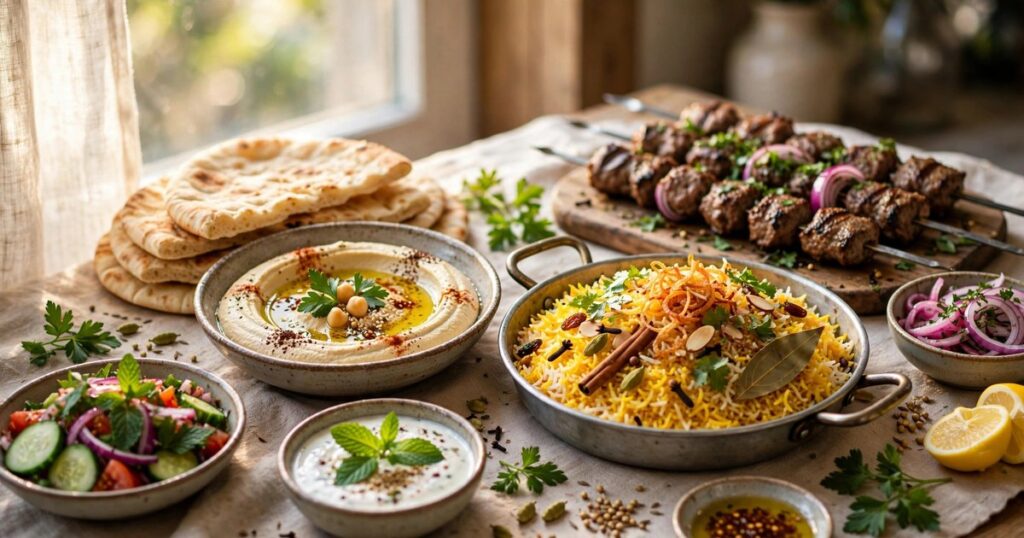
It’s 8:47 PM, you’re starving, and someone just suggested burgers. Easy for them to say — they don’t have to think about where the meat came from. If you eat halal, “where should we eat?” is never quite that simple. One wrong guess and you’re stuck picking at fries while everyone else digs in.
The good news: finding halal restaurants near you in 2026 is easier than it’s ever been. There are dedicated apps, certification bodies, Google Maps tricks, and even delivery filters built specifically for this. The hard part isn’t the search — it’s knowing which results you can actually trust. This guide covers both: how to find halal restaurants fast, and how to verify they’re the real deal before you order.
Quick Answer: Search “halal restaurants near me” in Google Maps, then cross-check the top results on Zabihah.com and Yelp. Look for halal certification (IFANCA, HMC) or ask the restaurant directly about its meat sourcing. When in doubt, seafood and vegetarian dishes are almost always a safe halal choice.
What Does “Halal” Actually Mean When You’re Eating Out?
Before you start searching, it helps to know exactly what you’re looking for — because “halal” means slightly different things to different people, and that affects which restaurants qualify.
At its core, halal means “permissible” in Islam. For meat, the key distinction is between halal and zabiha (also spelled zabihah). All zabiha meat is halal, but not everyone considers all halal meat to be zabiha:
- Zabiha halal means the animal was slaughtered according to Islamic law — a swift cut to the throat while the name of God is invoked, with the blood fully drained. Many Muslims only eat meat slaughtered this way.
- General halal is a looser standard some people accept — meat from animals that are halal species (chicken, beef, lamb) but not necessarily slaughtered with the zabiha method. Others draw the line strictly at zabiha only.
Seafood is considered halal by the vast majority of scholars without any special slaughter requirements, which makes fish restaurants and sushi spots a reliable fallback. Eggs, dairy, fruits, vegetables, grains, and legumes are all halal by default.
Beyond meat, the things that can make a dish not halal include pork and pork derivatives (gelatin, lard, pepperoni, bacon bits — even “hidden” in beans or pastries), alcohol in cooking (wine sauces, beer-battered fish, rum cake, vanilla extract in large amounts), and cross-contamination where halal food shares fryers, grills, or cutting boards with pork or non-halal meat.
Knowing your own standard matters. Are you strictly zabiha-only? Are you fine with “no pork, no alcohol, halal meat” even without certification? There’s no wrong answer — but once you know your line, verifying restaurants becomes much simpler.
What’s the Fastest Way to Find Halal Restaurants Near Me?
If you need an answer in the next ten minutes, here’s the exact sequence that works best:
- Google Maps first. Search “halal restaurants near me” or “halal food near me.” Google has gotten noticeably better at this — many halal restaurants now list it in their attributes, and Maps shows a dedicated “halal” tag on some listings. Sort by rating, then read the most recent reviews for mentions of halal.
- Cross-check with Zabihah.com. This is the longest-running halal restaurant directory in the US (since 1998) and still the most trusted. Search your city or zip code. Listings often include details like whether the place is 100% halal, partially halal, or zabiha-certified — plus user reviews from other halal eaters.
- Check Yelp’s halal filter. Yelp lets you filter restaurants by “halal” under dietary restrictions. The filter isn’t perfect (it’s self-reported by businesses), but combined with review photos of menus and certification plaques, it’s a solid second source.
- Ask the local community. Your city almost certainly has a “Halal Food in [City]” Facebook group or an active Reddit thread (r/halalfood is genuinely useful). Locals know which spots quietly switched suppliers and which new places are worth trying before they show up on apps.
- When all else fails, call. A 60-second phone call — “Hi, is your chicken zabiha halal?” — tells you more than 20 minutes of scrolling. Restaurants that serve halal meat are used to the question and usually answer proudly.
Which Apps and Tools Are Actually Worth Using?
Not every “halal finder” app is equally useful. Here’s an honest rundown of the main ones, so you don’t waste time downloading duds:
| Tool | Best for | Cost | Watch out for |
|---|---|---|---|
| Zabihah.com | The most detailed halal restaurant database; certification and zabiha status notes | Free | Some listings are dated — verify recent reviews |
| Google Maps | Fastest nearby search with ratings, hours, and photos | Free | “Halal” tags are self-reported by businesses |
| Yelp | Halal dietary filter + real diner reviews and menu photos | Free | Filter misses places that didn’t tag themselves |
| HalalAdvisor | Travel-focused; useful for finding halal food in unfamiliar cities and countries | Free | Stronger internationally than in the US |
| HappyCow | Vegetarian/vegan spots (a great halal-safe fallback anywhere) | Free | Not halal-specific; still check for alcohol in dishes |
| Uber Eats / DoorDash | Delivery; search “halal” to surface participating restaurants | Free to browse | Listings may be franchise-level, not per-location verified |
| TikTok / Instagram | Discovering new halal spots via local food creators | Free | Hype doesn’t equal verified — cross-check before going |
My personal workflow: Google Maps to find candidates, Zabihah to verify, and the restaurant’s own Instagram to drool over the menu photos. Three tabs, five minutes, decision made.
How Can I Tell If a Restaurant Is Really Halal?
This is the part most guides skip, and it’s the part that actually matters. A restaurant with “Halal” painted on the window isn’t automatically serving 100% halal food. Here’s the checklist I run through:
- Look for a certification plaque or certificate. Legitimate certifiers include IFANCA (Islamic Food and Nutrition Council of America), HMC (Halal Monitoring Committee, big in the UK), ISA (Islamic Services of America), and various local masjid or halal council certificates. A framed certificate on the wall is a strong signal.
- Ask the direct question: “Is your meat zabiha halal?” Vague answers like “yes, it’s halal, don’t worry” deserve a follow-up. Confident, specific answers (“Yes, we get our chicken from [supplier], here’s our certificate”) are what you want to hear.
- Ask about the supplier if you eat strictly zabiha. Serious halal restaurants know their supplier’s name and are happy to tell you. If the staff looks confused by the question, take that as your answer.
- Check the menu for red flags. A “halal restaurant” that also serves pork ribs or bacon cheeseburgers is, at best, partially halal. That’s fine if only the chicken is halal and it’s cooked separately — but you need to confirm the separation.
- Ask about shared cooking surfaces. “Do you use separate fryers/grills for the halal items?” matters at mixed-menu places. Cross-contamination is the silent dealbreaker most people forget to ask about.
- Read recent reviews, not just the rating. Search reviews for the word “halal” — other Muslim diners often report exactly what the staff told them about sourcing. A review from three months ago beats a certificate from 2019.
What Kinds of Halal Food Should I Try?
One of the best things about eating halal in 2026 is the sheer variety. Halal isn’t a cuisine — it’s a standard that spans nearly every cuisine on earth. If you’ve been rotating between the same two spots, here’s what’s out there:
- Middle Eastern & Levantine: shawarma, falafel, mixed grills, hummus, knafeh. The classic entry point, and usually the easiest to verify.
- South Asian (Desi): biryani, karahi, nihari, kebabs, haleem. If you’ve never had a proper dum biryani, start with our guide to the best biryani in Queens, NY to see what the hype is about.
- Turkish: adana kebab, pide (Turkish flatbread pizza), döner, baklava. Turkish grills are often fully halal by default.
- Malaysian & Indonesian: nasi lemak, rendang, satay, murtabak. Underrated and incredible — halal is the norm, not the exception, in these cuisines.
- Somali & East African: suqaar, sambusas, fragrant spiced rice with banana on the side (trust the combination). A growing scene in cities like Minneapolis and Columbus.
- North African: Moroccan tagines, couscous, Tunisian grilled meats. Cozy, aromatic, and great for groups.
- Chinese halal: Lanzhou hand-pulled beef noodles, cumin lamb — the Hui Muslim tradition. If your city has one, it’s usually a hidden gem.
- American halal: halal smash burgers, fried chicken spots, and halal BBQ joints are booming. The “halal cart” chicken-over-rice you know from NYC now has sit-down cousins everywhere.
Where Should I Eat for Different Occasions?
The “best” halal restaurant depends entirely on the situation. Use this as a quick filter:
| Occasion | What to look for | Safe bet cuisines |
|---|---|---|
| Date night | Ambience, smaller plates, somewhere you’d actually linger | Turkish grill, Moroccan, upscale Lebanese |
| Family dinner | Big portions, kid-friendly options, easy parking | Desi buffet, Middle Eastern family platters |
| Late-night craving | Open past 11 PM, quick service | Halal carts, shawarma shops, halal fried chicken |
| Work lunch | Fast, affordable, near the office | Biryani takeout, falafel wraps, halal bowls |
| Feeding a crowd | Catering trays, group platters, reservation-friendly | Mixed grills, Desi catering, Mediterranean platters |
| Delivery at home | Good packaging, travels well | Biryani, kebab platters, halal burgers |
For a concrete example of a city with a deep halal bench, check out our roundup of the best halal restaurants in Paterson, NJ — it’s one of America’s great halal food cities, with everything from Palestinian bakeries to Turkish steakhouses on the same streets.
How Do I Order Halal Food for Delivery?
Delivery adds a layer of uncertainty — you can’t see the certificate on the wall or ask the server a follow-up. Here’s how to keep it safe:
- Search “halal” inside the delivery app (Uber Eats, DoorDash, Grubhub all support it). But treat this as a starting list, not a verified one — franchise listings sometimes apply chain-wide, and individual locations vary.
- Open the restaurant’s actual menu or website. If their own site says “100% zabiha halal,” that’s far more reliable than the app’s tag.
- Use the order notes. A short note — “Please confirm all meat is halal, thank you!” — costs nothing and signals to the kitchen that someone’s paying attention.
- Stick to what travels well. Biryani, kebab platters, and rice bowls survive delivery beautifully. Crispy fried things and delicate grills, less so.
- When the food arrives, do a quick sanity check. If something looks off — say, bacon where it shouldn’t be — don’t eat around it; contact support and the restaurant. Cross-contamination in a delivery bag is still cross-contamination.
One more tip: many of the best halal spots do their own delivery through their website or WhatsApp, skipping the apps entirely. You often get fresher food, lower prices, and you can ask your halal questions directly to the person packing your order.
How Do I Find Halal Food When Traveling?
Eating halal away from home takes a little more planning, but it’s very doable:
- Research before you land. Search Zabihah.com and HalalAdvisor for your destination, and save 3–4 spots in Google Maps before the trip. Arriving hungry in an unfamiliar city with no plan is how bad decisions happen.
- Know the local landscape. In Malaysia, Indonesia, Turkey, the Gulf states, and much of the Middle East, halal is the default — you can relax. In Japan, South Korea, and parts of Europe, you’ll need to hunt; look for “Muslim-friendly” restaurant lists from local tourism boards.
- Hotels can help more than you’d think. Concierges in major cities get this request constantly and usually have a go-to list. In Muslim-majority destinations, most hotel restaurants are halal by default — still worth confirming.
- Keep a grocery backup plan. In tricky destinations, a supermarket run for bread, cheese, fruit, canned tuna, and snacks covers you between restaurant finds. Kosher-marked products (OU, Star-K symbols) are a widely available halal-safe fallback for packaged foods.
- Learn the key phrase. “Halal?” works in most of the world, but knowing the local phrasing — or having it saved in your phone’s notes app — smooths things enormously at small local spots.
What Mistakes Should I Avoid?
- Assuming every Middle Eastern restaurant is fully halal. Many are, but plenty serve alcohol or use non-halal meat for some dishes. Always verify — cuisine is not certification.
- Thinking “no pork on the menu” equals halal. The meat still needs to be halal-slaughtered (or at least halal-sourced, depending on your standard). No pork is necessary but not sufficient.
- Trusting the word “halal” in the restaurant’s name alone. Names are marketing. Certificates, suppliers, and straight answers are evidence.
- Forgetting about alcohol in food. Wine reductions, beer batters, rum desserts, and some salad dressings can sneak alcohol into an otherwise halal meal. Worth asking at fancier places.
- Ignoring how old the information is. Restaurants change suppliers, ownership, and standards. A glowing “100% halal!” review from 2021 doesn’t guarantee 2026. Check dates.
- Being shy about asking. Halal restaurants field these questions every single day. Asking “is your chicken zabiha?” is not rude, not awkward, and not unusual — it’s normal, and any good restaurant respects it.
Frequently Asked Questions
Is all halal food zabiha?
No. Zabiha (zabihah) refers specifically to meat slaughtered according to Islamic law. “Halal” is the broader category of what’s permissible. Some Muslims eat only zabiha-slaughtered meat, while others accept halal meat more broadly. If you’re strictly zabiha, say so explicitly when asking restaurants — don’t assume “halal” on the sign means zabiha in the kitchen.
Are seafood and vegetarian dishes always halal?
Almost always, with small caveats. Seafood is halal by overwhelming scholarly consensus, and vegetarian/vegan dishes are halal as long as they contain no alcohol, pork-derived gelatin, or cross-contamination from non-halal cooking surfaces. When you’re unsure about a restaurant’s meat, ordering the fish or vegetarian option is the safest move on the menu.
How do I ask a restaurant if its food is halal without feeling awkward?
Just ask directly: “Is your meat halal?” or “Is your chicken zabiha?” Halal restaurants hear this daily and usually answer with pride — many will even show you their certificate. If the staff seems annoyed or evasive, that’s useful information too. Confidence and clarity from the restaurant is exactly what you’re looking for.
Do halal restaurants cost more than regular restaurants?
Sometimes slightly, and there’s a real reason: certified halal meat often costs the restaurant more from suppliers, and certification itself has fees. In practice, most halal spots are priced competitively with their non-halal equivalents — think $12–$18 for a shawarma platter or biryani, $20–$35 per person at a sit-down grill. The famous halal carts remain some of the best cheap eats in any city.
What’s the difference between halal and kosher?
Both are religious dietary laws with real overlap — no pork, specific slaughter rules, no mixing of certain foods. Kosher slaughter shares similarities with zabiha, and many Muslims accept kosher meat when halal isn’t available. Key differences: kosher law also prohibits mixing meat and dairy and forbids shellfish, while halal permits shellfish and has no meat-dairy separation rule. Kosher certification (OU, Star-K) is a handy fallback when you’re traveling and can’t find halal.
Can I trust “halal” options at big chain restaurants?
It depends on the chain and location. Some chains (like certain locations of The Halal Guys, or regional fried-chicken chains) are reliably halal. Others slap “halal” on a menu item at the corporate level while individual franchises source differently. Always verify with the specific location — call them, don’t just trust the app listing.
What should I do if a restaurant lied about being halal?
First, don’t eat the food if you’ve discovered the problem before or during the meal — politely stop and explain. Leave an honest, factual review on Google and Zabihah so other halal eaters aren’t caught out. If you paid for something misrepresented, you’re within your rights to ask for a refund. And report it in your local halal food group; community word-of-mouth is the fastest correction mechanism there is.
Finding halal restaurants near you doesn’t have to be a research project every time you get hungry. Build your personal shortlist — two or three verified spots per cuisine you like — save them in Google Maps, and you’ll never be stuck again. And when you discover a great new place, pay it forward: leave a review mentioning the halal status. The next hungry person searching at 8:47 PM will thank you.
Want to keep exploring? Browse our Food Guides hub for more city-by-city halal roundups and food-travel guides.
I’m Lila Spoonbelle, your host on this flavorful ride through food, fun, and fearless puns. Let’s turn every bite into a burst of laughter!