
Halal Food in Seoul: The Complete 2026 Guide for Muslim Travelers
Quick Answer
Seoul is one of the friendliest major Asian cities for Muslim travelers who love to eat. Itaewon — home to Seoul Central Mosque — anchors a dense cluster of halal-certified Korean BBQ joints, fried-chicken shops, and Turkish, Pakistani, and Indian restaurants. Myeongdong, Hongdae, and Gangnam each hide halal gems, convenience stores stock readable packaged foods, and prayer rooms are spreading across malls and airports. With this guide, you will eat very well.
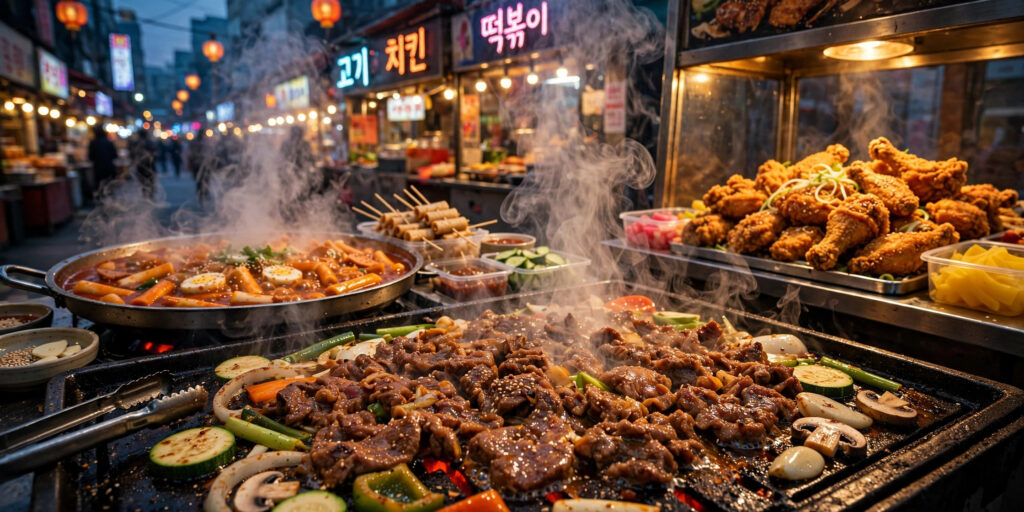
A decade ago, Muslim travelers in Seoul survived on a short loop: the same few restaurants near the mosque in Itaewon, plus a lot of convenience-store triangle kimbap eaten with crossed fingers. That era is over. Korea has spent years courting Muslim visitors, and the change is visible on the plate — halal-certified Korean BBQ restaurants where you grill your own meat, fried-chicken shops with halal certificates on the wall, and a growing list of mainstream restaurants offering halal or Muslim-friendly menus.
This guide is built for the practical traveler: where to go, what to eat, how to read a label, where to pray, and what to say. No paid placements, no fluff — just a food lover’s map of halal Seoul, in the same spirit as our complete halal food guide to Tokyo.
Why Seoul Works for Muslim Travelers in 2026
A halal infrastructure that keeps growing
Korea’s tourism authorities identified Muslim travelers as a priority market years ago, and Seoul shows the results. Halal certification bodies now work with restaurants across the city, the Korea Tourism Organization publishes Muslim-friendly restaurant lists, and both Incheon and Gimpo airports offer prayer rooms plus halal dining options. Eating halal in Seoul increasingly feels planned-for rather than improvised — a shift you can taste.
The Itaewon advantage
Every great food city has a neighborhood that does the heavy lifting, and in Seoul that neighborhood is Itaewon. Centered on Seoul Central Mosque (built in 1976, still the heart of Muslim life in Korea), Itaewon’s streets hold the densest concentration of halal restaurants in the country — Korean, Turkish, Pakistani, Indian, Arab, and Malay, often side by side. If you base yourself here, halal food stops being a logistics problem and becomes a delicious one: which cuisine tonight?
The Best Areas for Halal Food
Seoul is vast, so anchor your eating around these clusters instead of crisscrossing the city on the subway.
Itaewon (the halal headquarters)
Start — and if in doubt, stay — here. The streets around Seoul Central Mosque form Korea’s Muslim quarter: halal butchers, Islamic bookshops, and dozens of restaurants. You will find halal-certified Korean BBQ, fried chicken, tteokbokki counters, plus Turkish kebab houses, Pakistani karahi spots, Indian curry houses, and Arab restaurants. Many display halal certification prominently in English and Arabic. For a first-timer, Itaewon removes all anxiety: walk out of your hotel and you are already surrounded by options.
Myeongdong
Seoul’s famous shopping and street-food district has quietly become more Muslim-friendly. Alongside the cosmetics shops and street stalls, you will find halal-certified restaurants and Muslim-friendly eateries marked on tourist maps. It is the best area to combine sightseeing, shopping, and eating in one efficient loop — and several restaurants here explicitly cater to visitors from Southeast Asia and the Middle East.
Hongdae and Hapjeong
The university and nightlife districts skew young, and younger Seoul is where the halal scene experiments. Look for halal fried-chicken shops, Muslim-friendly Korean restaurants, and international eateries around Hongik University station. It is a great dinner neighborhood after a day elsewhere — lively, walkable, and increasingly accommodating.
Dongdaemun
The 24-hour shopping district runs on night-owl energy, and its food follows. Late-night halal options cluster around the markets — kebab shops and Asian restaurants that stay open when the tour buses leave. If your body clock is still on home time, Dongdaemun will feed you at 2 a.m.
Gangnam and COEX
South of the river, the COEX mall area and Gangnam’s back streets hold a scattering of halal-certified and Muslim-friendly restaurants, useful if your hotel or business is on this side. COEX is also one of the malls with prayer facilities, making it a practical midday stop.
What to Eat: Halal Korean Food in Seoul
Halal Korean BBQ (samgyeopsal, reimagined)
This is the headline act. Several Itaewon-area BBQ restaurants operate with halal certification, serving certified-halal beef and chicken for tabletop grilling. The ritual is unchanged: grill thin slices over the flame, wrap in lettuce with garlic, ssamjang, and rice, eat in one glorious bite. It is interactive, social, and — when the meat is certified — completely worry-free. These spots fill up at dinner; arrive before 7 p.m. or be ready to queue.
Halal fried chicken
Korea’s fried chicken is a national treasure — shatteringly crisp, often glazed in sweet-spicy yangnyeom sauce — and halal-certified shops in Itaewon and beyond mean you do not have to miss it. Order the classic yangnyeom (sweet-spicy) and the plain crispy to compare. Pair with pickled radish, never with beer — the chicken needs no help.
Tteokbokki and street food (bunsik)
Seoul’s beloved street snacks — chewy tteokbokki rice cakes in gochujang sauce, odeng (fish-cake skewers) in hot broth, hotteok (sweet pancakes) — are mostly built on seafood and vegetables rather than pork. Tteokbokki sauce is typically vegetarian-friendly, but recipes vary by vendor, so ask about pork or alcohol in the sauce using the phrases below. Myeongdong’s street stalls are the classic tasting ground; go hungry and graze.
Bibimbap and hearty bowls
Bibimbap — rice topped with seasoned vegetables, egg, and gochujang — is one of the safest and most satisfying halal bets in Korean cuisine. Order the vegetable or beef version and confirm no pork. Similar logic applies to hearty stews and noodle soups: Korean food leans heavily on beef, chicken, and seafood, which keeps most of the menu in play once you screen for pork and alcohol.
Itaewon’s international row
Some nights you will want a break from Korean food, and Itaewon delivers: Turkish pide and kebabs, Pakistani karahi and biryani, Indian curries, Arab shawarma and mandi, Malaysian nasi lemak. Many of these restaurants are run by long-settled Muslim families cooking for their own communities — always the best sign. Prices here are often gentler than mainstream Korean restaurants, and portions are generous.
Convenience Stores & Supermarkets: Reading Labels
Korea’s convenience stores (CU, GS25, 7-Eleven) are temples of snacking, and a surprising amount is navigable. Triangle kimbap, onigiri-style rice balls, and packaged breads often have ingredient lists you can decode — but Korean labels are in Korean, so learn the two terms that matter most: pork (dwaejigogi) and alcohol (sul).
- Generally safe bets: plain rice balls with tuna-mayo or vegetable fillings, plain milk and yogurt, fresh fruit, most plain breads and pastries.
- Check carefully: instant noodles and ramyeon (flavor sachets sometimes contain pork extracts), processed sausages and ham, sauces and marinades, chocolate and candy (gelatin and alcohol fillings).
- Translation help: the Papago app’s camera mode translates Korean labels live — download the Korean language pack before you fly. It is more accurate than Google Translate for Korean.
- Supermarkets: large Lotte Mart and Emart branches in tourist areas stock imported halal-certified products and have wider selections than convenience stores.
Prayer Spaces in Seoul
Seoul makes the prayer part of the day easy — especially if you plan around Itaewon.
- Seoul Central Mosque (Itaewon): the anchor. Five daily prayers, Friday congregation, and an English-speaking community happy to point you toward food. Time a visit for Dhuhr and eat lunch in the surrounding streets.
- COEX and major malls: large shopping complexes increasingly provide multi-faith prayer rooms — COEX in Gangnam is the best-known example. Look for signage or ask the information desk.
- Airports: both Incheon and Gimpo have dedicated prayer rooms, plus halal restaurant options airside and landside. Incheon’s are well-signed in English and Arabic.
- Hotels: many mid-range and upscale hotels in tourist districts can provide a prayer mat and indicate the qibla on request — ask at check-in.
Useful Korean Phrases for Halal Dining
English works in Itaewon’s restaurants, but these phrases unlock the rest of the city. Romanization is approximate — show the Korean text on your phone if pronunciation fails.
- “Igeo hallar-ieyo?” — Is this halal?
- “Dwaejigogi deureogasseoyo?” — Does this contain pork?
- “Sul deureogasseoyo?” — Does this contain alcohol?
- “Dwaejigogi an meogeoyo” — I don’t eat pork.
- “Hallar eumsik isseoyo?” — Do you have halal food?
Staff in tourist areas are used to these questions — ask confidently and with a smile, and you will almost always get an honest answer.
3-Day Halal Food Itinerary
Day 1 — Itaewon deep dive
Morning: arrive, settle in, visit Seoul Central Mosque. Lunch: halal Korean BBQ — arrive before the dinner rush. Afternoon: explore Itaewon’s Islamic quarter (halal butchers, bookshops, groceries). Dinner: Pakistani karahi or Turkish kebabs on the main strip. This day alone justifies the trip.
Day 2 — Myeongdong and Hongdae
Morning: Myeongdong shopping with street-food grazing (tteokbokki, hotteok, egg bread — ask first). Lunch: a halal-certified restaurant in the district. Afternoon: palace or museum sightseeing. Evening: Hongdae for halal fried chicken and the neighborhood’s electric night energy.
Day 3 — Gangnam and Dongdaemun
Morning: COEX mall (prayer room available) and a Muslim-friendly lunch nearby. Afternoon: Gangnam sightseeing or a hanok village visit. Evening: Dongdaemun’s night markets — late-night kebab shops and Asian restaurants that understand the 2 a.m. traveler.
Practical Tips for Muslim Travelers
- Maps: download Naver Map — it outperforms Google Maps in Korea for walking directions, subway exits, and restaurant listings. Papago (also by Naver) handles label translation.
- Payment: get a T-money card at the airport for subways and buses; most restaurants take foreign credit cards, but street stalls are often cash-only.
- Timing: lunch sets (11:30 a.m.–2 p.m.) are the best value in Korean restaurants; dinner queues at popular halal BBQ spots start around 6:30 p.m.
- Certification vs. Muslim-friendly: “halal-certified” means audited by a certification body; “Muslim-friendly” usually means no pork/alcohol but without formal certification. Both are common — certified for peace of mind, Muslim-friendly when options are thin.
- Combine trips: Seoul pairs naturally with our other halal travel guides — see halal food in Tokyo for East Asia and where to eat in Lahore for South Asia.
Frequently Asked Questions
Is Seoul halal-friendly for Muslim tourists?
Yes — increasingly so. Itaewon anchors a dense halal restaurant scene around Seoul Central Mosque, halal certification is growing across the city, airports and major malls provide prayer rooms, and tourist authorities publish Muslim-friendly dining lists. It is one of East Asia’s easier capitals for halal eating.
Where is the best area to stay for halal food in Seoul?
Itaewon, without question. Staying near Seoul Central Mosque puts dozens of halal restaurants — Korean BBQ, fried chicken, Turkish, Pakistani, Indian — within walking distance, removing all mealtime logistics.
Is Korean BBQ halal in Seoul?
At halal-certified BBQ restaurants (concentrated in Itaewon), yes — they serve certified-halal beef and chicken for tabletop grilling. Regular BBQ restaurants typically serve non-certified meat, so look for the halal certification displayed at the entrance.
Can I find halal food at Incheon Airport?
Yes. Incheon Airport has halal restaurant options in its terminals plus dedicated prayer rooms, well-signed in English and Arabic. It is one of the smoother Muslim-traveler airport experiences in Asia.
Is Seoul street food halal?
Often, but check. Tteokbokki, odeng skewers, and hotteok are usually built on seafood and vegetables rather than pork — but sauces and broths vary by vendor, so ask about pork and alcohol before ordering.
Where can I pray in Seoul?
Seoul Central Mosque in Itaewon is the main mosque. Prayer rooms also exist at Incheon and Gimpo airports, COEX mall, and several major shopping complexes; many hotels provide prayer mats and qibla direction on request.
Eat Well, Travel Easy
Seoul rewards the Muslim traveler who plans just a little: base yourself in Itaewon, learn five Korean phrases, download Naver Map, and the city opens up plate by plate — smoky BBQ, shattering fried chicken, chewy tteokbokki at midnight in Dongdaemun. For more halal travel eating, browse our Travel Guides, from Tokyo to Lahore.
I’m Lila Spoonbelle, your host on this flavorful ride through food, fun, and fearless puns. Let’s turn every bite into a burst of laughter!