
Where to Eat in Lahore: 15 Food Street & Old City Gems (2026)
Quick Answer
Lahore is Pakistan’s food capital, and its old-city food streets are the beating heart of it. Fort Road Food Street pairs Mughal-era views with barbecue and desi staples; Gawalmandi, Lakshmi Chowk, and Anarkali serve nihari, paye, chargha, lassi, and falooda late into the night. Go after sunset, eat where the crowds are thickest, and pace yourself.
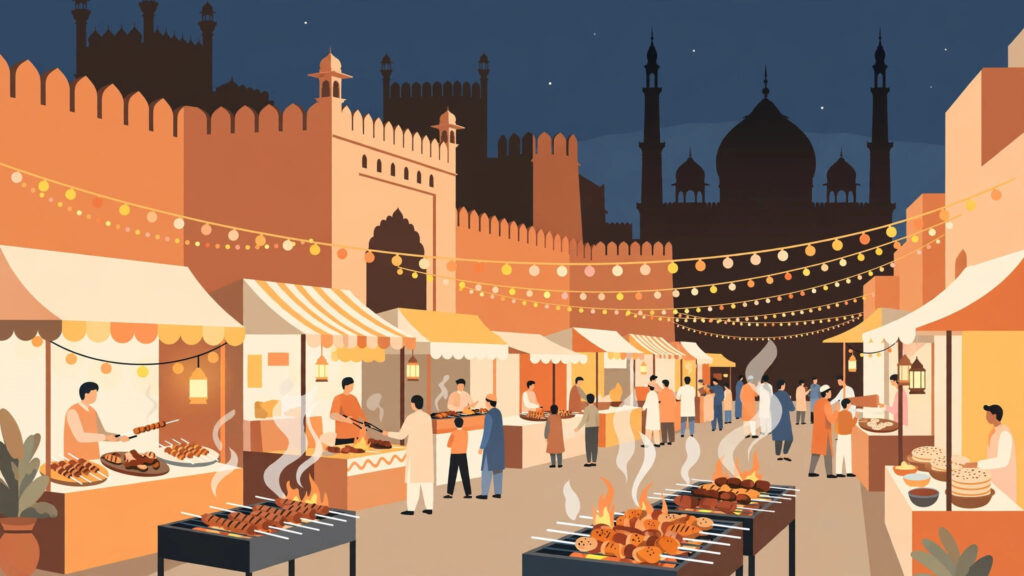
Every Pakistani city claims its food, but Lahore does not claim — it demonstrates. Nightly. The old city, the walled labyrinth around the Badshahi Mosque and Lahore Fort, transforms after dark into one of the great street-food theaters of South Asia: smoke rising from charcoal grills, cauldrons of nihari bubbling since dawn, lassi churned in clay cups the size of flowerpots. This is not tourist food. This is what Lahore eats, and you are invited.
This guide walks you through the four great food streets and fifteen gems worth your appetite — what to order, when to go, and how to eat it all like you belong.
Why Lahore Is Pakistan’s Food Capital
Lahore’s food culture runs deeper than appetite — it is identity. Centuries as a Mughal capital layered Persian, Central Asian, and Punjabi cooking into something entirely its own: slow-cooked, spice-forward, unapologetically rich. The city’s famous greeting says it all — “Lahore Lahore aey” — and the full saying ends with a boast that those who have not seen Lahore have not been born. Food is how the city proves it.
What makes the old-city food streets special is concentration. Within a few square kilometers you can trace the whole canon: breakfast paye at dawn, chargha at lunch, barbecue after dark, falooda at midnight. No reservations, no tasting menus, no pretense — just generations of cooks doing one thing perfectly.
15 Food Street & Old City Gems
1. Fort Road Food Street at sunset
Start here for the view alone. This purpose-built food street sits directly across from the illuminated Badshahi Mosque and Lahore Fort — at night, with the domes glowing, it is one of the great dinner views in Pakistan. The stalls serve the greatest hits: barbecue platters, karahi, chapli kebab. Come at maghrib, grab a rooftop table, and let the city do the rest. It is the most visitor-friendly entry point to old-city eating.
2. The barbecue rows of Fort Road
Within the food street, the grill stations are the main event. Seekh kebabs, malai boti, chicken tikka — ordered by the skewer, eaten standing or at shared tables, best with hot naan straight from the tandoor. Order in rounds, not all at once; the second round always tastes better when the first has settled.
3. Desi ghee breakfast near the Fort
If you can manage one early morning, the area around Fort Road does a magnificent desi breakfast: halwa puri, lassi, and omelets cooked the Lahori way. It is a different city at 8 AM — quieter, smokier, smelling of ghee and fresh bread.
4. Gawalmandi’s nihari houses
Gawalmandi is where Lahore comes for nihari — the slow-cooked beef shank stew that is arguably the city’s signature dish. The old nihari shops here start their pots before dawn and serve until the cauldron empties. Order it with khameeri roti, a squeeze of lemon, julienned ginger, and green chilies on the side. This is a breakfast dish in Lahore; visitors who show up at lunch often find the best pots already sold out.
5. Siri paye at dawn
Paye — trotters slow-simmered into a rich, sticky curry — is Lahore’s other dawn ritual. The paye shops of Gawalmandi ladle it over fresh naan with the same dawn-to-morning rhythm as nihari. Rich? Extremely. Worth it? Completely. One bowl is a meal.
6. Gawalmandi’s late-night barbecue lanes
As the nihari pots empty, the grills fire up. Gawalmandi after 9 PM is a barbecue crawl: tikka shops, kebab carts, and fried-fish stalls competing for your attention. Follow the smoke and the crowds — the busiest grill is rarely wrong.
7. The lassi shops of Gawalmandi
No Gawalmandi run ends without lassi. The old shops churn it thick, serve it in tall glasses or clay cups, crowned with a slab of malai (clotted cream) and sometimes crushed pistachios. Sweet or salted — order one of each and decide for yourself. It doubles as dessert and digestion aid.
8. Lakshmi Chowk’s karahi quarter
Lakshmi Chowk is karahi country. The wok-like karahis here clang from lunch till late night, turning out chicken and mutton karahi with tomatoes, ginger, and green chilies in the classic Lahori style — drier and more caramelized than the Peshawari version. Sit at the steel tables, order half a chicken karahi to start, and add naan by the basket.
9. Chargha houses of Lakshmi Chowk
Lahore’s chargha — a whole chicken marinated in spices, steamed, then deep-fried to a shattering crisp — is a rite of passage. The Lakshmi Chowk specialists have the timing down to a science: juicy inside, crackling outside. It arrives whole on a platter; eat it with your hands, with raita and onion rings, and accept that your shirt may not survive.
10. Daal chawal, the sleeper hit
Between the barbecue and the chargha, do not sleep on daal chawal. Lakshmi Chowk’s daal shops serve lentils over rice with the confidence of places that have done it for decades — tarka sizzling, achaar on the side. It is the cheapest, humblest, and quietly one of the most satisfying plates in the old city.
11. Falooda and kulfi stalls
End the Lakshmi Chowk circuit with falooda — vermicelli, basil seeds, milk, rose syrup, and a scoop of kulfi — or a dense slice of traditional kulfi on a stick. After the smoke and spice, the cold sweetness lands like a benediction.
12. Anarkali’s gol gappay lanes
Anarkali, one of South Asia’s oldest bazaars, hides gol gappay (pani puri) carts in its lanes that locals defend with tribal loyalty. Crisp shells, spiced potato, tangy imli water — eaten in quick succession, one after another, standing at the cart. Ask for “teekha” if you want the full experience; ask for “halka” if you value your evening.
13. Anarkali’s samosa and pakora fry shops
The fry shops of Anarkali do samosas, pakoras, and jalebi in the late-afternoon slot — the 4-to-6 PM window when Lahore takes its snack break. Jalebi fried to order, still crackling, eaten hot: accept no substitutes.
14. Old Anarkali’s desi sweet shops
Between meals, the mithai shops of old Anarkali are worth a slow walk: barfi, gulab jamun glistening in syrup, patisa flaking apart. Buy a small mixed box — it makes an excellent gift and an even better midnight snack.
15. The midnight chai dhabas
Lahore does not sleep, and neither do its chai dhabas. The tea stalls ringing the old city serve doodh patti (milky chai) and Kashmiri chai into the small hours, with benches full of night-shift workers, students, and travelers. End any food-street night here. Order the Kashmiri chai at least once — pink, salty-sweet, topped with crushed nuts.
Must-Try Dishes, Decoded
- Nihari: slow-cooked beef shank stew, eaten at breakfast with khameeri roti. Rich, deep, non-negotiable.
- Paye: trotter curry, equally slow, equally essential. A dawn dish.
- Chargha: whole fried chicken — crisp outside, juicy inside. A Lahori signature.
- Daal chawal: lentils over rice. Humble, cheap, perfect.
- Lassi: thick churned yogurt drink, sweet or salted, crowned with malai.
- Falooda: the great South Asian dessert-drink — vermicelli, basil seeds, rose syrup, kulfi.
- Gol gappay: crisp shells filled with spiced potato and tangy tamarind water. Eat fast, eat many.
Best Times to Go
- Dawn (6–9 AM): nihari and paye. Go early or miss out — the best pots sell out.
- Lunch (12–3 PM): karahi, chargha, daal chawal at Lakshmi Chowk.
- Evening (7 PM–midnight): the main event. Fort Road Food Street glows, Gawalmandi grills fire, Anarkali buzzes. This is when to do your serious eating.
- Late night (midnight–2 AM): falooda, kulfi, and chai dhabas. Lahore’s sweetest hour.
- Ramadan evenings: iftar transforms the food streets into a festival — arrive hungry and expect crowds. Many travelers call it the single best food week of the year in Lahore.
Hygiene and Safety Tips for Visitors
- Eat where it is busy. High turnover means fresh food. A packed stall with a queue is the best hygiene certificate in street food.
- Watch the water. Stick to bottled or filtered water; skip ice at the smallest stalls unless you see it coming from a proper ice factory bag.
- Go cooked and hot. Fresh-off-the-grill and bubbling-cauldron dishes are your safest bets. Be more cautious with raw salads and chutneys at tiny carts.
- Pace yourself. The spice and richness are real. Eat slowly, drink water between stops, and do not try to cover all four streets in one night — that is a rookie mistake.
- Keep valuables simple. The old-city lanes get crowded; a front pocket or money belt beats a dangling bag.
- Travel with a local if you can. A Lahori friend or guide unlocks the best stalls, handles ordering, and knows which lane to skip. Many travelers report this single choice made their trip.
How to Eat Like a Local
- Use your hands. Nobody will judge you for eating with your hands — in fact, the reverse. Naan is your utensil; tear, scoop, fold.
- Order in rounds. Lahoris do not order the whole table at once. Start small, see what sings, order more of that.
- Chai is punctuation. It ends meals, fills gaps, and seals friendships. Never refuse chai.
- Say the words. “Bohat aala” (excellent) to the cook earns you a grin and occasionally an extra kebab. Food praise is a love language here.
- Share tables. At busy stalls, sharing a table with strangers is normal and often the start of a conversation — and a recommendation for the next stop.
Getting Around the Old City
The walled city is a walking game — the lanes around Fort Road, Gawalmandi, and Anarkali are best explored on foot, ideally after 6 PM when the heat breaks and the grills light. Between clusters, auto-rickshaws are plentiful and cheap; agree on the fare before hopping in, or use a ride-hailing app. Lakshmi Chowk sits slightly apart and is an easy rickshaw hop from the walled city. Wear comfortable shoes, carry small cash (many stalls are cash-only), and keep your phone charged for photos — you will take many.
Frequently Asked Questions
Where is the best food street in Lahore?
Fort Road Food Street is the best starting point — great food with the Badshahi Mosque view, and the most visitor-friendly setup. For deeper local flavor, Gawalmandi (nihari, barbecue), Lakshmi Chowk (karahi, chargha), and Anarkali (snacks, sweets) each deserve their own evening.
What food is Lahore famous for?
Nihari, paye, chargha, chicken karahi, daal chawal, lassi, falooda, and gol gappay form the core canon. Lahore’s style is rich, spice-forward Punjabi cooking with Mughal roots — slow-cooked, generous, and unapologetic.
Is street food in Lahore safe for tourists?
Generally yes, with sensible precautions: eat at busy stalls with high turnover, stick to freshly cooked hot food, drink bottled water, and pace yourself. Many visitors eat their way through the old city without issues — going with a local guide helps enormously.
What time do Lahore food streets open?
Nihari and paye shops open at dawn (around 6 AM) and often sell out by late morning. The main food streets come alive after 7 PM and run past midnight, with dessert and chai stalls going latest. Plan dawn for breakfast dishes, evening for everything else.
How many days do I need for Lahore food?
Three evenings is the sweet spot: one for Fort Road, one for Gawalmandi and Lakshmi Chowk, one for Anarkali — with a dawn nihari run worked in. Each night, pick one area and eat it properly rather than rushing between streets.
Lahore does not do food as a side activity — food is the activity. Give the old city three nights, follow the smoke, trust the crowds, and you will understand why the city greets you with a boast. For more eating adventures, explore our food-travel guides and restaurant guides — and when the spice finally defeats you, our food puns are waiting.
I’m Lila Spoonbelle, your host on this flavorful ride through food, fun, and fearless puns. Let’s turn every bite into a burst of laughter!